Farewell to a legend: Clint Eastw…See more…
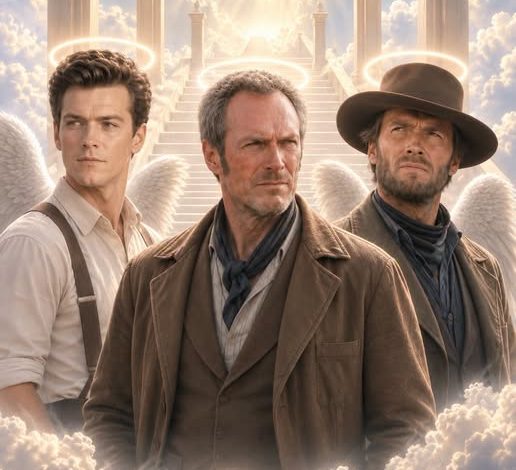
For the first time, the world is watching Clint Eastwood fade.
Not on-screen. Not inside a script. Not as some fictional gunslinger riding toward a carefully written sunset.
But in real time.
The man who spent decades making silence look powerful, who could turn a single stare into an entire conversation, is now being seen through a very different lens. His children’s voices carry emotion when they speak about him, and suddenly the image that once seemed almost indestructible begins to soften.
The granite calm is still there.
But underneath it is something the movies rarely showed us.
A father.
An aging man.
A human being.
Fans sense the change too. What once might have been another chapter in the long mythology surrounding Clint Eastwood now feels more intimate. The tributes, memories, and conversations carry the strange sadness of people realizing that even the figures who seemed larger than life are not exempt from time.
For generations, Eastwood represented toughness.
He was the man who rarely needed to raise his voice. The man who could stand perfectly still while everyone else seemed to move around him. Whether he was playing a cowboy, a cop, or another hardened loner, his characters carried the same unmistakable message: fear was something you stared down.
But time does not negotiate with legends.
It comes quietly.
A little slower walking.
A little more help getting through the day.
A longer pause between words.
A hug that lasts a few seconds more than it once did.
And suddenly the image of invincibility begins to disappear—not because the legend was false, but because there was always a person underneath it.
What lingers now is not simply the actor or director.
It is the father.
His children speak not only about the extraordinary life their father built, but about the ordinary moments that somehow become the most precious as the years pass. Quiet mornings. Coffee shared without ceremony. Old Westerns playing somewhere in the background. Familiar conversations. A hand reaching for theirs when he thinks nobody is watching.
Those are the moments that never make movie trailers.
They are also the moments that matter most.
The myth was built from squints, showdowns, dusty roads, and characters who walked away from danger without looking back.
The love is built from something much quieter.
Presence.
Memory.
Touch.
The simple comfort of knowing someone is still sitting beside you.
That contrast makes this chapter of his life especially moving. The world spent decades watching Clint Eastwood portray men who seemed impossible to break. Now, the people closest to him are showing us the side of him that cinema could never fully capture.
The side that gets tired.
The side that laughs more softly.
The side that needs a chair, a helping hand, or a familiar voice.
The side that grows older.
And perhaps that is why these moments can feel so painful to millions who never met him.
When someone has been part of your cultural landscape for most of your life, their aging can feel strangely personal. You may have watched his films with your parents. You may remember the first time you saw one of his Westerns. You may have heard his voice before you were old enough to understand why it sounded so different from everyone else’s.
He becomes part of the background of your own memories.
So when he grows older, something inside you recognizes the passage of your own time.
The cowboy is aging.
The actor is aging.
And, inevitably, so are we.
That is the uncomfortable truth behind every beloved legend. We want the heroes of our youth to remain untouched by time. We want the old photographs to be permanent. We want the characters to keep walking into the sunset forever, never limping, never hesitating, never needing anyone to steady them.
But real life offers no such ending.
It asks even our strongest people to eventually slow down.
As the world contemplates the possibility of goodbye, the distance between Clint Eastwood and the people who watched him all their lives seems to collapse. He no longer feels like an unreachable figure standing on the other side of a movie screen.
He feels like someone’s father.
Someone’s grandfather.
Someone sitting quietly in a familiar room, surrounded by memories that stretch back farther than most people can imagine.
And that makes the story less about celebrity and more about something nearly everyone understands.
Aging.
Love.
Family.
The fear of losing someone who once seemed permanent.
There is something profoundly human about watching a person who spent his career portraying strength eventually become vulnerable to the same passage of time as everyone else.
It does not diminish him.
It completes the picture.
Because perhaps true strength was never about being invincible. Maybe it was about continuing forward even after invincibility was no longer possible.
The legend gave audiences courage.
The man now gives them something different: perspective.
A reminder that life is not measured only by the battles we win, the awards we collect, or the characters people remember. Sometimes a legacy lives in much smaller places—in a child’s memory of a father’s laugh, in an old movie playing on a quiet afternoon, in the warmth of a hand held a little longer than necessary.
Those moments cannot be photographed into immortality.
But they remain.
And perhaps that is the grace hidden inside growing old.
The world may remember Clint Eastwood for the squint, the silence, the gunfighter, the cowboy, and the unforgettable characters who never seemed afraid of anything.
His family remembers the man behind them.
The father who loved.
The aging man who became softer with time.
The person who, after spending a lifetime teaching fictional heroes how to face death, eventually reminds the rest of us that the most courageous thing is sometimes much simpler:
To sit beside someone you love.
To hold their hand.
To stay.
And when the final chapter eventually comes, the most important part of his legacy may not be that Clint Eastwood once looked invincible.
It may be that, after a lifetime of playing heroes who never flinched, he allowed the world to see what every hero eventually becomes.
Human.
Fragile.
Loved.
And, in the end, graceful.