I Gave Up 22 Years of My Life Raising My Triplet Nieces What They Did at Their College Graduation Noah s Second Chance
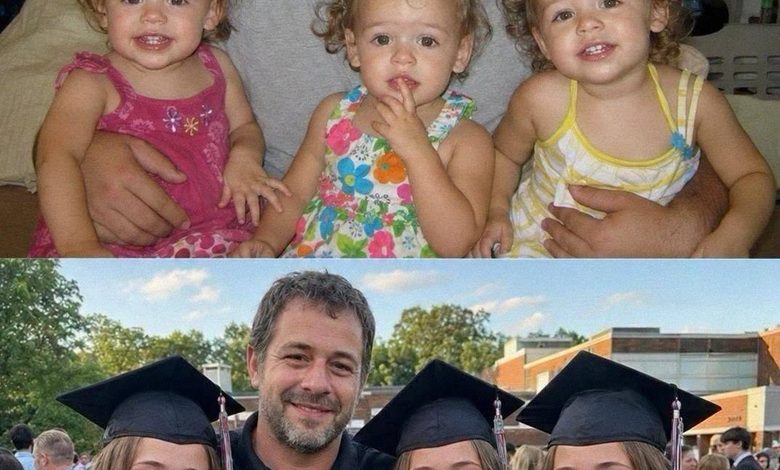
He Spent 22 Years Raising His Sister’s Triplets—Then Their Graduation Gift Changed His Life Forever
For twenty-two years, Noah devoted nearly every part of his life to raising three girls who suddenly had no one else. When they finally graduated and stepped into lives of their own, he expected to feel free. Instead, he discovered that letting them go would force him to confront everything he had put aside—including himself.
The Phone Call That Had Waited Twelve Years
Diana answered on the second ring.
For several seconds, Noah couldn’t speak.
Twelve years had passed since they had truly been part of each other’s lives. Twelve years of silence, missed opportunities, misunderstandings, and conversations that had ended before either of them said what mattered.
“Hello?” Diana finally said.
Noah closed his eyes.
“It’s me.”
Another pause followed.
Then Diana quietly answered, “I know.”
A faint smile appeared on Noah’s face.
Of course she knew.
Some voices stayed with you no matter how much time passed.
Noah stood beside the window of his apartment, looking at the evening traffic below.
“I didn’t know if I should call.”
“You always say that before doing something important,” Diana replied.
For the first time in days, Noah genuinely laughed.
Then Diana asked the question he had been expecting.
“How are they?”
Noah looked toward the framed photograph on his desk.
Three young women stood beside him wearing graduation gowns. Their smiles were similar, but Noah could see all the differences other people missed.
“They graduated last week.”
“I know. I saw the pictures.”
Noah swallowed.
“They’re not little girls anymore.”
“No,” Diana said gently. “They aren’t.”
Twenty-two years.
That was how long Noah had spent building his life around them.
And now, suddenly, they didn’t need him in the way they once had.
“I thought I would be happier,” he admitted.
“Why?”
“Because I finally have my life back.”
Diana remained silent.
Noah stared at the photograph.
“The problem is,” he whispered, “I don’t know what my life is anymore.”
To understand why, he had to go back twenty-two years—to the morning when everything changed.
Part One: The Night Noah’s Old Life Ended
At thirty-one, Noah Carter’s life was ordinary, but it was his.
He had a steady job, a small apartment, a used truck, and modest plans for the future. He hoped to save enough for a house. He wanted to travel. Maybe he would meet someone, marry, and have children someday.
There was no urgency.
He thought he had plenty of time.
Then, one cold November morning, his older sister Emily called.
Or at least Noah thought it was Emily.
When he answered, all he heard was crying.
“Emily?”
No response.
Then a man’s voice came through.
“Are you Noah Carter?”
“Yes.”
“This is the hospital.”
There had been an accident.
Emily and her husband had been driving home when another vehicle crossed the center line. Her husband died at the scene.
Emily reached the hospital alive, but she never regained consciousness.
Noah spent hours beside her bed, holding her hand and talking to her as though she could hear him.
He told her she would be okay.
He told himself the same thing.
But eventually a doctor entered the room, and Noah understood from the expression on his face that there would be no happy ending.
Emily’s condition was deteriorating.
Then came another reality Noah could barely process.
Emily had three infant daughters.
Triplets.
Emma, Lily, and Grace were only a few months old.
Within hours, three babies had lost both their parents.
A social worker eventually sat beside Noah in the hospital hallway.
“We need to discuss temporary arrangements for the children.”
Noah looked through the nursery window at three bassinets.
“I’m their uncle.”
“Yes.”
“I’ll take them.”
The social worker studied him carefully.
Noah was unmarried. He lived alone. He worked full-time. He had never raised a child, much less three infants simultaneously.
And he was grieving too.
“You don’t have to decide tonight,” she told him.
“Yes, I do.”
“Why?”
Noah looked through the glass again.
Three babies lay inside, completely unaware that their lives had changed forever.
“Because they’re waiting for someone to choose them.”
That decision took only seconds.
Living with it would shape the next twenty-two years.
Three Babies, One Man, and No Idea What He Was Doing
The first night was chaos.
Noah quickly discovered that babies apparently possessed an extraordinary ability to coordinate their crying.
One would wake.
Then another.
Then the third.
He moved around the apartment with bottles, diapers, blankets, and the permanently exhausted expression of a man who had absolutely no idea what he was doing.
He barely slept.
The following morning he called work.
“I need some time off.”
“How much?”
“I don’t know.”
Two weeks became a month. Eventually, Noah negotiated fewer working hours.
His savings began disappearing.
Everything came in threes.
Formula.
Diapers.
Clothes.
Doctor visits.
Emergencies.
But the money frightened him less than the possibility of failing.
What if he missed something important?
What if one of them became sick and he didn’t know what to do?
What if he wasn’t enough?
Late at night, when all three girls were finally asleep, Noah sometimes sat beside their cribs and cried quietly.
Then he would look at them and whisper the same words.
“I’m still here.”
Night after night, he repeated them.
Eventually, those four words became a promise.
Learning Who They Were
To outsiders, the triplets looked almost identical.
To Noah, they quickly became unmistakably different.
Emma had a small birthmark near her shoulder and grew into the most cautious of the three.
Lily curled her fingers while sleeping and later became fearless, stubborn, and determined.
Grace had a tiny crease beside her eye when she smiled and seemed able to sense other people’s emotions before anyone else did.
Noah learned that raising triplets was not simply doing the same parenting job three times.
They wanted different things.
They feared different things.
They reacted differently to disappointment.
And, like many siblings, they constantly compared themselves.
Why was Lily better at math?
Why could Emma stay awake longer?
Why did Grace have more friends?
Noah became whatever the moment required.
Cook.
Nurse.
Referee.
Driver.
Homework assistant.
Disciplinarian.
Cheerleader.
Storyteller.
Handyman.
He wasn’t perfect.
But every morning he got up and tried again.
Then, when the girls were six, a question arrived that Noah had been dreading.
They were looking through an old family album when Grace pointed at a photograph.
“Uncle Noah, why don’t we live with Mommy?”
Noah froze.
He sat down beside them.
“She died when you were babies.”
Lily looked confused.
“And Daddy?”
“He died too.”
Silence filled the room.
Emma eventually looked at him.
“Then who takes care of us?”
“I do.”
“Why?”
Noah looked at all three girls.
“Because I love you.”
Grace thought about that.
“Are you our dad?”
His heart tightened.
“No. I’m your uncle.”
“But you take care of us.”
“Yes.”
“You make our lunch.”
“Yes.”
“You come to school.”
“Yes.”
“And you stay near us when we’re sick.”
Noah smiled.
“Yes.”
Grace considered this information with the uncomplicated logic of a six-year-old.
“So you’re like a dad.”
Noah looked at the three children whose lives had become his life.
“Maybe I’m an uncle who gets to do some dad things.”
Grace smiled.
“Okay.”
The conversation ended there.
Noah remembered it forever.
Part Two: The Life He Quietly Put Aside
Years passed.
Noah’s friends married.
He attended their weddings alone.
They bought houses.
He continued renting because saving for the girls’ education seemed more important than a mortgage.
Friends traveled.
Noah took the triplets to parks, museums, and inexpensive attractions close to home.
Whenever he considered buying something for himself, another need appeared.
A new jacket could wait.
His old truck still ran.
A vacation could happen next year.
The girls needed school supplies.
At the time, Noah rarely called these things sacrifices.
They were simply decisions.
But decisions repeated year after year eventually become a life.
When the girls were twelve, Emma began to understand.
“Don’t you ever wish you had your own family?” she asked one evening.
Noah hesitated.
“Sometimes.”
“Do you regret taking care of us?”
His answer came immediately.
“Never.”
“But you could have had children.”
“I have children.”
Emma smiled.
“You know what I mean.”
He did.
But he had never found a simple way to explain that sometimes love arrives in a form completely different from the future you imagined.
The Teenage Years
Then came adolescence.
Suddenly the little girls who once needed Noah to tie their shoes were slamming doors, arguing about rules, discovering music he didn’t understand, asking for clothes he thought were ridiculously expensive, and eventually becoming interested in dating.
Noah announced that he would not interrogate every boy who visited.
Lily looked relieved.
“Good.”
“But I am meeting them.”
“You just said—”
“I changed my mind.”
“You’re impossible.”
“I’m responsible.”
“You’re old.”
Noah stared at her.
“I’m thirty-nine.”
“Exactly.”
All three girls laughed.
So did Noah.
Yet beneath the humor was an uncomfortable realization.
Time was accelerating.
He had spent years concentrating on the next problem—the next bill, next school year, next appointment—that he had barely noticed each stage disappearing.
Soon they were learning to drive.
Then came college applications.
Noah proofread essays, drove them to campus visits, completed financial forms, attended meetings, and searched for scholarships.
Eventually, all three received university acceptance letters.
They celebrated.
Noah was enormously proud.
But that night, another emotion surfaced.
Fear.
For years he had worried about whether the girls could survive without him.
Now he began wondering whether he could survive without them.
The Empty House
The first daughter left in August.
Then the second.
Then the third.
Noah carried boxes, assembled furniture, purchased supplies, and gave each of them more advice than they wanted.
Finally, the last car disappeared.
Noah stood outside watching until he could no longer see it.
Then he entered the house.
Silence greeted him.
For years, he had dreamed of silence.
Now he hated it.
There was no fighting over the bathroom.
No footsteps.
No music coming through walls.
No one shouting, “Uncle Noah, where are my keys?”
He walked into the kitchen.
Three empty chairs surrounded the table.
For years Noah had imagined that once the girls became independent, he would feel free.
Instead, he felt unnecessary.
“They’re going to be okay,” he whispered.
He believed it.
What he didn’t know was whether he would be.
Graduation Day
Four years later, Noah watched three twenty-two-year-old women cross a graduation stage.
When Emma’s name was announced, he applauded until his hands hurt.
When Lily crossed, he stood.
By the time Grace received her diploma, Noah was crying openly.
As he watched them, he couldn’t stop seeing the hospital nursery.
Three bassinets.
Three tiny babies.
Three children who had once depended on him for everything.
Now they stood before him as educated young women preparing to build lives of their own.
After the ceremony, Noah expected them to leave with friends.
Instead, Emma announced that they had somewhere to take him.
They drove to a restaurant with a private room.
When Noah entered, he stopped.
Photographs covered the tables.
Hundreds of them.
Their first Christmas.
Birthdays.
First days of school.
Soccer matches.
Science fairs.
Family outings.
Teenage years.
Graduations.
Twenty-two years of life spread across one room.
At the center stood a framed photograph of Noah with the three girls.
“What is all this?” he asked.
Grace stepped closer.
“We wanted to thank you.”
“You don’t have to thank me.”
“Yes,” Lily replied. “We do.”
Then she handed him an envelope.
The Letter That Finally Broke Him
Inside was a letter the three sisters had written together.
They told Noah they knew he always claimed he had sacrificed nothing.
But they had noticed.
They knew about opportunities he had declined.
They knew about the house he never purchased and the vacations he postponed.
They remembered how he put their needs ahead of his own without making them feel guilty.
Most importantly, they remembered that he stayed.
When they were frightened, he stayed.
When they were difficult teenagers, he stayed.
When money was tight, he stayed.
When raising them became exhausting, he stayed.
The girls told him that family was not simply the people who gave you life.
Sometimes family was the person who remained when life became difficult.
Noah continued reading until his vision blurred.
They told him he had not merely raised three nieces.
He had helped raise three women capable of loving, working, forgiving, and standing on their own.
Whatever they accomplished next, they wrote, part of it would always belong to him.
Finally came the line that Noah could barely read:
Now it’s our turn to take care of you.
He lowered the paper.
“I can’t do this.”
Grace wrapped her arms around him.
Emma followed.
Then Lily.
For one extraordinary moment, Noah was surrounded by the same three people he had once been able to carry as babies.
And twenty-two years of emotion finally came out.
He cried.
The girls cried with him.
The Second Envelope
Eventually Lily handed him another envelope.
“There’s more.”
Noah immediately became suspicious.
“What did you do?”
“Open it.”
Inside was a bank document.
The girls had been saving money for him since they started working.
Noah protested immediately.
“I don’t need your money.”
“We know,” Emma said.
“Then why did you do this?”
“Because you spent twenty-two years making sure we had a future.”
She smiled.
“We want you to have one too.”
It wasn’t a fortune.
It couldn’t repay twenty-two years, nor was it intended to.
It represented something more important.
A beginning.
For the first time in decades, Noah was being asked to imagine a future based not only on what other people needed from him, but also on what he wanted for himself.
That evening, sitting alone, he thought about Diana.
Then he picked up the phone.
Part Three: Learning That Love Doesn’t Require Disappearing
Diana had known Noah before the accident.
She had known Emily.
She remembered the man Noah had been before his identity became almost entirely defined by three words:
The girls’ uncle.
For years Diana had watched him disappear deeper into responsibility.
Eventually, their friendship suffered.
There were misunderstandings, missed conversations, and hurt feelings.
Then silence.
Twelve years of it.
Noah had always convinced himself that reconnecting would be selfish.
The girls needed him.
He had no room for distractions.
But after graduation, he asked himself a question he had avoided for decades.
What do I want?
The answer felt almost forbidden.
He wanted companionship.
Friendship.
Possibility.
A life that included the girls without being limited entirely to them.
So he called Diana.
During that first conversation, Noah admitted what he had believed for years.
“I thought I had to choose.”
“Between what?”
“Being there for them and having a life.”
Diana paused.
“You never had to choose between those things.”
“They needed me.”
“Yes.”
“I couldn’t leave.”
“You didn’t.”
“I gave them everything.”
“I know.”
“Then how was I supposed to do both?”
Her answer was gentle.
“You could have remembered that you were a person too.”
Noah said nothing.
It was painful because he knew she was right.
He had spent years making decisions for everyone without asking what they actually wanted.
He assumed Diana would be better without him.
He assumed the girls needed every part of him.
He assumed his own dreams could always wait.
Eventually, waiting became a habit.
And then the years were gone.
Starting Again
Nothing changed overnight.
Noah remained Noah.
He still worried about the girls.
He still called too often.
He still asked whether they were eating enough.
He still gave advice nobody requested.
But he also began doing things for himself.
He took a weekend trip.
He replaced his aging truck.
He began restoring furniture because he enjoyed it, rather than because someone was paying him.
He met old friends.
And he continued talking to Diana.
Their conversations began cautiously.
They talked about Emily.
The girls.
The years they had lost.
The mistakes both had made.
Eventually they met for coffee.
Then dinner.
Then another dinner.
There was no dramatic declaration that suddenly transformed everything.
There were simply two people discovering that twelve years apart had not completely erased what had once mattered.
The triplets noticed quickly.
One afternoon Noah casually mentioned that he had plans that evening.
“With who?” Lily demanded.
“No one.”
“You’re lying.”
“I am not.”
Grace immediately understood.
“Uncle Noah has a date.”
Silence.
Then chaos.
All three started laughing and firing questions at him.
Who was she?
How did they meet?
How long had he known her?
Why hadn’t he told them?
Noah tried to stop the interrogation, which only made them laugh harder.
But underneath the teasing, he saw something he hadn’t expected.
Relief.
The girls were happy.
They didn’t see his new life as abandonment.
They had never wanted him to remain frozen in the role of caretaker forever.
They wanted him to be happy.
What Twenty-Two Years Had Really Built
Over time, Noah began to understand that graduation hadn’t ended his family.
It had simply changed it.
Emma moved away for work.
Lily continued her education.
Grace joined a nonprofit organization.
Their conversations changed.
They called Noah to discuss promotions, apartments, relationships, disappointments, successes, and decisions.
Sometimes they called because they missed him.
And Noah stopped calling only to check whether they were safe.
Sometimes he called because he had heard a joke.
Sometimes he wanted their advice.
Sometimes he simply missed them too.
Their relationship was no longer between a guardian and three dependent children.
It was between four adults connected by something they had built together.
Years later, Diana once asked Noah whether he regretted everything he had given up.
He considered the question carefully.
There were things he might have done differently.
Perhaps another career.
A house.
More travel.
Marriage.
Maybe biological children.
An entirely different version of himself.
But regret raising Emma, Lily, and Grace?
Never.
“No,” Noah finally answered. “But I regret believing I wasn’t allowed to have anything else.”
That was the difference.
He had once believed love meant sacrificing enough of yourself to prove how deeply you cared.
Now he understood that caring for someone did not require disappearing.
The Man Who Finally Came Home
Noah kept the girls’ graduation letter beside his bed.
Over time, the edges softened and the ink faded.
Whenever life became difficult, he read it again.
Not because he needed praise for what he had done.
He read it because it reminded him what the girls had taught him.
Family is not defined only by blood.
Love is not measured only by sacrifice.
And caring for other people should not require erasing yourself.
One Sunday afternoon, all three women returned home.
Within minutes, the quiet house became chaotic again.
Someone complained about the Wi-Fi.
Shoes appeared in the hallway.
An argument started over food.
Someone took the last piece of cake.
Noah stood in the kitchen listening.
And smiled.
Emma noticed.
“What are you smiling about?”
“Nothing.”
“You’re weird.”
“So I’ve been told.”
She hugged him.
Soon Lily appeared.
Then Grace.
For one brief second, Noah looked at them and saw babies again.
Three tiny faces.
Three lives that once depended entirely on him.
Then the image disappeared.
Standing before him were three grown women.
Strong.
Independent.
Kind.
They had dreams Noah couldn’t choose for them and futures he couldn’t control.
And that was exactly how it was supposed to be.
For twenty-two years, Noah had secretly feared the day they would stop needing him.
When that day arrived, he discovered that he had misunderstood what growing up meant.
They still needed him.
Just differently.
They didn’t need him to make their lunches anymore.
They didn’t need him to drive them to school.
They didn’t need him to solve every problem.
Now they needed him as the person they could call after a difficult day.
The man who knew their history.
The person who had stayed.
Their uncle.
Their family.
In helping them become independent, Noah hadn’t made himself unnecessary.
He had succeeded.
That night, after the house became quiet again, Noah stood by the window.
Years earlier, he had told Diana that he didn’t know where to start rebuilding his life.
Her response remained with him.
Start by not disappearing this time.
Noah finally understood.
For decades, he had thought his story was about everything he gave up.
It wasn’t.
It was about everything he built.
Three daughters he never expected to raise.
A family born from tragedy but sustained by choice.
A future he protected long before he knew what it would look like.
And, waiting beyond twenty-two years of responsibility, a future of his own.
Tomorrow he would call the girls.
He would meet Diana for coffee.
Maybe he would finally plan the trip he had postponed for so many years.
There was still time.
That realization might have been the greatest gift the girls ever gave him.
Noah had spent twenty-two years ensuring that three little girls had a future.
Now that they were grown, they were reminding him of something he had almost forgotten:
He deserved one too.