My 12-Year-Old Son Mowed Elderly Neighbors’ Lawns for Free All Summer — Then Two Police Cars Came Looking for Him
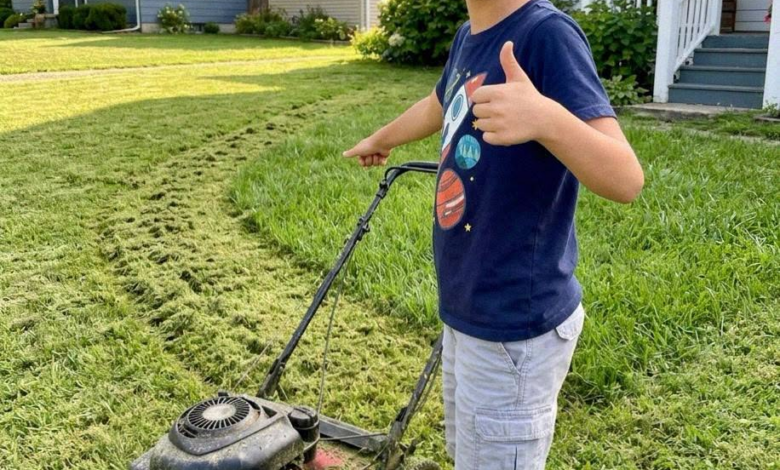
I thought my twelve-year-old son had simply spent the summer doing something kind for elderly neighbors.
I was proud of him.
I never imagined that one afternoon, two police cars would pull up outside our house and ask for him by name.
My son, Justin, isn’t perfect. He forgets homework, leaves wet towels on the floor, and somehow thinks empty cereal boxes belong back in the pantry.
But he has a good heart.
A few days after school ended, I saw him pushing our old lawn mower down the sidewalk.
“Where are you going?”
“Mrs. Hall needs help.”
An hour later, he came home soaked in sweat.
She had tried to pay him $20.
“Did you take it?”
He looked offended.
“No.”
The next morning, he asked me, “Do you think other old people around here need their lawns done?”
That was how it started.
Twice or three times a week, Justin pushed our mower around the neighborhood and offered to help elderly neighbors for free.
I gave him rules.
Don’t go inside strangers’ houses. Keep your phone charged. Always tell me where you’re going.
Within weeks, everyone knew him as “the lawn kid.”
Then, near the end of summer, Justin told me he had one last yard to finish.
“Dorothy’s.”
I barely remembered the name.
“Be home by lunch.”
He gave me a dramatic salute.
“Yes, commander.”
He returned an hour later, ate two grilled cheese sandwiches, complained about school supplies, and acted like nothing had happened.
Then two police cars stopped outside our house.
My stomach dropped.
Two officers walked up the driveway.
“Ma’am, is your son the boy who’s been mowing lawns around the neighborhood?”
Every terrible possibility crossed my mind.
The officer continued.
“Has he been visiting a small blue house near the end of Hawthorne Street?”
“Yes. Why?”
Justin stepped beside me.
“I haven’t broken anything.”
The officer looked at him.
“What’s your name?”
“Justin.”
“How well do you know Dorothy?”
“I mow her yard.”
“Anything else?”
Justin hesitated.
“Just little stuff.”
The officer showed me his phone.
They had found notes in Dorothy’s kitchen:
JUSTIN COMES TUESDAY.
ASK JUSTIN ABOUT THE MAILBOX.
JUSTIN KNOWS WHERE THE GARDEN KEY IS.
My hands started shaking.
Then the officer explained.
Dorothy had been found several blocks from home that morning. She was confused and couldn’t remember where she lived.
She was safe, but her family had been desperately trying to understand what was happening to her.
And apparently, my twelve-year-old knew more about her daily routine than any of us realized.
“The first time I mowed her lawn, she wouldn’t answer the door,” Justin explained. “So I just did the front.”
After that, Dorothy started asking him for small favors.
Bring the trash can back.
Move a flowerpot.
Grab groceries from the porch.
Change the batteries in a lantern.
“Why didn’t you tell me?”
Justin looked genuinely confused.
“Because what could go wrong?”
The officers asked if he could help them understand Dorothy’s house.
So I went with them.
Inside the kitchen were handwritten reminders everywhere.
TAKE PILLS WITH BREAKFAST.
TRASH WEDNESDAY.
CAROLINE’S PHONE NUMBER BESIDE PHONE.
Justin walked around carefully.
“Her important papers are in a green folder.”
I stared at him.
“How do you know that?”
“She couldn’t reach them once.”
Then he pointed toward a cabinet.
“She keeps birdseed back there. She feeds the birds every morning.”
That was when I realized something.
Justin hadn’t just been mowing Dorothy’s lawn.
He had quietly become part of her routine.
Then Dorothy’s niece, Caroline, arrived.
She burst through the door crying.
“You’re Justin?”
He nodded.
Caroline looked at me.
“Why was a twelve-year-old doing all this?”
“He wasn’t managing her house,” I said. “He was just helping.”
Justin interrupted.
“There are notes everywhere with my name.”
Caroline looked stunned.
Justin explained that Dorothy sometimes watched through the curtains when people knocked.
“She told me people make a big deal out of everything.”
Caroline sat down.
She explained that Dorothy had been forgetting things for months—repeating questions, missing appointments, and insisting everything was fine.
Then Justin suddenly remembered something.
“She asked my name three times once.”
Caroline stared at him.
“And she kept trying to pay me.”
Justin gave a small laugh.
“I thought she was being stubborn.”
Then he remembered something else.
“One time she looked through the window while I was mowing.”
“What happened?”
“When I finished, she asked why some strange kid was in her yard.”
My chest tightened.
Justin had thought she was joking.
None of us had realized what was happening.
Then Caroline looked at him and said quietly:
“You kept showing up.”
Justin shrugged.
“That’s all I did.”
“No,” she said. “You brought back her trash. You checked her groceries. You found things she misplaced. You were part of her routine.”
Justin looked uncomfortable.
“I just mowed her lawn.”
Three days later, Caroline called.
Dorothy wasn’t going home.
She needed more care than she could safely receive alone.
When I told Justin, he stopped eating.
“Ever?”
“I don’t know.”
“Can I see her?”
The next day, we visited.
On the way, Justin suddenly asked:
“What if she doesn’t remember me?”
I didn’t know what to say.
Then he asked:
“Can we take her yard?”
“What?”
“Not all of it.”
He wanted to take Dorothy’s daisies, rosemary bush, and the little rose plant beside her porch.
So we dug them up.
Justin handled every root like it was precious.
When we arrived at Dorothy’s new place, a maintenance worker had prepared a small garden bed beneath her window.
Halfway through planting the rosemary, a door opened.
Dorothy stepped outside with Caroline.
She looked at Justin.
For several seconds, nothing happened.
Then she noticed the gardening tools.
“You’re the lawn boy.”
Justin smiled.
“Justin.”
Dorothy nodded slowly.
“Right. Justin.”
He pointed toward the plants.
“I brought part of your yard.”
She walked over and touched the rosemary.
She rubbed a leaf between her fingers and smelled it.
Then she smiled.
“Smells like home.”
Justin looked down quickly.
But I saw the tears in his eyes.
A couple of weeks later, I thought his summer project was finally over.
Then one Saturday morning, I heard the garage door open.
I looked outside.
Justin was walking down the driveway wearing his grandfather’s old work gloves.
He wasn’t carrying the mower.
He had a watering can.
I stepped outside.
“Where are you going?”
He looked at me like the answer was obvious.
“Dorothy’s.”
“I thought you retired.”
“From mowing.”
He rolled his eyes and headed toward the sidewalk.
Then he called back over his shoulder:
“Her plants still need me.”