Park Rangers Cut Open the Anacondas Belly and See More
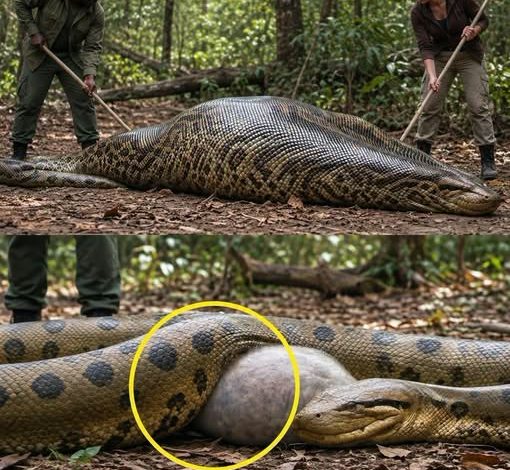
The jungle didn’t just go quiet. It felt like it was holding its breath. Rangers stood frozen, staring at the massive anaconda sprawled across the path, its body grotesquely swollen in one place, as if hiding something the forest itself wanted buried. When the knife finally cut into the cooling flesh, fabric appeared. Then metal. Then bone. That was when everythi… Continues…
They realized, almost in the same instant, that this was no longer about the snake. The remains inside that swollen body belonged to someone who had once chosen this path, wearing that boot, carrying that backpack, believing the trail would eventually lead home. Instead, their story had vanished into the undergrowth, swallowed by a predator and forgotten by the world beyond the trees.
Now, the rangers’ work shifted from curiosity to responsibility. Each recovered item was treated like a fragile piece of a life interrupted: a frayed strap, a torn shirt, a rusted zipper. Somewhere, a name was attached to them—a family, a history, a set of plans that never reached their next chapter. In the end, the most terrifying part wasn’t the anaconda’s size, but how easily a human life could disappear, leaving only questions in the silence it left behind.
The discovery forced the team to secure the area and contact investigators rather than continue treating the event as a wildlife incident. Rangers are trained to protect visitors and animals, but a scene containing possible human remains requires a different chain of responsibility. The location, condition of every object, and surrounding tracks all had to be recorded before anything could be moved.
In dense forest, identifying a missing person can be difficult. Heat, moisture, animals, and vegetation quickly alter clothing and personal belongings. A serial number, label, dental record, or piece of equipment may become the detail that connects remains to an unresolved report. That process is slow because accuracy matters to both investigators and the family waiting for answers.
The anaconda itself was a reminder of the scale and power of wildlife in an environment where humans are visitors. Large snakes usually avoid people, and encounters of this kind are rare, but remote terrain can magnify every risk. Rangers must consider weather, visibility, water levels, and the possibility that a person was already injured before the encounter occurred.
What began as a shocking discovery became a solemn recovery operation. The belongings inside the snake were no longer strange objects; they represented a life, a route taken, and people who may have spent years wondering what happened. The most important outcome was the chance to replace uncertainty with an identity and finally give a family a path toward closure.
For the rangers, the memory of the scene would remain long after the trail reopened. Wildlife work can include danger, but discovering evidence of a missing person’s final moments carries a different emotional burden. Debriefing and support are important for teams asked to move from routine field duties into a recovery operation. Their careful actions preserved evidence while treating the remains with dignity. In a place where nature quickly covers every disturbance, that discipline gave investigators the best chance to learn what happened and ensured that the person inside the forest would no longer be entirely lost to it.