My Son and Daughter-in-Law Laughed When I Walked Into the Courtroom — Then a Sealed Folder Exposed Everything
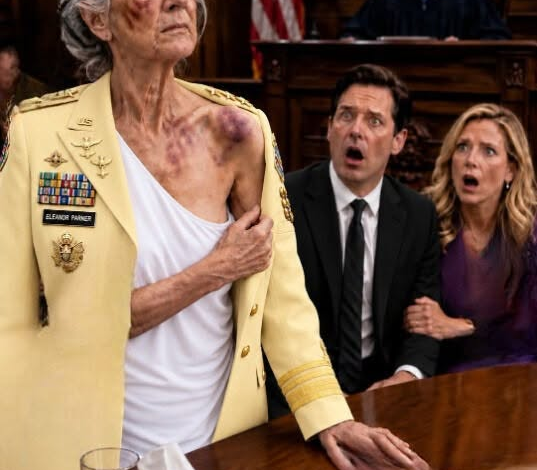
The sealed folder on Judge Mercer’s desk had been waiting twenty-six years to be opened.
Daniel, my son, stopped laughing the moment the judge pulled out a yellowed envelope marked:
FOR ELEANOR. IF NECESSARY.
It was written in my late husband Thomas’s handwriting.
Thomas had supposedly died eleven months earlier.
Inside was a letter warning me that Daniel had been secretly using our identities to create companies, forge signatures, and obtain fraudulent loans.
One company appeared repeatedly: Vance Heritage Solutions LLC.
I was listed as a guarantor.
I had never agreed to any of it.
A forensic report confirmed that my signature had been digitally reconstructed from an old mortgage document.
Then Daniel made a mistake.
He whispered to his attorney, “You said she wouldn’t know how to challenge it.”
Judge Mercer heard him.
His wife, Vanessa, immediately demanded her own lawyer.
The evidence became worse. Investigators found suspicious payments between Daniel’s company and his attorney Curtis Hale’s firm, including a $110,000 transfer shortly before Thomas supposedly died.
Then Vanessa privately admitted something disturbing.
The night Thomas died, Daniel had not been where he claimed.
She had later found blood on his jacket—and a brass key marked 317.
That key opened Thomas’s old workshop.
Inside, investigators found a hidden safe containing financial records, a recorder, and another message:
ELEANOR — LISTEN BEFORE YOU TRUST DANIEL.
The recording captured Daniel arguing with Thomas.
“You should have stayed out of it, Dad.”
Then Curtis Hale entered the room.
The recording ended.
But another file had been recorded three days after Thomas’s supposed death.
Thomas’s voice came through the speaker.
“Eleanor, if you’re hearing this, then everyone believes I’m dead.”
I froze.
Thomas revealed that Daniel had been involved in a larger financial scheme and that he had deliberately disappeared to expose the people behind it.
Investigators eventually found security footage showing Thomas alive.
He had been secretly working with Margaret Vale, a former financial investigator.
The conspiracy was much larger than Daniel.
Shell companies, forged documents, fraudulent trusts, and stolen identities had been connected to an old operation known as the Bellweather network.
Margaret admitted she had once helped create part of that system before becoming an informant.
Then our house caught fire.
Daniel was trying to destroy the remaining evidence.
He failed.
Investigators tracked Daniel and Curtis to an old Bellweather headquarters, where they found boxes of records belonging to elderly victims.
Daniel finally confessed.
But then investigators found something even more shocking.
The original Bellweather directory contained Thomas’s name at the top.
Thomas admitted that years earlier, he had designed a legitimate financial structure that the criminal network later exploited.
He hadn’t created the crimes—but his work had unknowingly helped make them possible.
I refused any money connected to the scheme.
Instead, I asked that recovered assets go toward compensating the victims.
Daniel eventually pleaded guilty.
When I visited him, he admitted he had spent years chasing money because he wanted to earn our respect.
I told him I had loved him long before money mattered.
But love didn’t erase consequences.
Months later, Thomas and I moved into a smaller home and slowly began rebuilding our marriage.
Daniel eventually began helping other inmates with financial literacy.
Years later, when he was released, he brought me a crooked birdhouse he had made in prison.
I hung it beneath the maple tree.
A few days later, sparrows moved in.
Thomas asked if I ever wished none of it had happened.
“Yes,” I said.
But I had learned something I would never forget:
Family doesn’t mean protecting someone from the consequences of their choices. Love doesn’t excuse betrayal. And forgiveness doesn’t mean forgetting.
Sometimes rebuilding begins with finally telling the truth.
And sometimes, even a crooked birdhouse can become a reminder that something broken can still become a home.