Chinese Olympic star Eileen Gu fires back at JD Vance after he criticized her for not representing U.S.
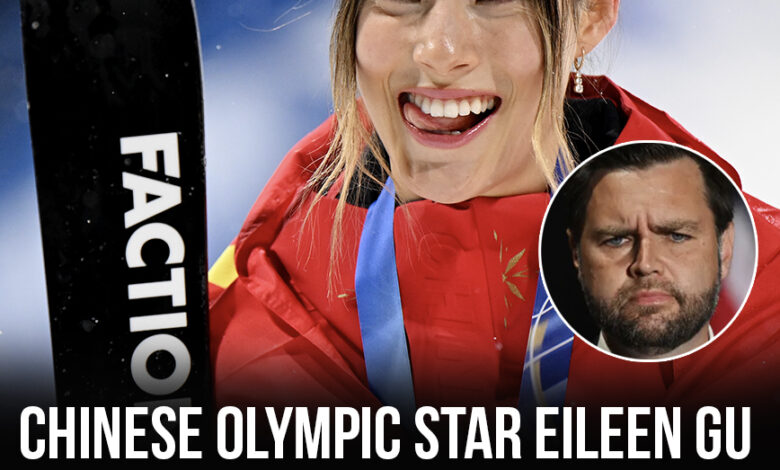
The 2026 Milano Cortina Winter Olympics have etched themselves into history as a period of unprecedented athletic achievement for the United States. Team USA’s performance has been nothing short of a “national triumph,” securing a record-breaking 12 gold medals and surpassing the 30-medal threshold for the first time on non-North American soil. However, beneath the surface of these podium finishes, a sharp ideological divide has emerged. The Games have transformed into a theater for a high-stakes cultural clash between the Trump-Vance administration and a new generation of globally-minded athletes.
At the center of this storm are Vice President JD Vance and the 22-year-old skiing sensation Eileen Gu, whose choices have ignited a fierce debate about national identity, dual heritage, and the boundaries of political speech in sport
I. The Administration’s Stance: “No Room for Politics”
The friction began as several American athletes used their global platform to express critical views on domestic U.S. policies. Vice President JD Vance, known for his “America First” rhetoric, offered a stern rebuke to these demonstrations. Speaking to reporters, Vance emphasized that the Olympic arena is not a venue for personal political grievances.
“You’re not there to pop off about politics,” Vance stated. “When Olympic athletes enter the political arena, they should expect some pushback.”
This sentiment was echoed by President Trump, who targeted freestyle skier Hunter Hess after the athlete suggested that wearing the American flag did not imply an endorsement of every government action. The administration’s position is clear: Olympic representation is a privilege that demands a unified national front, and dissent while in uniform is viewed as a breach of that contract.
II. The Eileen Gu Controversy: Citizenship and Allegiance
While Vance criticized the speech of those on Team USA, he reserved a different kind of scrutiny for Eileen Gu. Born in San Francisco and trained in the American system, Gu’s decision to compete for China has become a flashpoint for American conservatives.
In a high-profile interview with Fox News, Vance questioned the ethics of an athlete benefiting from American freedoms and resources only to represent a geopolitical rival on the world stage.
- The “America First” Critique: Vance argued that those raised in the U.S. should naturally want to represent the nation that fostered their talent.
- The Question of Status: While Vance admitted he had “no idea” what her official legal status should be, his rhetoric suggested that Gu’s allegiance was ideologically suspect.
III. The Prodigy from San Francisco: A Life of Dualities
To understand the weight of the Gu-Vance clash, one must look at Eileen Gu’s unique upbringing. Raised as a single child in San Francisco’s prestigious Sea Cliff neighborhood, Gu was the product of two worlds. Her mother, Yan Gu, was a first-generation Chinese immigrant and an elite student-athlete at Peking University before moving to the U.S.
Gu’s skiing journey began at age three in Lake Tahoe, and her rise was meteoric. By age nine, she was a national champion. In 2019, at just 15 years old, she made the controversial decision to switch her competitive allegiance to China. This choice was not just athletic; it was a branding and cultural pivot that allowed her to become a superstar in a market of 1.4 billion people.
IV. The “Punching Bag”: Eileen Gu Fires Back
After claiming gold in the halfpipe at the Milano Cortina games—bringing her total to five Olympic medals—Gu faced a barrage of questions regarding the Vice President’s comments. Her response was a blend of intellectual defense and sharp wit.
1. The “Monolithic China” Defense
Gu argued that the criticism against her is rooted in a specific brand of American Sinophobia. She pointed out that many athletes switch countries without facing such vitriol, but because she chose China, she has been turned into a “political punching bag.”
“People only have a problem with me because they lump China into this monolithic entity and they just hate China,” Gu explained. “And also, because I win. If I wasn’t doing well, they probably wouldn’t care.”
2. The Two-Word Jab at JD Vance
When asked directly about Vance’s specific criticisms by USA Today, Gu delivered a response that was both dismissive and pointedly calm: “I’m flattered. Thanks, JD! That’s sweet.” By using sarcasm to neutralize the Vice President’s “pushback,” Gu signaled that she was not offended by the administration’s scrutiny, but rather emboldened by it.
V. Beyond the Flag: The Philosophy of “Building My Own Pond”
For Gu, the decision to ski for China is framed as an act of female empowerment rather than a rejection of American values. Having previously told Time magazine that she likes “building her own pond,” she views herself as a cultural ambassador who can inspire millions of girls in China who have never seen a freeskier who looks like them.
- Unity vs. Division: Gu described the Olympics as a spirit of communication. She suggested that those who focus on her citizenship rather than her sport are living “sad little lives.”
- Identity: In 2022, she famously stated, “I felt just as American as I am Chinese.” In 2026, that duality remains her greatest strength and her most controversial trait.
Conclusion: The New Olympic Reality
The clash between JD Vance and Eileen Gu is a microcosm of the modern world. It is no longer just about who is the fastest on the slopes; it is about the “ownership” of talent in a globalized era. As the 2026 Games conclude, the debate over whether an athlete is a national asset or a global free agent continues to simmer. For JD Vance, the flag is a sacred obligation. For Eileen Gu, it is a tool for cultural bridge-building. As both sides dig in, the only certainty is that the “political arena” of the Olympics is here to stay.