When We Were 19, My Best Friend and I Promised That If We Were Both Single at 60, We d Find Each Other I Turned 60 Last Tuesday, and My Old Landline Rang
I’d spent decades convincing myself that some people belong in your past, no matter how much you once wanted them in your future. Then a voice I hadn’t heard in 41 years said my name.
The hospital room was at the end of the hall. I stood outside it with my hand on the door, trying to understand how I’d gotten there. Forty-one years.
That’s how long it had been since I’d seen Jeffrey.
I stood outside it with my hand on the door.
Forty-one years since his last letter and since he’d asked me not to contact him again.
And now his son, Peter, stood beside me, saying, “He’s been asking if you’re here yet.”
I looked at him.
Peter had Jeffrey’s eyes.
“He’s been trying to stay awake for you.”
That almost made me turn around.
I was 60 years old. I’d spent most of my life learning how to live without Jeffrey.
Then, 40 minutes earlier, my childhood landline had rung. Now I was about to see him again.
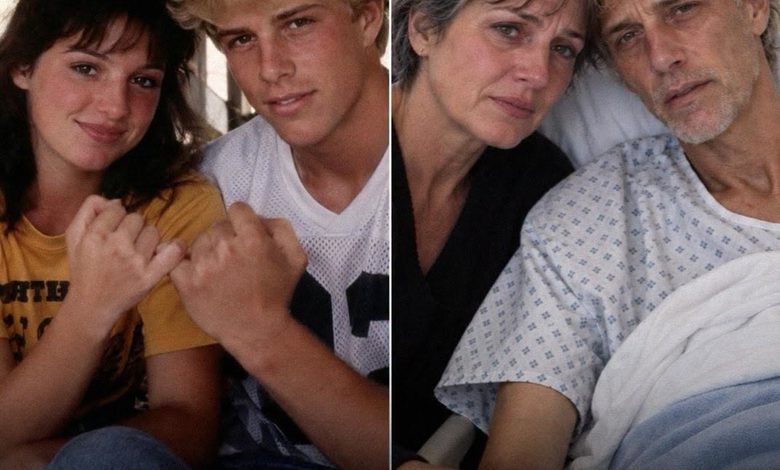
I pushed open the door. Jeffrey lay in the hospital bed. He was thinner than the boy I remembered. His hair had gone white. His face had changed.
But he was still Jeffrey.
His eyes found mine.
My throat closed. Then I noticed the chair beside his bed.
Something was waiting on it.
And the second I saw it, I gasped and stopped breathing.
Jeffrey and I became best friends when we were 17. Not boyfriend and girlfriend. Just Jeffrey and Ruth.
He dated other girls. I went out with other boys. I even went to prom with someone else, though my best friend ended up driving me there after my date’s car broke down.
Everyone thought we were ridiculous.
They all believed we’d eventually realize we belonged together, but we laughed.
He dated other girls.
My mother, Erica, used to watch us at the kitchen table arguing over homework and say, “One day, the two of you are going to figure this out.”
“You know exactly what.”
Then he’d look at me. I’d roll my eyes.
That was the truth. Or at least it was what we were willing to admit.
Losing my best friend scared me more than dating him ever excited me. I think he felt the same way. So we kept things simple.
Until one summer night when we were 19.
We’d both had terrible dates. Mine spent two hours talking about himself.
Jeffrey’s date left early after arguing with him about a movie.
Losing my best friend.
We met at our old high school football field afterward. The gates were open, so we climbed under the bleachers and sat on the grass.
Jeffrey leaned back against a metal support.
“We’re bad at this.”
He was quiet for a moment. Then he said, “What if we never get it right?”
“What if we’re both single forever?”
I looked at him. Then Jeffrey held out his pinky.
“If we’re both single at 60, we’ll stop being idiots and find each other.”
I stared at his hand.
He wasn’t laughing anymore.
“What if we never get it right?”
“Because if we haven’t figured things out by then, we obviously need help.”
I hooked my pinky around his.
For one second, neither of us moved.
I remember thinking I should say something. I didn’t.
Two months later, Jeffrey left for college three states away.
“We obviously need help.”
At first, we wrote constantly.
Long letters and birthday cards.
Jeffrey told me about his roommate who never cleaned anything. I told him about working at the library while taking classes.
He complained about the cafeteria food. I complained about customers returning books with coffee stains.
For the first year, I knew more about Jeffrey’s life than people living down his street.
Then the letters became less frequent. Every week became every other week. Every other week became once a month.
I thought college was changing him.
The truth was, my life was changing, too.
I knew more about Jeffrey’s life.
I started training to become a teacher. I made new friends. I went on dates.
But every time something important happened, Jeffrey was still the first person I wanted to tell.
Then, during his second year, he wrote about a girl named Margaret. She was studying nursing.
He said she was funny, challenged him, and he thought I’d like her.
That’s when I finally understood something I should’ve known years earlier.
I went on dates.
I was in love with Jeffrey.
I sat on my bedroom floor with his letter in my lap and cried because I’d waited too long to understand my own feelings.
That night, I started writing to him. I got several pages in.
I told him I loved him and thought I always had.
Then I tore it up.
I started writing to him.
If he were happy, I didn’t want to ruin it. So I kept being his friend for a while.
In the summer of 1986, a final letter arrived.
I knew something was wrong before I opened it. Jeffrey’s letters usually started with a joke.
I didn’t want to ruin it.
Margaret and I are getting married. The ceremony is in August.”
I sat at our kitchen table staring at the sentence. I kept reading.
My best friend told me the wedding would be small and Margaret’s family was helping them get settled.
Then I reached the bottom. There was one more thing.
Jeffrey asked me not to contact him again.
He said Margaret knew how close we’d been and that he wanted to give his marriage a fair start. Jeffrey said our friendship mattered too much to him to let it become something that hurt someone else.
“I hope you have a wonderful life, Ruthie.
I cried for weeks.
But I respected his choice. I didn’t write back, call, or try to see him.
Margaret knew how close we’d been.
I heard pieces of his life through people who still knew his family. He and Margaret had a child, and he built a career.
Eventually, the updates stopped too.
I have never been married. I dated and had relationships.
One almost became serious.
The updates stopped too.
But whenever people asked why I never settled down, I gave them the easiest answer.
“I just never met the right man.”
However, that wasn’t entirely true. I had met him at 17.
Last Tuesday, I turned 60.
I live in my childhood home now.
I never settled down.
After my parents died, I kept the house. I’d spent so many years moving from one apartment to another that coming back felt right.
That evening, I had dinner alone and cut myself a piece of birthday cake.
At 9:17 p.m., the old landline rang.
Almost nobody called on it anymore.
I nearly ignored it, but decided to answer.
I kept the house.
A man said, “Is this Ruth?”
“My name is Peter. I’m Jeffrey’s son.”
I sat down. For a second, I couldn’t speak.
“My father wants to speak with you. He… doesn’t have much time.”
My hand tightened around the receiver.
Before I could answer, I heard movement. Then a weak voice came through the phone.
Tears sprang to my eyes.
Then came a small, weak laugh.
“Of course, I remembered every birthday.”
I covered my mouth.
Forty-one years disappeared in one sentence.
Then his voice broke.
“Ruthie, I need you to know something before I die.”
I closed my eyes.
“I was in love with you when we made that promise.”
“And I’d already bought the ring.”
“The one I was going to give you before I left for college.”
The room seemed to tilt. I stood up.
“Then why did you marry someone else?”
“That’s what I’ve spent 40 years wishing I could explain.”
My best friend’s voice dropped.
“I need you to come here.”
“Please come to the hospital.”
His breathing was uneven.
“There’s one thing you need to see. Once you do, you’ll understand why I walked away.”
I grabbed my coat.
Forty minutes later, I walked into his hospital room. Jeffrey looked at me and smiled.
I cried before I could stop myself.
Then I saw the chair beside his bed.
There was a wooden box I knew.
It had belonged to my father, Thomas.
He used to keep important papers in it. But after he died, I searched the house for it and never found it.
I looked at Jeffrey.
“Why do you have my father’s box?”
My hands shook as I lifted the lid.
Inside were letters. My father’s letters. Years of them.
Beneath the letters was a small ring box. I opened it.
Inside was a simple diamond ring. I looked at Jeffrey.
“Why didn’t you give it to me?”
He nodded toward another envelope. That one had his name on it.
The handwriting belonged to my father.
I unfolded the letter.
Ruth will be accepted into a teaching program here. She has a real future ahead of her. If you ask her to follow you, she will. Please don’t make her choose between you and the life she can build here. If you care about her, give her room to become her own person.
“She has a real future.”
Tears ran down my face. I looked up.
“My father sent this?”
“Before I left for college. He knew about the ring. I showed it to him, because I asked for his blessing.”
“What did he say?” I asked, although I had an idea.
“I showed it to him.”
“That we were too young. That you’d give up anything if I asked because you were loyal to me.”
I looked at the letters in the box.
“So you eventually started a new life?”
“I tried to hold on, but eventually I thought I was helping you.”
“You never even asked what I wanted.”
His voice was quiet.
I felt angry, but mostly I felt tired.
“I tried to hold on.”
Jeffrey looked toward the window.
“When your letters slowed down, I thought your father had been right. I thought you were moving on.”
“My letters slowed down because yours did.”
“I know that now. I actually knew before the wedding.”
I stared at him.
“I know that now.”
“Your father visited me.”
“He came to tell me he’d been wrong.”
My father had died the following year after a long illness.
Jeffrey said that my father began regretting what he’d done. He gave Jeffrey the wooden box as an apology; it included letters he’d sent to my mother before they married.
My father was also in love with someone whose parent thought they were making a mistake. But if he had listened then, I wouldn’t be here.
“Why didn’t you just come back?” I asked.
“Because I’d already promised my life to Margaret by then. I loved her too, Ruth.”
Strangely, that didn’t hurt as much as I expected.
“What you had with her was real?”
“I wouldn’t want another woman’s whole life turned into a mistake just because we were afraid to speak when we were teenagers.”
Jeffrey reached for my hand.
“I wrote that final letter because I knew if we continued talking, I might run back to you.”
“And you thought cutting me off was better?”
A sad smile crossed his face.
“I thought it was responsible. I was wrong.”
“I wrote that final letter.”
I took his hand.
“What did she say?”
“She said we were two of the stupidest people she’d ever heard of.”
I laughed. Jeffrey laughed too. Peter smiled.
“She sounds smart,” I said.
He told me Margaret had died several years earlier.
Afterward, he’d considered calling me many times. He never did.
“I didn’t know if I had the right,” he said.
I shook my head.
“So we lost over four decades because everybody kept deciding what was best for somebody else.”
We sat in silence for a moment.
Then I remembered. I looked at him.
His eyes widened. Then he smiled.
“We had a deal.”
My friend slowly raised his pinky.
“If we’re both single at 60…”
I hooked mine around his.
“We stop being idiots and find each other.”
Tears ran down his face.
I glanced at the ring.
I stayed with my best friend through the next day. We talked more in those hours than I thought possible. He told me about Peter and his daughter, Anna. I told him about my students and the years I’d spent teaching.
We talked about my mother, about Margaret, and even about my father.
I was angry with my father, but I also understood something I hadn’t understood at 19.
He told me about Peter.
My father had been scared for me the way my maternal grandfather had been scared for my mother. Dad had made the wrong choice because he thought he was protecting my future.
Jeffrey had done the same thing.
We’d all stayed silent because we thought silence was kinder.
My father had been scared.
Jeffrey came home from the hospital two days later.
Peter arranged for him to stay with family and receive care there. Nobody knows exactly how much time he has. But I’m not measuring it.
Yesterday, Peter drove his father to my house.
We sat on the porch where Jeffrey and I used to do homework as teenagers.
He held my hand.
Jeffrey placed the wooden box next to me.
“I never actually officially asked you.” He smiled. “Ruth, would 19-year-old you have said yes?”
I thought about it. Then I looked at the man beside me.
I squeezed his hand.
I thought about it.
“So that’s a no?”
“It means she knows we don’t need 40 more years to prove what we already know.”
Then he slipped the ring onto my finger.
He leaned his head against mine.
For most of my life, I thought our story had ended in 1986.
We’d simply stopped writing it.
Now we call each other every morning. Peter comes by often. Anna has already started calling me Aunt Ruth, even though I told her she doesn’t have to.
I thought our story had ended in 1986.
Jeffrey and I won’t get back the years we lost. I’ve accepted that.
But I also won’t waste the time we have by grieving for time we can’t change.
For years, I thought meeting the right person at the wrong time meant you’d lost your chance.
Now I know timing isn’t always the whole story. Sometimes life gives you another door.
You just have to stop being afraid to open it.
La información contenida en este artículo en moreliMedia.com no se desea ni sugiere que sea un sustituto de consejos, diagnósticos o tratamientos médicos profesionales. Todo el contenido, incluyendo texto, e imágenes contenidas en, o disponibles a través de este moreliMedia.com es para propósitos de información general exclusivamente. moreliMedia.com no asume la responsabilidad de ninguna acción que sea tomada como resultado de leer este artículo. Antes de proceder con cualquier tipo de tratamiento, por favor consulte a su proveedor de salud.
MORELIMEDIA.COM está dedicado a compartir los momentos más interesantes de la vida.