Trump sparks outrage after people spot small detail in The White House
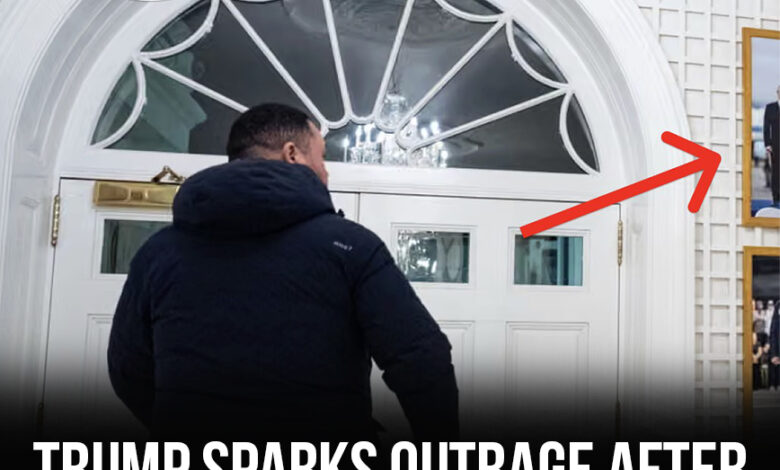
It is a well-established fact that Donald Trump prioritizes visual representation, often surrounding himself with images that commemorate his personal and political milestones. However, a recent addition to the White House’s interior décor has transcended mere aesthetics, sparking a fierce geopolitical debate.
The placement of a framed photograph featuring Trump alongside Russian President Vladimir Putin in a high-traffic corridor of the West Wing has become a lightning rod for criticism, with detractors labeling it a “grotesque” display of camaraderie with a foreign adversary.
I. The Placement: Symbolism in the West Wing
The photograph was strategically placed in the corridor linking the West Wing to the Executive Residence—a path walked daily by the President, his family, and senior staff.
Reports from the White House press corps, first highlighted by PBS News correspondent Elizabeth Landers, reveal a detail that critics find particularly “on the nose”: the image of Trump and Putin hangs directly above a framed photo of the President with one of his grandchildren. This vertical hierarchy has led to accusations that the administration is elevating an adversarial leader above American family values.
II. The Anchorage Summit: A Historic and Controversial Backdrop
The photograph was taken in August 2025 during the leaders’ summit in Anchorage, Alaska. This meeting was the first face-to-face encounter between the U.S. and Russian presidents since the full-scale invasion of Ukraine began four years prior.
The summit was characterized by several high-profile moments of diplomacy:
- The Shared Ride: In a break from protocol, Putin rode in the U.S. presidential limousine—“The Beast”—with Trump, rather than his own state vehicle.
- The Handshakes: Numerous choreographed handshakes were broadcast globally, signaling what the Kremlin described as a “diplomatic milestone.”
- The Textbooks: Russian officials have already indicated that the Anchorage Summit will be featured in updated Russian history textbooks as a turning point in East-West relations.
III. The Administration’s Defense: “Historic Accomplishments”
When questioned about the choice to display this specific image, the White House remained defiant. A spokesperson told The Guardian that the Alaska Summit was a “historic moment” that brought the two nations closer to a peace deal regarding the war in Ukraine.
“This is one of many accomplishments that President Trump chooses to feature at the White House, where photographs are rotated frequently to highlight Presidential travel,” the spokesperson added, while placing blame for the war’s duration on the “incompetence” of the previous administration.
IV. The Domestic and International Backlash
The reaction to the portrait has been sharply divided along ideological and international lines.
The Critics: Grotesque and Tone-Deaf
- Senator Mark Warner (D-Va.): The Senator criticized the optics, arguing that putting Putin “above the American people and his own family” sends a dangerous message to the world.
- Estonian Lawmaker Marko Mihkelson: Across the Atlantic, the reaction was even more severe. Mihkelson warned that if the U.S. President honors a man he considers the “greatest war criminal of the 21st century,” a sustainable peace in Ukraine may be impossible.
- Social Media Outcry: Critics on X (formerly Twitter) labeled the display “grotesque” and “a betrayal of American interests.”
The Supporters: A Sign of Dialogue
- Kirill Dmitriev: A senior Russian negotiator praised the move, stating the image “speaks for itself” regarding the renewed dialogue between the two nuclear powers.
- Trump Loyalists: Supporters see the photo as a symbol of “Peace through Strength,” arguing that only a leader willing to sit down with adversaries can prevent global conflict.
V. The Relationship: Personal vs. Professional
While Trump has frequently praised Putin’s “strength” and leadership style, experts note there is no evidence of a genuine personal friendship. Instead, their relationship is a complicated tapestry of official summits, politically charged phone calls, and high-stakes posturing.
The addition of this photo comes during a period of significant interior changes at the White House, including a renovation of the Palm Room. However, unlike a fresh coat of paint, the Anchorage portrait serves as a visual manifesto of Trump’s foreign policy: one that prioritizes direct, often controversial engagement over traditional isolation.
Conclusion: A Portrait of a Divided Nation
The Anchorage portrait is more than just a photograph; it is a Rorschach test for the American public. To some, it represents the bold diplomacy of a President willing to break bread with enemies to secure a deal. To others, it is a chilling reminder of an administration’s perceived proximity to an authoritarian regime. As the photographs in the West Wing continue to rotate, the debate over this particular image is unlikely to fade as long as the war in Ukraine and the questions surrounding Russian influence persist.