An “Old Grandmother” Took Control of a Failing Plane—Then Two F-35s Revealed Who She Really Was
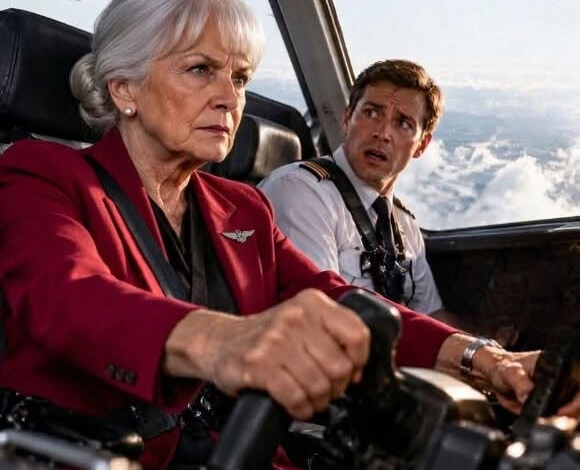
When an airliner began losing engine power over Nevada, an elderly passenger named Pauline Sanders stood up and warned the crew that something was seriously wrong.
The young first officer, Mark Jensen, dismissed her.
He saw gray hair, a red jacket, and an elderly woman who looked confused.
What he didn’t know was that Pauline had once been one of the most legendary Cold War test pilots in American aviation.
Her old call sign was “Widow Six.”
The captain had become incapacitated, the aircraft was losing control, and the failing engine was getting worse.
Pauline finally demanded access to the cockpit.
Mark reluctantly let her take the controls.
Within minutes, she stabilized the aircraft, declared an emergency, and redirected the plane toward Nellis Air Force Base.
Then two F-35s appeared beside them.
One of the fighter pilots asked Pauline to state her qualifications.
“I’ve flown everything from the T-38 to the YF-23,” she answered calmly. “My old call sign was Widow Six.”
Silence filled the radio.
“Widow Six… ma’am?”
The fighter pilots immediately recognized the name.
At Nellis, officers began searching through decades-old classified records.
Pauline landed the damaged aircraft safely despite the failing engine.
When she stepped onto the runway, a senior officer saluted her.
“Colonel Sanders,” he said. “You have no idea how long we’ve been waiting for you.”
The young first officer who had mocked her silver flight pin could barely believe what he was hearing.
But the biggest surprise was still waiting.
Pauline was taken into a secure facility beneath the base, where General Thomas Vance showed her a classified file connected to Project Nightshade, a Cold War program she thought had been destroyed decades earlier.
Then came the revelation that shook her.
Her former flight partner, Major Arthur “Artie” Pendelton, was alive.
Pauline had been told he died after an experimental aircraft accident in 1981.
Instead, he had survived—and spent decades hidden under a classified identity.
The two old pilots were finally reunited.
Then the military uncovered something even bigger.
The aircraft Pauline had flown during Project Nightshade had secretly survived too.
Under a cover in an underground hangar sat the restored Nightshade X-11, the experimental aircraft she had once flown near the edge of space.
Pauline placed her hand on the fuselage.
“I thought she broke into a thousand pieces.”
“She didn’t,” General Vance told her. “We kept her hidden.”
The government also revealed that her Cold War flight records had been buried for decades to protect classified programs.
Her achievements were finally being restored to the historical record.
But Pauline cared less about medals than the people she had saved.
At the press conference, she explained that courage wasn’t about never being afraid.
It was about knowing what to do when everything suddenly went wrong.
She also publicly credited Artie, the flight partner whose story had been hidden beside hers.
Meanwhile, Mark approached Pauline with his flight logbook.
He apologized for judging her by her age.
Pauline signed the emergency entry:
“Hand-flown with courage when the computers failed. Keep flying, Mark.”
Then she gave him one final lesson:
“A great pilot has enough humility to recognize when someone else knows more.”
As the sun disappeared over the Nevada desert, Pauline stood beside the runway with the old silver dart resting above her heart.
She had saved hundreds of passengers.
Found the partner she thought she had lost forever.
And reclaimed a legacy that had been buried for decades.
After years of silence, Widow Six was finally home.