My Son Served Me Dog Food at My 70th Birthday Dinner—The Next Morning, I Canceled His Cards and Discovered His Secret.
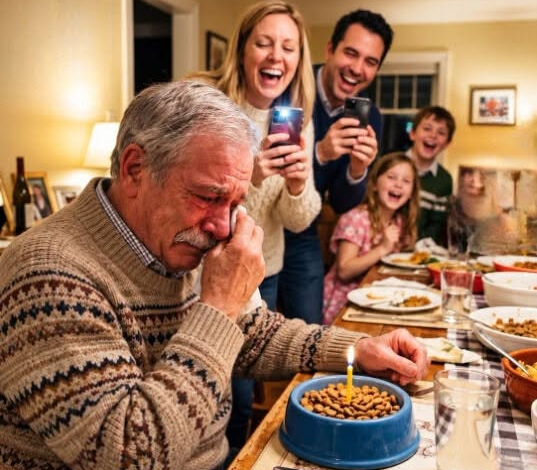
At my 70th birthday dinner, my own son humiliated me by serving me dog food.
I didn’t argue.
I didn’t make a scene.
But the next morning, I canceled the credit cards I had been paying for my family.
My son Louis stormed into my bedroom.
“Dad! What did you do to the cards?”
I calmly showed him four years of expenses—nearly $60,000 covering food, utilities, car payments, vacations, and shopping.
Then he said something that stopped me cold:
“Not for much longer.”
I had already discovered an unusual $4,800 payment to a property company.
The payment had been connected to documents using my personal information—documents involving my house.
Before Louis could explain, an investigator arrived at my door.
She told me they were investigating a suspected fraudulent property transfer involving my home.
Then my son’s wife, Carla, panicked.
She had apparently told Louis that I had already signed the paperwork.
But that wasn’t the worst discovery.
Investigators later found a hidden camera in my bedroom, months of recordings, forged documents, suspicious financial transfers, and evidence of a much larger scheme.
Then Louis’s deleted emails were recovered.
One message appeared to suggest that he wanted me out of my own house.
I thought I had finally discovered who my son really was.
But the truth was far more complicated.
An old family grudge, financial manipulation, and a decades-old scandal were all connected.
And then investigators discovered something my late wife Lucy had secretly arranged years earlier.
The house wasn’t actually mine to sell or transfer.
Lucy had placed it in a protected family trust.
She had also created another trust for Louis—one worth nearly $1 million—but he couldn’t receive it unless he learned to live independently, repay his debts, and stop relying on me financially.
Over the next 18 months, Louis changed.
He sold his luxury car, found steady work, repaid what he owed, and slowly rebuilt his life.
Eventually, he earned the trust money.
But when I told him about it, he surprised me.
He didn’t want it immediately.
For the first time, my son understood that being rescued wasn’t the same as being successful.
Years later, the house they had tried to take became something completely different.
I decided it would eventually become a safe place for elderly victims of financial exploitation.
And Louis became the kind of man who helped others instead of taking from them.
In the end, I realized something:
Sometimes the hardest way to save someone is to stop saving them.
My son didn’t change because I rescued him.
He changed because, finally, he had to save himself.