Mike Pence with tears in their eyes make the sad announcement..
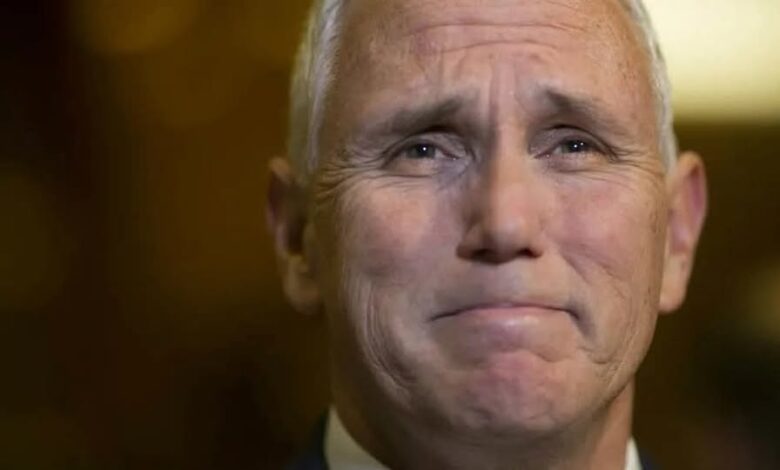
For a man who had built his entire public identity on steady resolve and unshakable composure, this was the moment the façade finally fractured. The cameras were already rolling when it happened. The lights were hot, the microphones live, the audience waiting. Then something shifted. The room grew unnaturally still. His voice, once firm and measured, trembled in a way no one had heard before. For months, perhaps even years, he had carried a truth that pressed heavier on him with each passing day. Now, standing before the nation, that truth was no longer willing to stay buried.
He remained at the podium longer than usual before uttering a single word, as though silence itself might postpone what was coming. The teleprompter glowed in front of him, filled with carefully prepared lines crafted by advisers and speechwriters. Yet he barely looked at it. This was not going to be another polished address shaped by strategy and polling data. This was something far more personal — a reckoning born from sleepless nights, quiet conversations at the kitchen table, and long moments of reflection when the noise of public life finally faded and doubt crept in.
When he finally began to speak, the practiced cadence that had defined his career seemed to waver. His hands, usually steady and deliberate, trembled slightly against the edges of the podium. He acknowledged what he could no longer deny: that the relentless demands of his public role had come at a steep personal cost. The endless travel, the late-night calls, the crises that never waited — all of it had slowly chipped away at the time and presence he owed to the people who mattered most. He admitted that while he had fought tirelessly for policies and principles, he had too often been absent from birthday dinners, school milestones, and quiet evenings that can never be reclaimed.
He spoke candidly about the emotional toll of years spent in political combat. The attacks, the scrutiny, the constant expectation to respond, defend, counter — it had hardened him in ways he had not intended. What once felt like purpose had, at times, begun to feel like survival. He described the exhaustion not just of the body, but of the spirit. The weight of leadership, he confessed, is rarely visible from the outside. It settles in slowly, layering pressure upon pressure until even the strongest shoulders feel the strain.
There was no attempt to shift blame, no dramatic flourish meant to rewrite history. Instead, there was humility. He acknowledged mistakes made in the name of ambition. He recognized the distance that had grown between his public image and his private self. The confession did not sound rehearsed; it sounded earned. Each sentence carried the gravity of someone who had wrestled with these thoughts in solitude long before daring to voice them aloud.
Then came the turning point. He spoke of stepping back. Of choosing family over power. Of envisioning a future not measured in approval ratings or election cycles, but in ordinary moments reclaimed. He described wanting to wake up without the immediate calculation of political consequences, to be present without distraction, to listen without the pressure of response. The words were simple, yet they carried the unmistakable weight of finality.
His voice cracked when he thanked those who had believed in him — supporters, colleagues, staff who had stood beside him through victories and defeats. He admitted that there were times he struggled to believe in himself, moments when doubt crept in behind closed doors even as he projected confidence in public. That vulnerability, more than any policy announcement, pierced the room. It was not the voice of a strategist or a candidate. It was the voice of a human being acknowledging his limits.
When he finished speaking, there was no immediate applause. No triumphant music, no orchestrated standing ovation. Instead, a thick, almost sacred silence filled the space. It was the kind of quiet that follows something deeply human — not spectacle, but truth. Some in the room lowered their eyes. Others simply stood still, absorbing the weight of what had just unfolded.
He stepped back from the podium slowly. The posture that had once conveyed authority now seemed softened, shoulders slightly lowered, as though the burden he had carried for so long had finally been set down. He did not linger for photographs. He did not wave for effect. He simply turned away from the cameras.