Case of Savannah Guthries Missing Mom Takes Dark Turn!
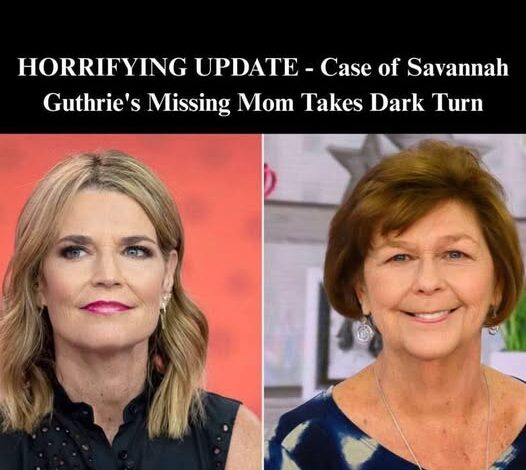
At exactly 2 a.m., something small but terrifying happened. Nancy Guthrie’s Apple Watch stopped communicating with her pacemaker. In another context, it might have been dismissed as a technical glitch. In this case, it marked the moment when concern tipped into dread. A vital signal went silent, and with it, the last digital reassurance that an 84-year-old woman was safe.
By morning, the unease had become alarm. Nancy’s place at church sat empty. For a woman known for punctuality and routine, absence was not normal. Friends noticed. Questions followed. When authorities entered her desert home, they found signs that deepened the fear: traces of blood, indications of forced entry, and personal items left behind. Nothing suggested a voluntary departure. Everything pointed toward interruption.
What began as a missing-persons report quickly took on the contours of something darker.
Investigators have remained cautious in their public statements, but behind the scenes, the language has shifted. This is no longer viewed as a random break-in or a simple disappearance. The broken sync between pacemaker and watch, the blood inside the home, and the absence of any clear exit path suggest a targeted event. Someone did not just stumble into Nancy Guthrie’s life that night. Whoever was involved appeared to know her, her routines, and the layout of her home.
Former law enforcement officials familiar with abduction cases have noted that these details matter. Random intrusions are messy and unpredictable. This scene was controlled. Personal. Quiet. That distinction changes everything.
The home itself tells a story. In daylight, it looks peaceful, almost idyllic—a place chosen for calm and safety. At night, under investigation lights, it becomes something else entirely. Every doorway, every step, every shadow becomes a potential clue. Detectives have traced the narrow window between Nancy’s last confirmed activity and the moment her devices went offline, reconstructing movements minute by minute.
The silence of her medical devices is especially troubling. For someone of her age, consistent medication and monitoring are critical. Each hour without access to care raises the stakes. Time, in this case, is not abstract. It is physical. It is measurable.
For Savannah Guthrie, this crisis has collapsed the distance between professional and personal in the most brutal way. She is accustomed to narrating tragedy with clarity and restraint, guiding audiences through unfolding events. Now, she is on the other side of that lens, waiting for updates that never come fast enough.
The role reversal is stark. There is no script for being both the face of calm and the center of chaos. Cameras follow her movements, but there is nothing performative about this moment. It is raw, private fear playing out in public view. The familiarity of her presence only sharpens the contrast: the woman who delivers the news now waits for it.
Law enforcement officials have acknowledged the urgency without offering specifics. They have warned about the risks associated with missed medication and prolonged stress. They have declined to confirm whether a ransom demand exists or whether any suspect has been identified. That restraint is intentional, meant to protect the investigation. But for families, restraint feels like absence.
Speculation has filled the gaps, fueled by the unsettling details that have emerged. Some have drawn parallels to high-profile abduction cases, noting similarities in age, vulnerability, and targeted access. Others caution against assumptions, reminding the public that early theories often collapse under scrutiny. Both perspectives underscore the same truth: uncertainty is corrosive.
What makes this case especially disturbing is how intimate it appears to be. Investigators have suggested that the person responsible may have harbored a long-standing grievance or personal motive. That possibility reframes the story entirely. It is no longer about chance or proximity. It is about trust breached and familiarity turned dangerous.
Neighbors have described a growing sense of unease. Routines have changed. Doors lock earlier. Conversations linger on the same unanswered questions. In communities like this, safety is assumed until it is shattered. When it breaks, it does so quietly, without warning.
Behind the headlines and analysis is the central, inescapable fact: an elderly woman is missing, and every hour matters. The technology meant to protect her instead marked the moment she vanished. The home meant to shelter her became a crime scene. The routines meant to anchor her life became the timeline investigators now study.
For Savannah and her family, the waiting is relentless. Days blur together, punctuated by briefings that offer little resolution. Hope and fear exist side by side, neither strong enough to eclipse the other. This is the psychological toll of not knowing—of imagining every possibility while being able to confirm none.
Authorities continue to work methodically, following leads that cannot yet be shared. Search efforts expand and contract as evidence dictates. The public sees only fragments, but for those closest to the case, every fragment is examined, replayed, and weighed.
This is not just a story adjacent to fame. It is a portrait of vulnerability that could belong to any family. The difference is visibility, and visibility does not soften impact. It amplifies it.
As the investigation presses on, the desert home stands silent, holding answers it cannot speak. The broken connection between devices remains a chilling marker of the night everything changed. Until clarity emerges, the case exists in a painful suspension—between evidence and theory, between urgency and patience, between hope and the fear of what answers might bring.
For now, the search continues. A family waits. And the nation watches, not for spectacle, but for the moment when uncertainty gives way to truth.