My Police Chief Stepfather Handcuffed Me While I Was on a Pentagon Call—Then Black SUVs Arrived at Our House
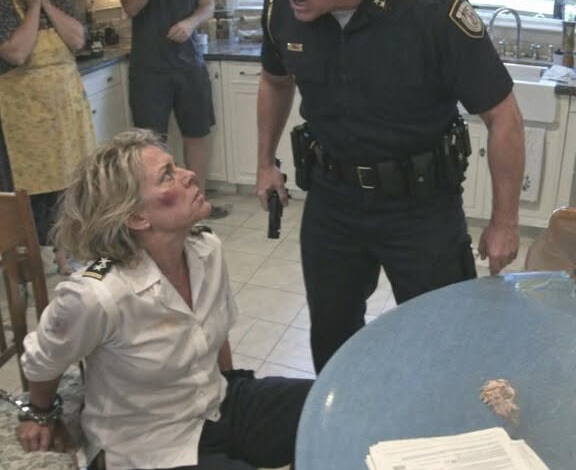
The first thing Michael Harris said when he walked into my mother’s kitchen wasn’t hello.
“Put that phone down, or I swear I’ll drop you, you fraud.”
He was already holding his service weapon.
I stood beside my mother’s old breakfast table, wearing black uniform trousers and a white blouse. My military jacket rested over a chair, and in my hand was a secure satellite phone connected to someone at the Pentagon.
“General Mitchell, could you repeat that last figure?” the voice asked.
Before I could answer, Michael stepped closer.
Behind him, my mother, Emma, nervously twisted her faded yellow apron. My stepbrother, Tyler, was recording everything on his phone. He clearly expected a confrontation and wanted proof of what he believed would be my humiliation.
For ten years, Michael had ruled my mother’s home as though it were an extension of his police department. As the local police chief, he was accustomed to people obeying him. At home, his temper was something everyone learned to work around.
He had never respected my military career. No matter what I accomplished, he treated my service as an exaggeration and my achievements as a personal insult.
When he demanded to know who I was talking to, I explained that it was a secure military line.
That only made him angrier.
“So now you’re a spy?” he sneered.
Then the voice on the phone addressed me again.
“General Mitchell, is there a problem?”
Michael burst out laughing.
“You? A general? Don’t make me laugh!”
I lowered the phone slightly but kept the connection open.
“Chief Harris, do not touch this device.”
His expression hardened.
“You don’t give orders in my house!”
“It’s my mother’s house,” I replied.
That was when everything changed.
Michael grabbed my wrist and slammed my hand against the table. Before I could react, he handcuffed me to a chair. My mother begged him to stop, but he ordered her to stay out of it.
Tyler continued recording.
Michael seized my phone and accused me of impersonating a federal official.
A voice from the other end demanded that he identify himself and warned him that he had interfered with a secure Department of Defense communication.
For the first time, Michael hesitated.
Then he made a decision that would change his life.
He drew his weapon.
My mother gasped. Tyler lowered his phone slightly, his amusement disappearing.
Michael shoved the chair, sending me crashing onto the kitchen floor. My shoulder and cheek struck the tiles, and I tasted blood. Still handcuffed to the chair, I looked up as he pointed his pistol toward me.
“Who do you think you are?” he shouted.
I looked him directly in the eyes.
“They already told you.”
Suddenly, another voice came through the phone.
“General Mitchell, remain down. Response team is inbound.”
Headlights appeared outside the kitchen window.
Then more headlights.
Several black SUVs pulled into the driveway, followed by additional vehicles. Doors opened, and personnel moved quickly toward the house.
Michael still refused to lower his weapon until the voice on the phone delivered a final warning.
“Chief Harris, put your weapon down and step away from Major General Mitchell.”
The color drained from his face.
Tyler stared at him.
“Dad… what have you done?”
The front door opened, and a response team entered alongside military personnel. They secured Michael’s weapon and ordered him away from me.
One person knelt beside me and asked whether I needed medical assistance. Another examined my injuries and the handcuffs.
My mother slid against the kitchen cabinets, finally breaking down in tears.
The team instructed Tyler to preserve his recording while the incident was documented. Michael tried to defend himself, insisting that he had been protecting his home and hadn’t known I was a general.
But he had been warned repeatedly.
My military orders, the secure communication records, witness statements, and Tyler’s video would all become important evidence.
Michael continued insisting that the incident fell under his jurisdiction. A federal official explained that the allegations would be handled through the appropriate investigative and legal processes.
My mother finally turned toward her husband.
“What exactly did you expect me to tell the authorities?”
For the first time in ten years, Michael had no convincing answer.
By sunset, he had been removed from the house. The following morning, his department placed him on administrative leave pending an outside investigation. Within days, my mother changed the locks.
That small decision meant more to me than she probably realized.
For years, she had excused his temper and controlling behavior as stress or concern. Now she was beginning to reclaim the home she had spent so long trying to keep peaceful.
Tyler called me twice. I didn’t answer.
When he eventually spoke to my mother, she explained why she could no longer tolerate his behavior.
“Because you laughed,” she told him.
Those three words said more than an argument ever could.
The investigations continued. Statements were collected, reports were filed, and the incident was treated as a serious alleged assault rather than a family disagreement.
My mother began counseling and slowly learned how to live without constantly worrying about Michael’s reactions.
When I visited her again, the kitchen looked almost exactly as it always had. The refrigerator still rattled, and the breakfast table still had its chipped blue tiles.
But Michael’s chair had been moved into the garage and replaced with a simple wooden one from the laundry room.
My mother apologized for the mismatched furniture.
I told her it looked like it belonged there.
She cried, but this time she remained standing.
Months later, people continued asking what I had felt when the black SUVs arrived. They expected me to describe the relief of being rescued or the satisfaction of watching Michael lose his authority.
But what I remembered most was the cold kitchen floor against my cheek, the handcuffs cutting into my wrist, and the fear in my mother’s eyes.
I had learned something painful that day.
Even someone with authority and respect in the outside world can be made to feel powerless by the people who are supposed to love them.
Sometimes, the hardest part isn’t proving who you are.
It’s watching your own family finally recognize the truth after years of refusing to see it.
Michael had demanded to know who I thought I was.
The answer had been coming through that secure phone all along.
He simply couldn’t accept that the person he had spent years belittling held a position he had never imagined—and that his own actions would finally have consequences.