Recent Poll Shows How Melania Trump Ranks Among Other First Ladies
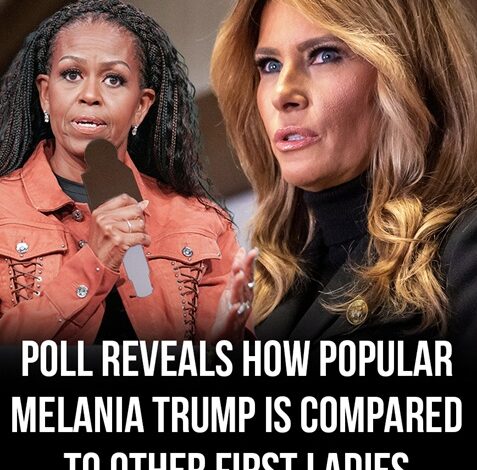
A new national poll comparing the approval ratings of America’s First Ladies has reignited discussion about the role, influence, and public perception of the women who have served in the White House.
While some First Ladies continue to command admiration decades after their tenure, the current landscape illustrates how political polarization, media coverage, and personal choices shape public opinion.
In particular, Melania Trump, the 45th First Lady of the United States, finds herself in a nuanced and complex position, reflecting both her visibility on the global stage and the sharply divided political environment of contemporary America.
The Context of the Poll
The survey, conducted with a nationally representative sample of 2,255 U.S. adults, placed Melania Trump alongside some of the most prominent and historically significant First Ladies in U.S. history, including Michelle Obama and Jacqueline Kennedy Onassis.
This competitive comparison was notable for its breadth, including First Ladies from several generations with vastly different social, cultural, and political contexts.
The survey’s methodology relied on stratified random sampling designed to capture a diverse cross-section of American society.
Respondents were selected based on gender, age, race, education, geographic region, and voter registration status.
To ensure representative results, the data was weighted by factors such as the 2019 American Community Survey, 2024 presidential vote, 2020 election turnout, baseline party identification, and current voter registration.
These methodological choices ensure that the poll reflects both national trends and partisan differences, providing a detailed look at how Americans view the women who have served in arguably one of the most high-profile political roles in the world.
Melania Trump’s Position
Melania Trump’s ratings highlight the divided public opinion that has surrounded her tenure as First Lady. According to YouGov, she currently holds a net approval rating of -16.
By comparison, her successor, Jill Biden, scores slightly higher at -9, reflecting a similar pattern of partisan polarization but less overall negativity. The lowest ranking in the poll went to Hillary Clinton, who registered -17.
These numbers illustrate an important aspect of contemporary political perception: negative ratings are increasingly common among modern public figures, particularly those connected to highly polarized administrations.
While negative approval does not always translate to unpopularity across the board, it reflects a nation deeply divided along political, ideological, and cultural lines.
The Most Admired First Ladies
Despite the mixed results for some modern figures, several First Ladies have retained remarkable levels of admiration from the public, achieving strong net positive approval ratings that transcend party lines. Among the top-ranked are:
Nancy Reagan (+25): Known for her style, advocacy on drug prevention, and devotion to her husband, President Ronald Reagan, Nancy Reagan continues to evoke admiration, particularly for her grace under scrutiny during tumultuous political times.
Rosalynn Carter (+32): Recognized for her advocacy on mental health issues and women’s rights, Rosalynn Carter is widely respected for her long-standing commitment to humanitarian work and public service.
Lady Bird Johnson (+23): Famous for her environmental initiatives and efforts to beautify American cities, Lady Bird Johnson’s influence endures, particularly in the context of environmental stewardship.
Barbara Bush (+21): Known for her literacy initiatives and focus on family values, Barbara Bush maintained a blend of warmth and directness that earned her lasting respect.
Michelle Obama (+21): Michelle Obama remains a highly visible figure on both domestic and international stages, recognized for her advocacy for education, health, and military families, as well as her cultural influence in fashion and public discourse.
Laura Bush (+19): Laura Bush’s emphasis on literacy, education, and women’s rights has earned her steady recognition, positioning her as a figure of competence and quiet leadership.
Standing out even further, however, is Jacqueline Kennedy Onassis, who achieved an exceptional +56 approval rating.
Her iconic style, cultural sophistication, and grace during personal and national tragedies have created a legacy that has endured across decades, demonstrating how the role of First Lady can resonate well beyond an individual’s time in office.
The Partisan Divide
The poll results also reflect a significant partisan divide. Melania Trump’s approval scores are notably higher among Republicans than Democrats, mirroring trends in public perception of her husband, Donald Trump.
This polarization highlights how political affiliation heavily influences public attitudes toward First Ladies, even when their initiatives or public activities are nonpartisan.
The findings underscore a broader pattern in modern American politics: the public evaluation of figures closely associated with the presidency is rarely purely personal or based solely on individual achievements.
Instead, it often intersects with broader political sentiment, media framing, and national cultural discourse.
Melania Trump’s Public Persona
Throughout her tenure, Melania Trump has been regarded as an enigmatic figure. Unlike some First Ladies who are highly visible in policy advocacy or public campaigns, Melania maintained a relatively private lifestyle.
While she engaged in initiatives such as the “Be Best” campaign, focused on children’s well-being and online safety, her approach was understated compared to the highly public and activist roles of some predecessors.
Her measured visibility has contributed to mixed public perceptions.
Admirers often appreciate her elegance, discretion, and focus on personal projects, while critics question the impact and substance of her initiatives. This duality places her squarely in the middle of the public approval spectrum.
The Broader Political Landscape
The poll coincides with renewed attention on Melania Trump due to the release of her controversial documentary, which reportedly generated $7 million in revenue during its opening weekend.
According to reports, Amazon purchased the rights for $40 million and invested an additional $35 million in marketing and promotion.
The high-profile distribution of the documentary has fueled discussion about her public image, contributing to the polarized reception reflected in survey data.
The broader context of the survey also included assessments of former presidents. Donald Trump ranked last among 20 presidents evaluated, earning a net approval rating of -20. Joe Biden followed closely as the second-lowest-ranked president in the poll.
Nearly half of respondents (48 percent) labeled Trump as “poor,” with an additional 6 percent rating him as “below average.”
This dual evaluation of both the First Lady and the president underscores how closely associated figures are often judged in tandem, particularly when their public personas and political influence are intertwined.
Historical Perspective on First Lady Ratings
Historically, First Ladies have held roles that blend public service, personal visibility, and symbolic representation of the presidency.
While the scope of their influence varies, public approval has often been tied to cultural expectations, social initiatives, and media portrayal.
For example, Jacqueline Kennedy Onassis is remembered not only for her personal style and public poise but also for her cultural stewardship during the 1960s, including efforts to preserve historical landmarks and promote the arts.
Similarly, Michelle Obama’s public health campaigns, educational initiatives, and memoir writing have contributed to her enduring visibility and positive reception.
Other First Ladies, such as Lady Bird Johnson and Rosalynn Carter, are celebrated for their quiet but effective advocacy on environmental and social issues.
These legacies illustrate that long-term approval often depends on a combination of personal qualities, policy impact, and public perception shaped over decades.
The Influence of Media
Media coverage plays a significant role in shaping public opinion of First Ladies. In the contemporary digital age, news cycles, documentaries, and social media amplify both positive and negative portrayals.
Melania Trump’s public image, for instance, has been heavily influenced by news reports analyzing her fashion choices, public appearances, and personal projects, in addition to her role as the spouse of a polarizing president.
The release of her documentary coinciding with the survey likely contributed to her placement in the middle range of approval ratings.
High-profile media projects provide both an opportunity to highlight achievements and a forum for critique, especially in a politically divided climate.
Implications of Partisan Perception
The survey demonstrates how partisan alignment strongly impacts public evaluations. Across multiple polls, First Ladies associated with controversial or polarizing presidencies often experience approval ratings that reflect broader political sentiment rather than individual initiatives alone.
Melania’s position reflects this reality: she receives comparatively higher approval among Republicans and lower approval among Democrats, illustrating how political context can mediate public perception of personal influence and accomplishment.
Looking Forward
Public perception of First Ladies is dynamic. Historical trends suggest that individuals may be more favorably evaluated over time, particularly when their contributions to public life are reassessed through historical, cultural, or policy lenses.
In Melania Trump’s case, evolving evaluations may consider both her public initiatives and her symbolic role during her husband’s administration.
The poll also illustrates that even contemporary First Ladies are subject to the same scrutiny and measurement that have historically defined public opinion of presidential spouses.
As time progresses, historians, media, and the public may reassess her tenure with the benefit of broader perspective, as has been the case with figures like Nancy Reagan and Laura Bush.
Conclusion
The recent survey comparing First Ladies provides a nuanced snapshot of American public opinion.
While figures such as Jacqueline Kennedy Onassis, Michelle Obama, and Lady Bird Johnson continue to command high approval ratings, others, including Melania Trump, occupy more complex positions in the public imagination.
Her approval ratings reflect both the political polarization of contemporary America and her unique approach to the role, characterized by discretion and selective public engagement.
At the same time, the broader survey underscores how approval ratings for both First Ladies and presidents are shaped by historical legacies, media portrayal, policy influence, and partisan alignment.
The results are a reminder that public opinion is rarely static, and the cultural memory of First Ladies evolves over time, influenced by both contemporary events and retrospective assessment.
For Melania Trump, the data situates her as a figure of intrigue and debate, reflecting a tenure marked by both public visibility and private discretion, and demonstrating that the role of First Lady continues to be both politically and culturally significant in the United States.