My Three Children Told Me to Stop Calling Them—So I Did. Three Months Later, They Arrived for Christmas and Discovered That Everything Had Changed
At 72, I never imagined hearing my own son tell me to stop calling him because he had a life of his own. I had spent decades putting my three children, Jennifer, Michael, and Lisa, before myself, helping them through every hardship and supporting them as they built families of their own.
After my husband, Richard, died suddenly at just 59, my children promised I would never have to face life alone.
But as the years passed, their visits became less frequent, and our phone calls slowly disappeared.
Then came the night that changed everything.
I woke up with frightening chest pain and immediately called 911. Terrified that I might suffer the same kind of heart attack that had taken my husband, I was rushed to the hospital.
I spent the night there, frightened and alone.
None of my three children came to see me.
When I was finally discharged, I had to arrange an Uber to take me home. Their brief messages offered little comfort, and when I tried explaining how scared I had been, Michael told me I needed to deal with my problems myself.
I sat at my kitchen table, staring at my phone, and finally understood something I had refused to accept for years.
I couldn’t keep begging my own children to care about me.
The following morning, I contacted Thomas Brennan, the attorney who had handled Richard’s estate. Together, we reviewed my finances and my plans for the future.
My Denver home was worth approximately $900,000. My savings and investments totaled around $600,000, and Richard had left behind a $250,000 life-insurance policy.
For the first time, I began making decisions based on what I wanted rather than what might please my children.
I decided to donate the insurance money to a local literacy nonprofit connected to a cause Richard had always cared about. I also updated my estate plans, changed my locks and passwords, and replaced the old gate code.
Then I made one more decision.
I stopped calling my children first.
For three months, I focused on rebuilding my own life. I joined a reading group, spent time with my neighbors, and started making plans without waiting for my children to remember I existed.
Slowly, the silence that had once felt unbearable began to feel like freedom.
Then, just before Christmas, Jennifer suddenly called.
“Mom, we’re all coming for Christmas,” she announced. “Michael, Lisa, and the whole family.”
I was surprised. After months of barely hearing from them, why had they suddenly decided to visit?
When I asked, Jennifer explained that they wanted to discuss my future. She suggested that perhaps it was time for me to move somewhere smaller.
I understood what she meant.
They wanted to discuss my house.
I told them I wasn’t hosting Christmas, but they insisted on coming anyway.
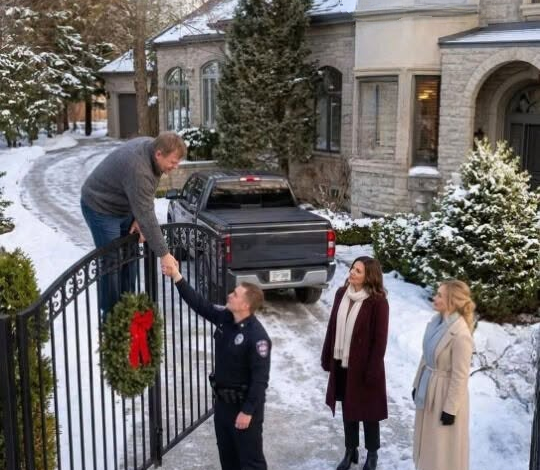
On December 23, their cars arrived outside my property. Michael confidently entered the old gate code, expecting the gate to open as it always had.
Instead, the keypad flashed red.
ACCESS DENIED.
Jennifer began demanding that I open the gate. Michael even tried climbing the fence before a security officer intervened.
I watched from inside my home, my heart aching as I realized how little they understood about what had happened between us.
They had spent months ignoring my calls, yet they still expected to walk into my home whenever they wanted.
I told them to leave.
But the next morning, after a long night of thinking, I decided to give them one final opportunity.
I invited all three children inside on one condition: we would talk about our relationship, not my money or inheritance.
They agreed.
We gathered around the kitchen table, the same table where I had once helped them with homework, listened to their problems, and celebrated their achievements.
This time, I spoke.
I told them about the terrifying night in the hospital. I explained how it felt to return home alone, knowing none of them had come to check whether their mother was okay.
I told them about the silence, the unanswered calls, and the moment Michael had told me to handle my problems myself.
For a while, nobody spoke.
Then I explained that I had changed my estate plans.
Jennifer immediately asked whether the house would remain in the family.
Michael admitted that he had assumed there would always be another opportunity to visit me.
Their reactions hurt, but they also made something painfully clear: they had begun treating my home and money as though they were already entitled to them.
I still loved my children. Nothing could change that.
But I finally understood that loving them didn’t mean surrendering control of my life or allowing myself to be taken for granted.
That evening, something unexpected happened.
We shared dinner, and gradually, the conversation changed. Instead of asking about my property, my children began asking about me.
What books was I reading? Had I made any new friends? Where did I want to travel?
For the first time in months, I felt as though they were trying to see me as a person rather than simply their mother.
Our relationship wasn’t magically repaired. I knew that trust would take time, and I wasn’t prepared to pretend the past hadn’t happened.
But we had finally begun an honest conversation.
Later that night, I stood beside an old photograph of Richard and our children.
I thought about the family we had built, the sacrifices we had made, and the promises we had all once believed would last forever.
I would always love Jennifer, Michael, and Lisa.
But I had learned an important lesson at 72: being a mother didn’t mean I had to spend the rest of my life waiting for my children to remember me.
My new gate represented more than security. It represented boundaries, dignity, and the beginning of a life I could finally call my own.
My home would always be a place where my family could be welcomed.
But from that Christmas onward, they would have to do something they had forgotten how to do.
They would have to call first—and show me that they wanted a relationship with their mother, not simply access to what she owned.