At 13, My Father Abandoned Me on a Rural Road, Saying, “You’re No Longer Part of This Family.” Twenty Years Later, I Received an Invitation to My Brother’s Wedding Along With a Letter From My Mother—And Her Words About That Day Made Me Doubt Everything I Thought I Knew.
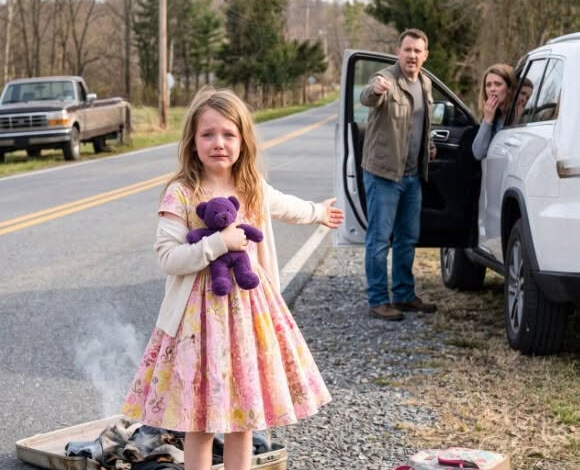
I was only thirteen when my father stopped the car on a lonely country road, turned toward me, and said the words that would haunt me for the next twenty years.
“You’re no longer part of this family.”
Then he drove away.
I stood there, watching the car disappear into the distance, unable to understand what I had done to deserve being abandoned by the people who were supposed to love me most.
A kind woman named Margaret eventually found me and took me into her home. I grew up believing my father had rejected me, and I spent years trying to convince myself that I could build a life without ever knowing why.
Then, twenty years later, an invitation to my brother Caleb’s wedding arrived in the mail.
Along with it came a letter from my mother.
I almost threw it away. But something made me open it.
The first few lines were ordinary, filled with memories and apologies. Then I reached a sentence that made my hands tremble.
“He left you because he believed it was the only way to keep you alive.”
I read those words again and again.
My father hadn’t simply abandoned me, according to my mother. He had been receiving threatening photographs and messages from someone who had been watching me since childhood. He had arranged for Margaret to take me in and keep me hidden.
For twenty years, I had believed I was unwanted.
Now I wondered whether the truth had been far more frightening.
Before I could ask my mother for answers, my brother called. Our father, Richard Whitcomb, had died six weeks earlier. Someone had broken into his house and searched his office, leaving papers scattered across the floor.
Among his belongings, Caleb had discovered a sealed folder bearing my name.
I traveled to Ohio to open it.
Inside were documents that changed everything I thought I knew about my childhood. I learned that I had been adopted as an infant and that my biological mother, Laura Mercer, had died under suspicious circumstances shortly after my birth.
A newspaper clipping described her death as a hit-and-run.
But my father’s handwritten notes suggested it had been no accident.
He had spent years investigating her death, and the documents indicated that the people responsible might still be searching for the evidence she had left behind.
Then I found a warning.
My father had written that I must never trust a man named Daniel Mercer. He might pretend to be a family friend—or even claim to be my father.
My blood ran cold.
I recognized Daniel from an old photograph and from a silver-haired stranger I had recently seen at my rehabilitation clinic.
Before I could make sense of the connection, Daniel appeared at Caleb’s house, demanding answers about a safe my father had left behind.
Caleb finally admitted that our father had recorded a message revealing that Laura’s killer might still be alive.
But the recording contained an even more disturbing confession.
Someone we already knew had helped conceal the truth.
Following Daniel’s clues, we discovered a red ledger and an old letter hidden among Margaret’s belongings. The letter revealed that she had deliberately helped arrange my disappearance, believing it was the only way to protect me from Martin Voss, a powerful businessman connected to a corrupt property-development company.
My biological mother had apparently uncovered evidence of financial crimes before she died.
And someone had wanted her silenced.
At an abandoned church, Caleb and I found a hidden box containing Laura’s original documents. One letter identified Samuel Reed, my father’s longtime attorney, as my biological father.
I could barely breathe.
But Samuel insisted he had only recently learned about me. Daniel, meanwhile, admitted that he had secretly cooperated with Voss for years because he feared what would happen to me if the truth came out.
Every answer seemed to reveal another lie.
Then we recovered an old recording of Laura confronting Voss about stolen financial records. His threats made it clear that he knew about her child and wanted the evidence destroyed.
We began to understand why my father had become so desperate when I was thirteen.
He had discovered that the danger surrounding Laura’s death had never truly disappeared.
As the investigation continued, Samuel and Daniel confronted each other about their roles in concealing information. Samuel admitted that he had unknowingly revealed details about Laura’s evidence to a corrupt supervisor. Daniel confessed that he had helped hide the truth after Voss threatened me.
We recovered more financial records, but Voss arrived before we could leave.
He offered us money in exchange for the evidence.
When we refused, his threats became more direct.
Fortunately, Emily had secretly called the police, and officers arrived before the confrontation escalated.
The investigation eventually led us to a safe-deposit box Laura had maintained for decades. Inside was another letter that overturned everything.
Samuel wasn’t my biological father.
Richard Whitcomb—the man who had abandoned me on that country road—was.
I sat in silence, trying to reconcile the father I remembered with the man described in the documents.
Laura had loved Richard before he married Evelyn, the woman who raised me. When Laura became frightened by the corruption she had uncovered, Richard agreed to raise her child.
He had known the truth all along.
But his desperate attempts to protect me had left me believing, for twenty years, that I was someone he no longer wanted.
Then came the revelation that nearly destroyed what little peace I had found.
Martin Voss’s journal identified Evelyn as the driver involved in Laura’s death.
The woman who had raised me as her own daughter might have played a role in the tragedy that took my biological mother’s life.
At first, I refused to believe it.
But investigators uncovered Evelyn’s written confession. She admitted that Voss had pressured her into following Laura and threatened her if she refused. During the confrontation, Evelyn’s vehicle struck Laura.
She claimed she had never intended to kill her and had been too frightened to tell the truth afterward.
Her letter also explained why she had later agreed to raise me. She had learned that I was Richard’s daughter and had tried to give me the life Laura never had the chance to provide.
Her guilt had shaped her decision, but she insisted that her love for me had become genuine.
I struggled with two truths that seemed impossible to hold together.
Evelyn had played a role in the tragedy that destroyed my biological mother’s life.
And she had also raised me, cared for me, and loved me for thirteen years.
I couldn’t erase what she had done. But I couldn’t pretend that every moment of our life together had been a lie, either.
Meanwhile, the evidence against Voss continued to grow. He was charged with multiple crimes connected to financial corruption, obstruction, evidence tampering, and witness intimidation.
Daniel cooperated with investigators and accepted responsibility for his own role in concealing information.
For the first time, the truth was no longer buried beneath threats and secrets.
Samuel began sharing memories of Laura with me, helping me understand the woman whose life had been taken before I could know her. Caleb and I also began rebuilding our relationship after twenty years apart.
One afternoon, he handed me a box of photographs Richard and Evelyn had secretly kept throughout my childhood.
There were pictures from birthdays, school events, and milestones I had never known my father had followed from a distance.
On the back of each photograph, Richard had written a date or a small note about my life.
Then I reached the final photograph.
His message broke my heart.
He had watched me grow up from afar and hoped that one day I would understand that he had left because he loved me badly—not because he had stopped loving me.
I cried for the thirteen-year-old girl who had stood alone on that road, believing she had been thrown away.
I cried for the years I had spent questioning my worth.
And I cried for the father whose fear had led him to make a decision that protected my life but wounded my heart.
A year later, Caleb accompanied me back to the country road where Richard had abandoned me.
Standing in the same place, I finally heard a part of the story I had never known. Caleb remembered our father crying as they drove away.
For the first time, I could imagine the fear and grief behind that terrible moment.
It didn’t make the abandonment right.
But it helped me understand that the truth was more complicated than the story I had carried for twenty years.
Eventually, our family began creating new memories. Caleb and Emily welcomed a daughter named Laura Margaret, honoring the two women whose lives had shaped mine.
As I held my niece, surrounded by the people who had stayed, I realized that healing wasn’t about pretending the past hadn’t happened.
It was about accepting the truth, allowing people to face the consequences of their choices, and refusing to let those choices determine the rest of my life.
The thirteen-year-old girl left beside that lonely road had never been unwanted.
She had been caught in the terrible decisions of frightened adults, trapped in secrets she was too young to understand.
But she had survived.
She had rebuilt her life.
And after twenty years of believing she had been abandoned because she wasn’t worthy of love, she had finally reclaimed her own story.
This time, when my family went home, no one was left behind.