This harmless-looking boy grew up to be one of the most evil men in history
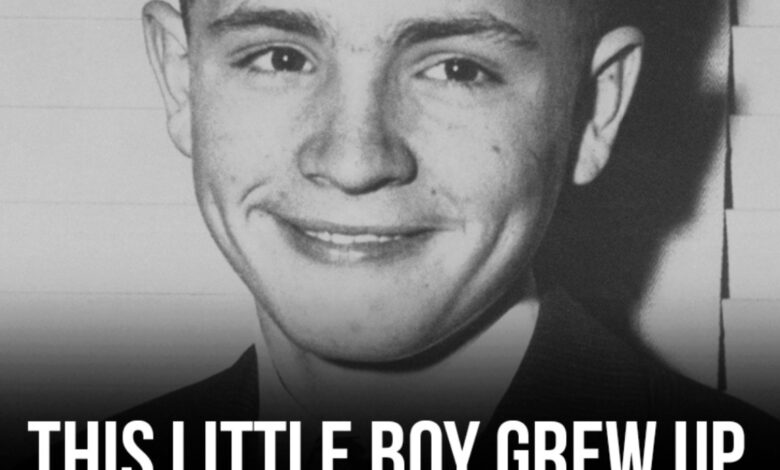
There is a chilling dissonance in looking at the childhood portraits of history’s most reviled figures. The grainy black-and-white image of a small, seemingly harmless boy offers no hint of the carnage that would follow. Yet, as the case of the boy born on November 12, 1934, illustrates, the chasm between an innocent beginning and a monstrous end is often bridged by a lifetime of chaos, institutionalization, and profound neglect.
This is the story of Charles Manson, a man whose name became a global shorthand for evil, but whose path to the Sharon Tate murders was paved long before he ever reached the canyons of Los Angeles.
A Heritage of Instability
The instability that defined Manson’s life began at conception. Born to a 16-year-old mother in Cincinnati, his father—a con artist by trade—vanished before the boy ever drew breath. By age four, his world fractured further when his mother, Kathleen, was arrested for a violent assault and robbery alongside her brother, Luther. While his mother served three years of a five-year sentence, the young Manson was shuttled to West Virginia to live with relatives.
Reunification with his mother brought only a brief respite of happiness before the reality of her alcoholism took hold. Manson would later describe being left with a rotating cast of strangers for days on end. When his mother eventually tired of his burgeoning behavioral issues, she opted to send him to reform school—a decision that effectively handed him over to the state for the remainder of his youth.
The “Insane Game” and the Reformatory Cycle
By age nine, Manson was already manifesting signs of severe anti-social behavior, allegedly setting fire to one of his schools. His adolescence was a blur of truancy, petty theft, and escapes. At thirteen, he was placed in the Gibault School for Boys, a Catholic institution where discipline was administered through frequent beatings.
Manson fled, briefly returning to a mother who rejected him once more. Living in the woods or under bridges in Indianapolis, he turned to burglary to survive. It was during these early stints in juvenile institutions that Manson developed his “insane game”—a tactical defense mechanism involving shrieking and physical contortions designed to convince larger, violent predators that he was too unhinged to be victimized.
The criminal trajectory only steepened. By the time he reached a federal reformatory in his late teens, Manson was reportedly involved in the sexual assault of another inmate at knifepoint. Psychiatric evaluations from the period were prophetic, labeling him “aggressively anti-social.”
Hypnosis, Hollywood, and “Helter Skelter”
Manson spent much of his early adulthood behind bars. While serving time at McNeil Island Penitentiary, he experimented with hypnosis, practicing his burgeoning powers of manipulation on fellow inmates—reportedly including a young Danny Trejo.
Upon his release in the late 1960s, Manson emerged into a counterculture ripe for exploitation. He harbored desperate ambitions of rock stardom, even befriending Dennis Wilson of The Beach Boys. But when the West Coast music scene rejected him, his humiliation curdled into a thirst for vengeance.
Manson’s fractured psyche eventually coalesced around a delusional interpretation of The Beatles’ music. He convinced a collective of vulnerable runaways and outcasts—the “Manson Family”—that a race war he dubbed “Helter Skelter” was imminent. His twisted prophecy claimed that Black Americans would rise to power but ultimately prove “incapable of surviving independently,” at which point Manson and his followers would emerge from a desert bunker to rule the world.
The Embodiment of Evil
In August 1969, the world watched in horror as the Manson Family carried out the ritualistic murders of actress Sharon Tate, her unborn child, and four others in a Benedict Canyon home. The directive from Manson, delivered through his right-hand man Tex Watson, was to make the scene “as gruesome as you can.” The following night, the carnage continued with the murders of Leno and Rosemary LaBianca.
Though Manson did not physically strike the fatal blows in the Tate-LaBianca killings, prosecutor Vincent Bugliosi successfully argued a theory of conspiracy. Manson was the architect, the puppet master who weaponized the trauma of his own youth to dismantle the lives of others.
“The very name Manson has become a metaphor for evil,” Bugliosi would later declare. “And evil has its allure.”
A Legacy Interrupted
Convicted of multiple counts of murder and conspiracy, Manson was sentenced to death in 1971, a sentence later commuted to life after California briefly abolished capital punishment. He remained a fixture of morbid fascination for decades, denied parole twelve times as he continued to exhibit the manipulative traits honed in reform schools seventy years prior.
Charles Manson died in 2017 at the age of 83. While he passed due to cardiac arrest and complications from colon cancer, his shadow remains fixed over American pop culture. The boy who once looked harmless in a photograph died as a singular warning of what happens when a society allows chaos to shape the foundation of a human life.