A Man Cleaned a Child’s Grave Every Sunday for Fourteen Years — I Finally Asked Him Who She Was
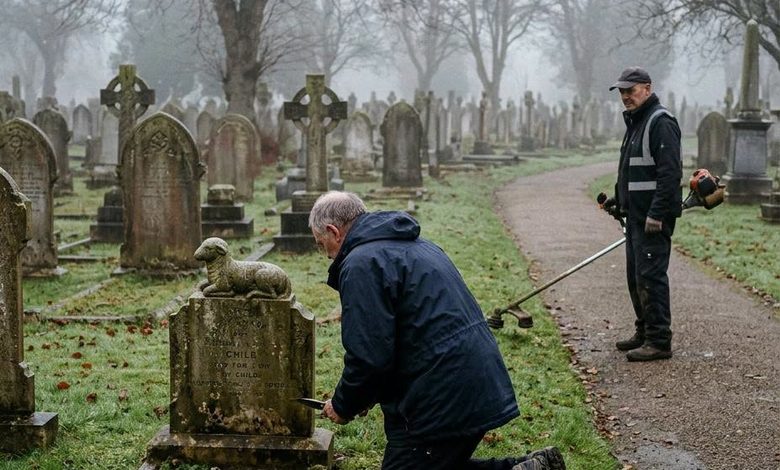
A man came to my cemetery every Sunday for fourteen years to clean one child’s grave that had no family — and when I finally asked him who she was, he told me the truth in nine words.
I am the groundskeeper at Thornefield. Four thousand one hundred graves, eleven acres, and a hedge that takes me three weeks.
My name is Hollis Trevelyan. I’m sixty-four and I have been there since 2003.
Section C, row nine, plot fourteen. Posy Calloway. Six years old.
A small stone with a lamb on the top, the sort they did in the nineties.
He started coming in the spring of 2012.
A man of about sixty, grey, a navy anorak, a canvas bag with a scrubbing brush and a bottle of water in it.
Sundays, about ten past eight, before anybody else is in there.
He cleaned the stone with the brush and plain water. Never bleach. Bleach ruins that stone and he knew it.
He cut the grass round the kerb with hand shears, on his knees, in a square.
Then he sat on the bench on the path for about forty minutes and then he went home.
He never brought flowers. Not once in fourteen years, and that is the thing that kept me wondering.
Everybody brings flowers. He brought a brush.
Here is what I knew about that grave from the book.
Posy Calloway. Born the eleventh of March 1991. Died the twenty-second of September 1997.
Interred the first of October. Plot purchased by a Rhiannon Calloway, address in Marchmont.
Nobody had visited it. I want to be precise about that, because it sounds like an accusation and it is not one.
In twenty-three years I have seen one visitor at that grave who was not him, and that was in 2008, and it was a woman who stood on the path and did not come up the row.
So for fourteen years a man I did not know cleaned the headstone of a child whose family never came.
I made up three stories about him over those years, the way you do.
A grandfather, estranged from the mother. That was my first and it lasted about four years.
Then a teacher, because of the shears and the square and the neatness of it.
Then, after about 2018, a man who had lost a child of his own somewhere else and could not get to her.
None of those are right and all three of them were me being comfortable.
We spoke, over the years. Not about that.
About the hedge. About the drainage in section F. About a fox that had been coming in through the Weddington gate.
He told me his name was Edgar and that he had been a joiner and that his knees were finished.
Fourteen years of Sundays and I knew his first name and his trade.
What changed it was the March of this year.
He did not come on the first Sunday. He has missed four Sundays in fourteen years and I know which four.
He did not come on the second either.
On the third he came at about half past nine, which is late for him, and he had a stick.
He got down on his knees to do the kerb and he could not get back up.
I was forty feet away with the strimmer and I saw it and I went over.
I got him up and sat him on the bench and he was grey and his hands were going.
I went and got him a cup of tea from the flask in my shed and we sat on that bench for about twenty minutes without saying anything.
And then I asked him.
I said: Edgar. Fourteen years. Who is she to you.
He did not look at me and he did not take long.
He said: “I was driving the car that killed her.”
Nine words.
I had been building a man in my head for fourteen years and he took him apart in nine words on a bench.
The twenty-second of September 1997, a Monday, about twenty past four in the afternoon.
A road called Brackenhill Lane with a bend in it and no path on the left-hand side.
He was forty-two. He had been a joiner for twenty years and he had never had a point on his licence.
He was not speeding. That went to court and it was established.
A child of six came off a verge after a ball and there were fourteen feet of road.
He was not charged with anything in the end. The inquest called it an accident and the coroner said so out loud.
He told me that bit quickly and in a flat voice, the way you say a thing you have said to yourself ten thousand times.
Then he told me the part I have not stopped thinking about since.
He did not start coming in 1997. He started in 2012.
For fifteen years he did not come near this place, because he did not think he had the right to.
What happened in 2012 is that he wrote to Rhiannon Calloway.
Not to apologise. He said he had done that in 1998 and been told, correctly, that it was not wanted.
He wrote to ask her permission to look after the grave.
Because he had driven past Thornefield in the January and seen the state of the sections from the road, and he knew she had moved to Scotland in 2003.
She wrote back. Three lines.
He has carried that letter in the canvas bag with the brush for fourteen years and he showed it to me on that bench.
It says: You may clean it. Do not plant anything and do not leave flowers, because flowers are from people who loved her. Tell me if the stone ever cracks.
That is why there were never any flowers.
It was not grief and it was not penance arranged to look good. It was a woman’s instruction, followed exactly, for fourteen years, by a man who thought he owed her that.
He has written to her once a year, every January, to tell her the condition of the stone.
She has never replied again. Not once in fourteen years.
He posts it anyway.
Edgar died on the fourth of June. His daughter rang the office because she found my number in his diary under Thornefield.
Eighty-one people at that funeral. He had a whole life I knew nothing about.
His daughter told me she had never known where he went on Sunday mornings.
Forty years old and she thought it was a walking group.
I wrote to Rhiannon Calloway in the June, at the Scottish address on his envelopes, because it felt like somebody had to.
I told her he had died and that the stone is sound.
She wrote back in the August. Four lines this time.
She asked whether the grass round the kerb was still being cut in a square.
I do it myself now. Sunday mornings, about ten past eight, with his shears, which his daughter gave me.
I have not told Rhiannon Calloway that it is me doing it and I do not know whether I will.
No flowers. That part I will not change.