Six gamblers made millions off of US airstrikes on Iran
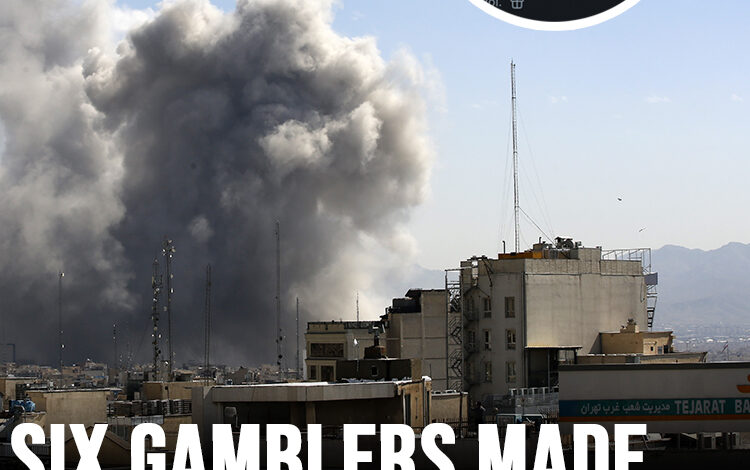
In the wake of a weekend that saw the geopolitical map of the Middle East redrawn by fire, a new and unsettling narrative is emerging: a global network of anonymous traders has reaped staggering profits by betting on the exact timing and lethality of the strikes against Iran. As the dust settles on the coordinated U.S. and Israeli operation that resulted in the death of Supreme Leader Ayatollah Ali Khamenei, politicians and financial watchdogs are sounding a frantic alarm over the ethics—and the legality—of profiting from the theater of war.
The Decapitation Payout: $529 Million in War Wagers
The military campaign, which decapitated the Iranian leadership on February 28, triggered a secondary explosion in the world of “prediction markets.” On platforms such as Polymarket and Kalshi, the announcement of the strikes was met not with somber reflection, but with a frantic rush to place high-stakes bets on the subsequent collapse of the regime.
The scale of the “war handle” is unprecedented. According to reporting from Reuters, approximately $529 million was traded on Polymarket specifically on contracts tied to the timing of the U.S.-Israeli intervention. Another $150 million was wagered on a single binary outcome: whether Ayatollah Khamenei would be removed from power by the end of March.
The “Hours Before” Anomalies: Suspicions of Inside Information
The most disturbing aspect of the surge involves the precision of the winners. A cluster of accounts reportedly generated approximately $1.2 million in profit by betting that the offensive would occur specifically on February 28. Investigative analysis reveals a suspicious pattern: the majority of these accounts were created just hours before the first missiles impacted Tehran.
This uncanny timing has led social media analysts and industry observers to wonder if these “bettors” possessed advanced knowledge of the Pentagon’s flight manifests. It raises the haunting possibility that the classified details of a military strike may have been used to front-run a prediction market.
Beyond the initial strikes, the speculation has turned toward the future of the state. Kalshi recorded $36 million in bets regarding potential regime change, while Polymarket saw $31 million in volume regarding whether the Supreme Leader’s seat would remain vacant through March 31.
The Legislative Backlash: “It’s Insane This is Legal”
The visibility of these profits has drawn a sharp, bipartisan rebuke from Washington D.C. U.S. Senator Chris Murphy of Connecticut did not mince words, characterizing the existence of these markets as “insane.” Murphy has signaled his intention to introduce federal legislation aimed at a total ban on contracts that allow citizens to hedge or profit from military operations.
Representative Mike Levin has also joined the chorus, demanding a full audit and increased transparency from these platforms. “Prediction markets cannot be a vehicle for profiting off advance knowledge of military action,” Levin stated, echoing concerns that these markets could incentivize the leaking of classified intelligence for financial gain.
The Legal Gray Area: Offshore vs. Regulated
Currently, these platforms operate in a murky legal vacuum. Under existing U.S. commodities law, contracts tied directly to war, violence, or assassination are strictly prohibited. However, because many prediction markets operate as decentralized online protocols or are based offshore, they frequently bypass the traditional regulatory net of the CFTC (Commodity Futures Trading Commission).
Tarek Mansour, the CEO of Kalshi, has moved to defend his company’s reputation. He maintains that Kalshi’s rules are specifically designed to prevent betting “directly tied to death,” asserting that their internal compliance prevents users from profiting from the loss of life. In a move to mitigate the optics of the situation, the company reportedly refunded certain fees and adjusted the payouts for markets specifically related to Khamenei’s death.
Conversely, Polymarket—which processed the lion’s share of the Tehran volume—has remained silent, declining to provide a comment to the media regarding the ethics of its “Epic Fury” contracts.
A Moral Crossroads
As the U.S. military continues its operations in the Gulf, the debate over prediction markets is forcing a confrontation with a difficult question: Does the “wisdom of the crowd” provided by these markets justify the ghoulish reality of betting on a body count?
The emergence of war-prediction markets represents a fundamental shift in how we process global trauma. Would you like me to look into the specific ‘insider trading’ laws that might apply to military personnel using these platforms, or perhaps examine how these markets predicted previous conflicts like the Ukraine-Russia war?