My Father Paid My Son Less Than His Cousins for Doing the Same Job — But What Happened at His Dinner Table Changed Everything
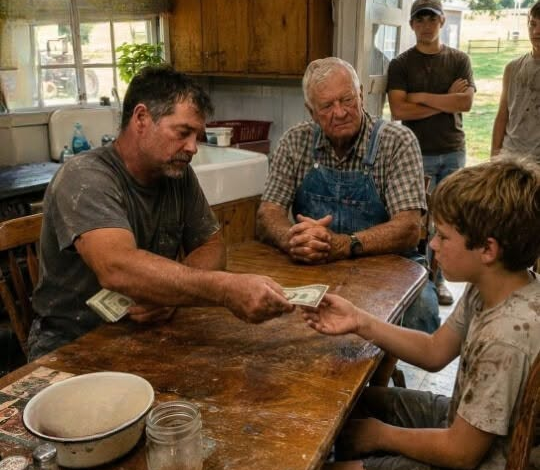
My 12-year-old son stood quietly in my father’s kitchen, staring at the money Grandpa had just handed him.
He had spent three hours mowing the same two-acre lawn as his older cousins under the hot Kansas sun. All three boys had worked hard, taking turns using the riding mower, push mower, and weed trimmer.
But when it was time to pay them, my father gave my son just $10 while his cousins each received $40.
I watched my son’s excitement slowly turn into disappointment. Instead of confronting my 73-year-old father, I quietly handed my son another $30.
The following Saturday, it happened again. My father paid my son less for doing exactly the same work. Once again, I covered the difference.
This continued for several weeks. Although my family was dealing with mortgage payments and other expenses, I refused to let my son believe his work was worth less than his cousins’.
Eventually, my sister explained the reason. Grandpa was deliberately giving her boys extra money because their father had abandoned them, and he wanted to help support them.
I understood his intentions, but treating the boys differently still didn’t feel right.
Then my son made a decision that nobody expected.
He used his savings to buy Grandpa a birthday present: a $28.53 straw hat to replace the old one Grandpa had been struggling to repair with tape.
When my father realized that my son had spent almost all of the extra money I had given him on that gift, he was deeply touched.
A few weeks later, something else happened. The older cousins noticed the unfair payments and decided to share some of their money with their younger cousin without anyone asking them to.
By the end of that summer, Grandpa finally admitted he had been wrong.
He began paying my son the same $40 as the other boys. He also returned the $330 I had secretly added to my son’s earnings over eleven Saturdays.
But that wasn’t the end of his decision.
My father contacted an attorney to reconsider his estate plans. He decided to establish an equal $20,000 certificate of deposit for my son, matching the arrangements he had already made for his other two grandsons.
He also created three education investment accounts, each starting with $5,000 and receiving monthly contributions of $100.
His plans for the family farm and house were updated to ensure all three boys would eventually receive equal consideration.
Two years later, my son Jasper Whitaker was 14 and had earned second place in a Kansas state agricultural mechanics competition.
Despite struggling with reading in school, he had discovered something he was truly talented at.
His cousins, Reid and Corbin, were there cheering him on, while Grandpa proudly watched from the audience despite his declining health.
Then my father finally revealed something he had never told us.
His own father had once paid him less than his brother for doing exactly the same work.
It was an old wound he had carried for years, and without realizing it, he had repeated that same behavior with his grandchildren.
My name is Brady Whitaker, and I’ll never forget the afternoon my father looked at all three boys and told them they each had wonderful futures ahead of them.
The old straw hat was still on his head, reminding him of the grandson who had shown him kindness even when he felt undervalued.
And around the same kitchen table where everything had started with a $10 payment, our family learned a lesson that would stay with us forever:
Every child’s effort deserves equal respect, and no child should ever feel that they are worth less than someone else.