Kelly Osbourne fires back at trolls after skinny BRIT awards look sparks concern
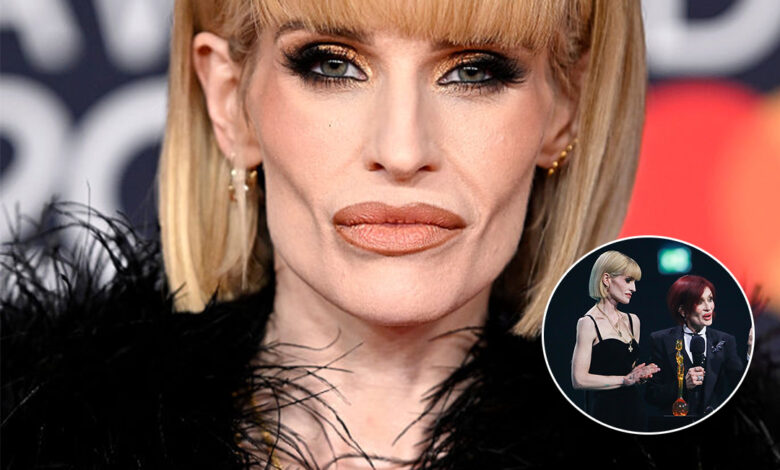
Kelly Osbourne’s appearance at the 2026 BRIT Awards in Manchester was intended to be a night of profound legacy and emotional tribute. Instead, it ignited a firestorm of global discussion after high-definition red-carpet photography revealed her noticeably slimmer figure. Now, the 41-year-old media personality and singer is taking a scorched-earth approach to her response—taking direct aim at the “haters” and the increasingly cruel ecosystem of online trolls.
A Night of Honor Overshadowed
The controversy began on a night meant for the Osbourne family to celebrate the monumental career of their late patriarch, the legendary Ozzy Osbourne. Kelly, alongside her mother, Sharon Osbourne, took to the stage in Manchester to accept a prestigious Lifetime Achievement honor on behalf of the “Prince of Darkness.” However, the cultural conversation shifted almost instantly from Ozzy’s musical contributions to Kelly’s physical appearance.
As photos from the event saturated social media feeds, they went viral for reasons far removed from the award ceremony. The imagery reignited an intense, almost forensic scrutiny of Kelly’s weight, sparking a wave of unsolicited “concern” and outright vitriol that has become a hallmark of the digital age.
“A Serious Cry for Help”: The Echo Chamber of Trolls
Kelly Osbourne is now firing back with significant force, characterizing the renewed backlash as not only “cruel” but fundamentally “dehumanizing.” The rhetoric on social platforms reached a fever pitch, with users adopting the guise of medical experts and concerned citizens to dissect her transformation.
“This is a serious cry for help,” wrote one social media user, a sentiment that was echoed thousands of times across various platforms.
”This is so bad. Someone needs to step in,” another commenter added, contributing to a narrative that frames Osbourne’s personal physical choices as a public emergency.
The Journalist’s Perspective: The Weight of Scrutiny
In my ten years of reporting on the industry, I have observed that for a woman in the public eye, her body is often treated as public property. Kelly Osbourne, who has been transparent about her journey with body image and health for decades, finds herself once again at the center of a debate she did not solicit. The language used by the public—terms like “cry for help”—often masks a deeper, more invasive desire to control the narrative of a celebrity’s autonomy.
Osbourne’s refusal to stay silent signals a shift in how celebrities are handling “body-shaming” in 2026. By labeling the reactions “dehumanizing,” she is highlighting the psychological toll of having one’s health status debated by millions of strangers based on a handful of photographs.
The Legacy Continues
Despite the noise, the core of the evening remained: the enduring impact of Ozzy Osbourne’s work. Yet, the reality remains that as Kelly moves into her 40s, every aesthetic shift is treated as a tabloid event. Her defiance at the 2026 BRITs suggests that while the trolls may never stop talking, she has reached a point where she is no longer willing to let their voices go unchallenged.
Kelly Osbourne remains a polarizing figure, not because of her actions, but because she serves as a mirror for society’s uncomfortable relationship with aging, weight loss, and the boundaries of public commentary.
The growing international concern regarding the noticeably thinner appearances of both Kelly and Sharon Osbourne has increasingly been filtered through a specific modern lens: a phenomenon commonly labeled by online speculators as “Ozempic face.” While the term has become a catch-all for rapid facial volume loss in Hollywood, the reality behind the Osbournes’ 2026 BRIT Awards appearance is a complex tapestry of medical science, personal tragedy, and a fierce rejection of “dehumanizing” public scrutiny.
The Science of Suppression
According to clinical insights from UCLA Health, the class of weight-loss medications currently dominating the cultural conversation works by suppressing appetite and significantly slowing the digestive process. This biological intervention leads to fat loss throughout the entire body rather than in targeted areas. When fat is lost rapidly from the face—an area that relies on adipose tissue for a youthful, “plump” appearance—the result can be a hollowed or “gaunt” look that the internet has aggressively branded as a side effect of GLP-1 agonists.
A Viral Flashpoint in Manchester
Photos of Kelly Osbourne from the February 28 BRIT Awards at Manchester’s Co-op Live quickly became the weekend’s most dominant viral talking point. As the images spread across social media and news aggregators with predatory speed, the commentary grew increasingly sharp. Within hours, the 41-year-old—who was in attendance to honor her late father, Ozzy Osbourne—took to her Instagram Stories to issue a scathing condemnation of what she described as heartless and relentless commentary.
“There is a special kind of cruelty in harming someone who is clearly going through something,” Kelly wrote, her words vibrating with a mixture of exhaustion and fury. “Kicking me while I’m down, doubting my pain, spreading my struggles as gossip, and turning your back when I need support and love most. None of it proves strength; it only reveals a profound absence of compassion and character.”
The Clash of ‘Concern’ vs. ‘Shaming’
The backlash did not happen in a vacuum. Kelly, who shares a 3-year-old son, Sid, with fiancé Sid Wilson, has long been a vocal critic of online toxicity, particularly when it originates from other women. Just days prior to the awards, she had responded to a comment comparing her to a “dead body,” calling the remark “disgusting” and stating that “no one deserves this sort of abuse.”
However, a vocal segment of the public “clapped back,” reframing their critiques not as body-shaming, but as a form of “genuine concern.”
- “It’s not all body shaming, this is scary thin,” one user argued.
- Another added: “There’s a huge difference between body shaming and genuine concern.”
The Anatomy of Grief: July 2025 to Present
The fundamental disconnect between the public and the Osbournes lies in the timeline of their tragedy. Kelly has repeatedly and explicitly linked her recent weight loss to the profound emotional hardship following the death of her father in July 2025. The legendary Black Sabbath frontman passed away from cardiac arrest, having battled coronary artery disease and Parkinson’s for years.
Kelly has utilized her platform to push back against the “Ozempic” speculation, denying the use of weight-loss medications and instead pointing to the physical toll of a life “flipped upside down.”
“I am ill right now,” she stated late last year in a moment of raw transparency. “I don’t understand why people expect me to bounce back and look like everything is just fine in my life when it’s not. The fact that I’m getting out of bed and facing my life—trying—should be more than enough.”
Sharon’s Defense and Her Own ‘Cautionary Tale’
Sharon Osbourne, 73, has stood as a protective bulwark for her daughter. During a December 10 interview with Piers Morgan, Sharon argued that the public is willfully ignoring the reality of Kelly’s bereavement. ”She’s not happy, she’s lost her daddy,” Sharon said. “She can’t eat right now. It’s a shield for people that are unhappy, and jealousy and people’s perception of somebody else.”
Sharon’s defense carries a unique weight because she is one of the few celebrities to have been entirely transparent about her own journey with GLP-1 medications. While Kelly denies using them, Sharon has previously admitted that her own use of the medication became difficult to control, eventually leaving her feeling “too gaunt.” She has since stopped the treatment and issued a stern warning to others about the addictive nature of rapid weight loss. “You can lose so much weight and it’s easy to become addicted to that, which is very dangerous,” Sharon previously remarked, acknowledging the risks she personally faced.
The Journalist’s Conclusion
As Kelly and Sharon Osbourne stood together on the stage in Manchester, they represented a family in the middle of a transformative year. Whether the public views their appearances through the lens of a “scary” medical trend or a devastating personal loss, the Osbournes have made their stance clear: their bodies are not a public debate, and their grief is not a gossip item.
In a world obsessed with “Ozempic face,” Kelly Osbourne is asking the world to look instead at the face of a daughter who simply misses her father.
The intersection of celebrity grief and medical speculation is a complex territory. Would you like me to further investigate the long-term physiological effects of “grief-induced” weight loss, or perhaps look into the history of how the British tabloids have covered the Osbourne family’s health over the past 40 years?