At My Father’s Funeral, My Stepmother Told Me to Sit in the Back Because “the Front Is for Real Family” — The Next Day, the Lawyer Asked for Me by Name
My dad married Vivian when I was twenty-three.
My mother had been gone four years. Dad was lonely, and Vivian was charming, and I was happy for him. I really was.
Vivian had two grown sons from her first marriage, Trent and Colby. Within a year they had keys to Dad’s house. I had to knock.
Within two years, Vivian had started saying things. Small things. That I only called when I needed something. That I made Dad “anxious.” That it would be better if I visited less often, “for his heart.”
So I visited less. I didn’t want to make his life harder.
Dad died in October. A heart attack in his garden, pulling up the last of the tomatoes.
Vivian planned the funeral without asking me a single question. I found out the time from a cousin.
When I walked into the church, the front two pews had little white cards on them. Reserved — Family.
I went to sit down in the front row.
Vivian put her hand on my arm.
“Hannah, sweetheart. The front is for his real family. Me and the boys. You understand. Why don’t you sit in the back, where it’s quieter?”
I looked at her. I looked at Trent and Colby, already sitting in the front pew in matching black ties, looking at their phones.
I was his only child.
I didn’t say a word.
I walked to the very last pew and sat down alone.
Vivian gave the eulogy. She talked about “our eleven beautiful years.” She didn’t mention me once. Trent read a poem. Colby cried loudly.
I sat in the back and held the funeral programme with my dad’s face on it, and I didn’t cry until I got to my car.
The next morning, the will was being read at Dad’s lawyer’s office.
Mr. Abernathy had been Dad’s lawyer for thirty years. He was the one who called me himself to make sure I’d come.
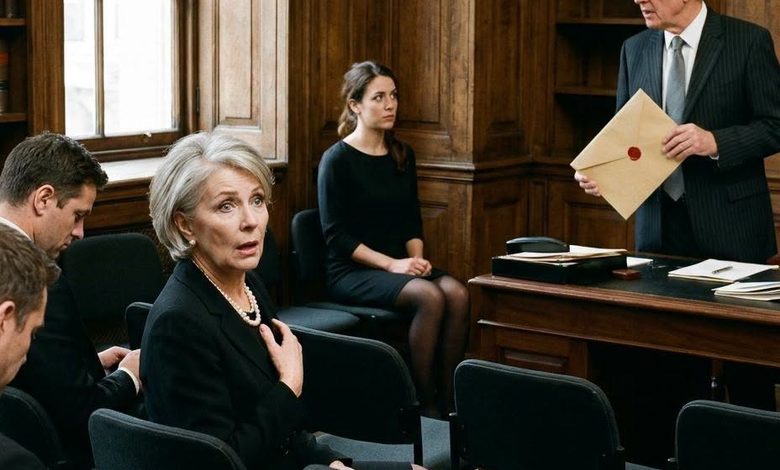
The chairs were set in rows. Vivian and her sons took the front. When I came in, she looked over her shoulder.
“There’s room at the back, Hannah.”
So I sat at the back again.
Mr. Abernathy came in with a folder and a sealed envelope. He sat down behind his desk. He put on his glasses.
Then, before he opened anything, he looked over the front row. Right past Vivian. Right past Trent and Colby.
And he said:
“Before we begin, which one of you is Hannah?”
I raised my hand from the back row.
“Your father asked me to read this to you first,” he said. “And he asked me to make sure you weren’t sitting in the back when I did.”
Vivian turned around in her chair. Her face had gone completely white.
Mr. Abernathy pointed to the empty chair beside his desk. The one facing everyone.
“Please, Hannah. Come and sit here.”
I walked up past Vivian, past her sons, and sat down.
He broke the seal on the envelope. Inside was a letter in my father’s handwriting. Big, slanted capitals. He always wrote like he was shouting cheerfully.
Mr. Abernathy read it aloud.
“Hannah. If Ed is reading this to you, I’m gone, and I’m sorry. I’m also guessing you are sitting in the back. I know that’s where you’ve been for a long time. That’s my fault. I let it happen because it was easier than an argument, and I was a coward about it.”
Vivian started to stand up. Mr. Abernathy raised one hand without looking at her, and she sat back down.
“I want you to know I never once believed you only called for money. I know you never made me anxious. I know who said those things, and I know why. I’m sorry I didn’t stop it.”
“Thank you for every Tuesday.”
Nobody in that room knew what that meant except me.
For eleven years, every single Tuesday, my father and I had lunch at the same diner across town. He told Vivian he was at the hardware store. We sat in the same booth. He always ordered the meatloaf and always complained about it.
Eleven years. Almost five hundred Tuesdays.
I had never told anyone. Neither had he.
Then Mr. Abernathy put the letter down and read the will.
Dad left Vivian the right to live in the house for the rest of her life. Every bill paid from a trust. She would never have to leave it.
But the house itself, the land, and the landscaping business he’d built for thirty-four years, went to me.
Trent and Colby each received five thousand dollars, “with my thanks for being kind to your mother.”
And I was named executor.
Vivian said, “That’s not possible. He told me everything was mine.”
Mr. Abernathy said, very calmly, “He changed it four years ago, Mrs. Whitlock. He sat in that chair Hannah is sitting in. He was very clear.”
Then he slid the papers across the desk to me.
“The executor signs first. In the front.”
Vivian walked out. Her sons followed her. Colby slammed the door hard enough to rattle the glass.
She threatened to contest the will. Her own lawyer told her that with Dad’s letter, the dates and Mr. Abernathy as a witness, she would lose, and it would cost her the trust that paid her bills.
She didn’t contest it.
I let her stay in the house. That’s what Dad wanted, and I didn’t need to take anything else from her. I don’t go there much.
I run the business now. Dad’s old crew stayed, every one of them. The foreman told me Dad used to talk about me every Tuesday afternoon when he got back from “the hardware store.”
I still go to the diner on Tuesdays.
Same booth. I order the meatloaf.
He was right. It isn’t very good.