A Woman Sees Seven Clowns Show up at Her Father’s Funeral and Leave a One-Inch Box on His Grave – When She Opens It, She Gasps
y dad was the most boring engineer I’d ever known. But when seven clowns appeared at his funeral and left a tiny box, I realized he’d been hiding something from me my entire life.
At thirty-two, I organized weddings and birthdays.
“Another wedding this weekend?” my husband Ryan asked.
“Three.”
“Do you ever stop entertaining people?”
I organized weddings and birthdays.
“Only when I’m asleep.”
“You probably tell jokes in your dreams.”
“At least my audience never complains.”
“You know normal people can sit quietly for five minutes, right?”
“Sounds like a medical condition.”
My audience never complains.
My father, Thomas, was my complete opposite.
“Dad, why are your kitchen drawers labeled?”
“So people put things where they belong.”
“And why did you measure the Christmas lights?”
“Because crooked lights look ridiculous.”
My father was my complete opposite.
“You’re an engineer, not a building inspector!”
“Someone has to maintain standards, sweetheart.”
I spent my childhood trying to make him laugh.
He rarely did.
“Dad, do I embarrass you?”
You’re an engineer.
“Why would you ask that?”
“You never laugh at my jokes.”
“That doesn’t mean I’m embarrassed.”
“Then what does it mean?”
He adjusted his glasses. “Emily, you’re overthinking it.”
Do I embarrass you?
But I never knew what he really thought of me.
Whenever I was upset, Dad wound an old music box with a dancing clown.
“Why a clown, Dad?”
“Because even clowns have bad days.”
“Do you?”
Emily, you’re overthinking it.
“Occasionally.”
“Then why don’t you ever laugh?”
“Someone has to be the serious one.”
Mom, Margaret, was different. She laughed at practically everything.
“You got your father’s best quality,” she often said.
I never knew what he really thought of me.
“His ability to calculate mortgage interest?”
“Something much better.”
She never explained.
***
Then Dad became seriously ill.
“Another ridiculous card?” he asked when I visited.
Someone has to be the serious one.
“You loved the last one.”
“It had a dancing potato.”
“And you almost smiled.”
“Your imagination is remarkable, sweetheart.”
***
One afternoon, I found him staring out his hospital window.
You loved the last one.
“Guess what? I’m becoming a magician.”
Dad raised an eyebrow.
“Ryan says I should make our electricity bill disappear first.”
Dad smiled faintly. “Emily, you don’t always have to laugh.”
“Somebody has to keep this family entertaining.”
Your imagination is remarkable.
“That’s not what I meant.”
I changed the subject.
Three weeks later, he was gone.
And organizing his funeral was the first event I couldn’t make beautiful.
***
Dad’s funeral was supposed to be small.
You don’t always have to laugh.
We invited family, neighbors, and former coworkers. The night before, I’d posted the details on Facebook because relatives kept asking for the cemetery address.
I didn’t think anything of it.
Ryan stood beside me as the minister began speaking.
“You okay?” he whispered.
Dad’s funeral was supposed to be small.
“Considering I haven’t threatened the funeral director over those flowers? Fantastic.”
“Emily.”
“I know.”
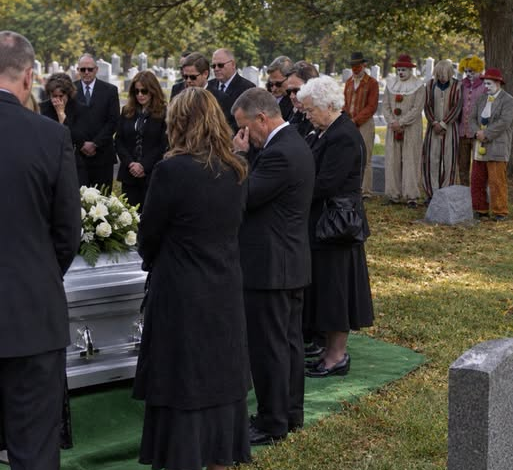
I spotted seven clowns near the cemetery fence.
“Ryan, are you seeing this?”
I’d posted the details on Facebook.
“Seven clowns?”
“At Dad’s funeral?”
“Maybe they’re at the wrong service.”
“Then why are they staring at his grave?”
None of them smiled.
Seven clowns?
My aunt leaned toward me. “Emily, did you hire entertainment?”
“For my father’s funeral?”
“I’m just asking.”
I turned toward Mom. “Do you know them?”
Her eyebrows lifted almost imperceptibly.
They’re at the wrong service.
Then she shook her head. “No, sweetheart.”
“Are you sure?”
“Of course.”
The clowns stood silently throughout the service.
When the mourners began leaving, they approached Dad’s grave.
Did you hire entertainment?
I couldn’t take it anymore.
“Excuse me!”
The tallest clown stopped. He was an older man with blue triangles painted beneath his eyes.
“Why are seven clowns attending my father’s funeral?”
“I’m Walter. Your father was our friend.”
They approached Dad’s grave.
“My father? The man who called rubber chickens an insult to poultry?”
“We knew him for many years.”
“Then why have I never met you?”
Walter hesitated.
“Thomas asked us to keep this private. He wanted you to discover his story yourself.”
Your father was our friend.
“Why?”
“He thought you’d understand better that way. And he made me promise not to explain everything here, at his funeral.”
“Told me what?”
He exchanged glances with the others.
Before I could respond, Walter removed a tiny dark-red box from his pocket.
He wanted you to discover his story yourself.
It was barely an inch wide.
He placed it among the flowers.
“What is that?”
“Something he left behind.”
“For whom?”
Walter removed a tiny dark-red box from his pocket.
“For you.”
Then all seven walked away.
“Wait! You can’t just leave that!”
Nobody turned around.
I followed them toward the parking lot, but they were already climbing into a white van.
Something he left behind.
I photographed the van’s license plate. There was a faded logo on the door, but I couldn’t make out the words.
Ryan caught up with me. “What’s happening?”
“I apparently missed the part of Dad’s life where he joined a circus.”
Mom appeared behind us.
“Emily, perhaps you should leave that box alone.”
You can’t just leave that!
I stared at her. “Seven strangers dressed as clowns just attended Dad’s funeral. We’re past leaving things alone.”
I returned to the grave and opened the box.
Inside was a miniature metal winding key.
Four numbers were engraved on its handle.
My birth year.
We’re past leaving things alone.
“Ryan,” I whispered, “why would Dad give strangers a key from the year I was born?”
And what did it open?
I showed Mom the key.
“Does this look familiar?”
She studied it. “Perhaps. Where did you find it?”
Inside was a miniature metal winding key.
“The clowns left it on Dad’s grave.”
Mom looked away.
“Emily, please. Not today.”
Then I noticed the tiny winding handle.
Suddenly, I remembered the dancing clown from my childhood.
What did it open?
Dad’s music box.
I hadn’t seen that music box since I moved out of my parents’ house.
Why had Dad sent me its key through seven strangers?
Was there something inside he wanted me to find?
***
An hour later, while relatives gathered at Mom’s house, I slipped into Dad’s study.
Dad’s music box.
His music box stood on the highest shelf.
I inserted the key. It fit perfectly.
The familiar melody filled the room, and the little clown began spinning.
Then I noticed the wooden base had shifted.
I turned the box over and discovered a hidden compartment.
Was there something inside he wanted me to find?
Inside, I found three things:
- Old photographs.
- Donation receipts.
- A worn notebook.
I called Ryan over. “Count the clowns.”
“Eight.”
“Recognize the seven from the funeral?”
I discovered a hidden compartment.
“Yeah. Who’s the eighth?”
I pointed.
“Your father?” my husband gasped.
“Wearing red shoes.”
“He looks miserable.”
Count the clowns.
“That’s his happy face.”
The receipts showed decades of donations to an organization I’d never heard of.
“Look at this.”
“Your dad in a clown costume?”
“Check the date.”
He looks miserable.
“June 2018.”
“Exactly. Why was he still dressing like that twenty-four years after I was born?”
“Maybe he enjoyed it?”
“Then why did he hide it from us?”
One sentence was underlined twice.
That’s his happy face.
‘I’m doing this to atone for my sin against them.’
“Ryan, what sin?”
“What?”
“Did Dad hurt someone?”
“Emily…”
One sentence was underlined twice.
“Was he supporting another family?”
“You don’t know that.”
“Then why did he write it?”
I searched online for the organization listed on the receipts.
Did Dad hurt someone?
The charity organized performances for children in hospitals and hospices.
Walter was listed as a founding member.
I called immediately.
“Hello, you’ve reached the charity office. Walter speaking.”
“It’s Emily. I found Dad’s photographs and notebook.”
Why did he write it?
Silence.
“I need answers, Walter.”
“Can you come tomorrow?”
“Only if you’re ready to tell me everything.”
“I am.”
I found Dad’s photographs and notebook.
***
That evening, Ryan found me studying Dad’s notebook.
“Maybe he just supported the charity,” he suggested.
“Then why hide it?”
“People keep things private.”
“Not thirty years of clown photographs.”
You’re ready to tell me everything.
He pointed toward another page. “What’s that?”
I read the sentence aloud.
‘She finally laughed. I was afraid I’d never hear that sound again.’
I stared at it. “Ryan, who was she?”
He didn’t answer.
And suddenly I wondered whether Dad had loved someone we knew nothing about.
People keep things private.
***
The following morning, Walter greeted me at the charity’s office.
The other six clowns sat around a table without makeup. They looked like ordinary retirees.
Somehow, that made everything stranger.
I spread the photographs and receipts across the table.
“Why was Dad sending you money for thirty years?”
I was afraid I’d never hear that sound again.
“He helped finance our programs,” Walter explained. “Without his support, this charity might not have survived.”
“Are you telling me Dad was some secret philanthropist?”
“In a manner of speaking.”
“And I found a photograph from 2018. Dad was still wearing that costume.”
Why was Dad sending you money for thirty years?
Walter glanced at the other men. “So you noticed.”
“Of course I noticed. What was he doing dressed like that twenty-four years later?”
“That’s something you’ll understand soon enough.”
“Then what’s this?”
I opened the notebook.
Dad was still wearing that costume.
“I’m doing this to atone for my sin against them. What did he do?”
Walter’s expression changed.
“Thomas believed he’d failed someone he loved.”
My throat tightened. “Another woman?”
Something you’ll understand soon.
“Oh, Emily. No.”
“Then who?”
Instead of answering, Walter retrieved an old photograph.
“Who’s that woman?” he asked, showing mea hospital photograph.
“Mom. She’s holding me.”
I’m doing this to atone for my sin against them.
“Look at her face.”
“She looks exhausted.”
“She was suffering, Emily.”
“From what?”
“Do you remember her ever discussing that year?”
She’s holding me.
“No. Why?”
He pulled out a chair. “Emily, there’s something you need to know about 1994.”
“What could possibly have happened that year besides my birth?”
“Your mother developed severe postpartum depression after you were born.”
She was suffering.
“How bad was it?”
“She barely spoke. Eventually, she began thinking about ending her life.”
I stared at him. “Dad knew?”
“Not at first.”
“Then what happened?”
There’s something you need to know about 1994.
“He realized she needed treatment and helped her get it.”
I looked at the photograph again.
Mom was holding me, but her expression was so empty I barely recognized her.
“Your father blamed himself for missing the signs,” Frank said.
I swallowed. “But where do the clowns come in?”
He realized she needed treatment.
“We performed at the hospital where Margaret was receiving treatment. Thomas watched one of our shows.”
“And?”
“He asked us to teach him.”
“Teach him what?”
Her expression was so empty.
“How to be a clown.”
“When was that?” I asked.
“1994. Just a few months after you were born.”
I looked down at the little key in my hand.
Dad had engraved my birth year on it.
He asked us to teach him.
“But we’re talking about my father, right? The man who organized his socks by color?”
Frank laughed.
“He arrived with a notebook, asking if there was a mathematical formula for making people laugh.”
Walter slid another photograph toward me.
Dad had engraved my birth year on it.
Dad stood in enormous red shoes, holding three juggling balls. Two were already on the floor.
“He was terrible at first,” Walter said. “But he practiced for months.”
I smiled through my tears. “That sounds like Dad.”
“He wanted to give Margaret something to smile about while she recovered. One evening, he performed at home, tripped over his shoes, and fell flat on his backside.”
Dad stood in enormous red shoes.
I looked at the ridiculous photograph.
“And Mom laughed?”
“For the first time in a long while.”
I pressed my fingers against my lips.
All those years, I’d thought Dad didn’t understand humor. He’d actually been learning it for someone he loved.
He practiced for months.
Walter pointed toward the photograph.
“That’s the woman your father was writing about.”
I touched Mom’s face. “Why didn’t he tell me?”
“Your parents wanted to leave that painful time behind. Thomas never liked taking credit for helping anyone.”
He’d actually been learning it for someone he loved.
“So he kept donating?”
“Yes. He was grateful to us and eventually helped expand our hospital programs.”
I leaned back, trying to take it all in.
“So that’s the secret. Dad became a clown to help Mom, and he kept supporting the people who taught him.”
“That’s how it started,” Walter said.
Thomas never liked taking credit for helping anyone.
I frowned. “What do you mean?”
He glanced at the other men.
“Emily, your father didn’t put away that costume when your mother recovered.”
“What are you saying? He kept performing?”
Dad became a clown to help Mom.
“For thirty years,” Walter said. “And not just for your mother.”
He reached beneath the table and pulled out a large album.
“Why didn’t he tell Mom?”
“He didn’t want to remind her of that painful time.”
“And me? I’m thirty-two, Walter.”
That’s how it started.
“He knew.”
“Then why keep it secret?”
“Because he didn’t want applause, Emily. He just wanted to help.”
He opened the album.
“Is that Dad in a children’s hospital?”
Not just for your mother.
“Yes.”
“With a rubber duck on his head?”
“His favorite trick.”
“And he’s measuring a teddy bear?”
“The children loved that.”
He just wanted to help.
I turned another page.
“Look at them, Walter. They’re all laughing.”
“That was why he kept coming back.”
“He performed under the name Mr. Serious,” Walter explained.
“Mr. Serious?”
The children loved that.
“He never smiled. That was his character. The grumpiest clown in the world.”
I started laughing through my tears.
“My father was a clown?”
“And he talked about you constantly,” Frank added.
“About me?”
He performed under the name Mr. Serious.
“He said his daughter was the funniest person he’d ever met. That she could make people laugh without even trying.”
I swallowed hard.
All those years, I’d wondered whether Dad was disappointed in me.
And he’d been proud of the very thing I thought he disliked.
The grumpiest clown in the world.
Walter closed the album.
“Your father learned something important, Emily. Laughter doesn’t erase suffering. Sometimes it just makes people feel less alone.”
I finally understood why Dad had called me his little clown.
And why he’d told me I didn’t always have to laugh.
His daughter was the funniest person.
***
I went straight to Mom’s house and showed her the photographs.
“You knew Dad was a clown?”
“Only that he performed for me years ago.”
“And your depression?”
“We didn’t want you feeling responsible.”
Dad had called me his little clown.
“Did you know he kept performing in hospitals?”
Mom stared at the photographs.
“No. He told me he’d stopped.”
She touched Dad’s picture.
“Mr. Serious? That sounds like him.”
We didn’t want you feeling responsible.
“Did he really make you laugh?”
“He tripped over his shoes and knocked over a laundry basket. Then he held my hand while I cried.”
“He didn’t try to cheer you up?”
“He just stayed.”
For once, I didn’t make a joke. I hugged her, and we cried together.
That sounds like him.
***
Two weeks later, I began volunteering for the charity.
During a hospital visit, a little boy noticed Dad’s yellow clown jacket. “Why are you sad?”
“I miss my dad.”
“I miss my grandpa too. Want to sit with me?”
I took his hand.
I didn’t make a joke.
Later, I told Walter, “We should offer quiet visits too. Some kids just need company.”
“Your father would love that.”
I smiled, remembering Dad’s words.
‘You don’t always have to laugh, sweetheart.’
I’d finally understood.
Sometimes love means making someone laugh. Other times, it means simply holding their hand.