My Daughter Died Giving Birth, and I Raised Her Son Alone — Ten Years Later, a Woman at Her Grave Handed Me a Letter
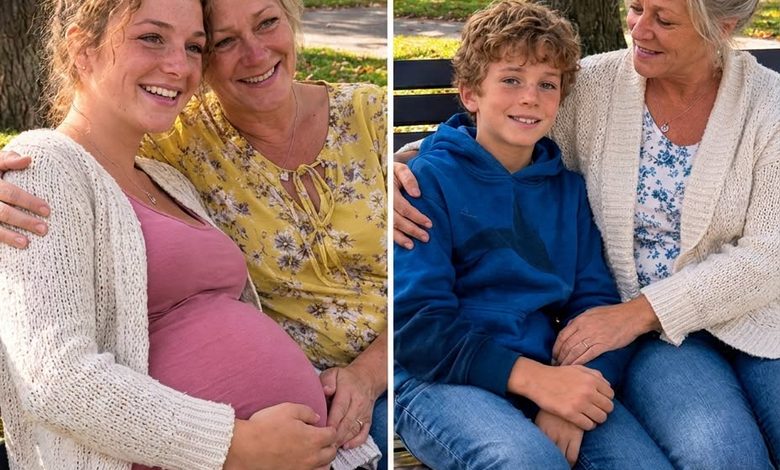
“I made your daughter a promise,” the woman said beside Teagan’s grave, holding out a sealed envelope with my name written across the front in handwriting I had not seen for ten years. My fingers tightened around the flowers I was carrying as I stared at the familiar loops and slant of my daughter’s pen. “She gave this to me the day Lucas was born,” the woman added. Before I could ask anything else, my grandson shouted from the bottom of the hill and came running toward us with a birthday card he had made for the mother he never knew. The stranger introduced herself as Trudy, one of the nurses who had cared for Teagan during labor, then pressed the envelope into my hand. “Don’t open it in front of him,” she whispered. By the time Lucas reached me, Trudy was already walking away, leaving behind a secret that had been waiting a decade to be opened.
Teagan had been eighteen when she became pregnant, and every conversation between us seemed to circle back to the father she refused to name. I had pushed for answers because I thought answers were what a mother was supposed to demand; Teagan kept telling me she could handle things herself. Then Lucas was born and a physician came into the waiting room with the sentence every parent fears: my daughter had died from complications surrounding childbirth, while her baby had survived. I took Lucas home and raised him alone. For ten years he grew into a baseball-loving boy who asked the same question every child eventually asks when half his story is missing: “Who was my dad?” That night, after Lucas went to bed, I opened Teagan’s envelope and found a photograph of her beside a teenage boy holding an old baseball glove. Her letter said he knew about the pregnancy and had wanted to stay, but his family had convinced him that a baby would destroy his future. Teagan had told him not to return until staying was his own decision. Then she wrote the sentence that broke me: “You kept asking me who he was, but you never asked why I was scared.”
When I confronted Trudy, she admitted that the young man had come to the hospital after Teagan died. He had seen me leaving with Lucas, panicked, and walked away. Trudy had kept the letter because she convinced herself that giving it to me immediately would only deepen my grief; after retiring, she finally admitted that she had made a choice that was never hers to make. I searched through Teagan’s old belongings until I found the boy’s first name in a school program and eventually located him. His first reply contained one word: “Lucas?” When we met, he admitted that he had known about his son, that he had come to the hospital ready to defy his parents, and that seeing me carrying the newborn after learning Teagan had died frightened him back into silence. I told him fear might explain what an eighteen-year-old did on one terrible day, but it could not explain ten years. He did not argue. “Every year I told myself I’d waited too long,” he said. “And every year that excuse became easier.”