My Wife’s Last Words Sent Me Searching for the Woman Who Broke My Heart 40 Years Ago—What I Found Brought Me to Tears
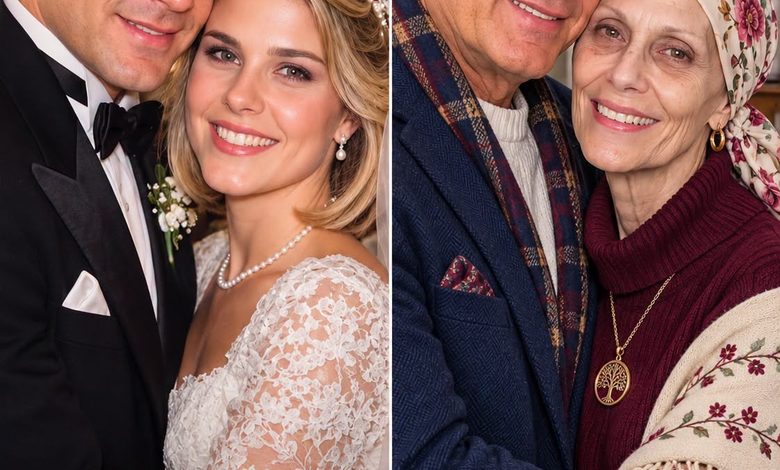
Part 1: The Promise in Room 214
The hospital room smelled of antiseptic and the faint lavender lotion Carol had carried in her purse for as long as I had known her. I sat beside her bed holding her hand while the machines kept their slow rhythm. I could not believe that thirty-six years of marriage had come down to one small room and one narrow window overlooking a parking lot.
Two days earlier, the doctor had walked me into the hallway and spoken gently about how far the illness had spread. Most of his words dissolved before they reached me. Only the ones that mattered stayed: nothing more could be done except to keep her comfortable.
Carol had come into my life when I was still carrying the wreckage of another heartbreak. She never demanded explanations or tried to hurry my healing. She simply stayed close, steady as a porch light, until one day I realized I had fallen in love with her.
When I met her in 1989, she was a single woman raising a three-year-old girl named Rebecca. Carol had told me early on that she could never have children of her own, and that Rebecca had come to her through a private adoption. I never asked more. A little girl with serious green eyes handed me a crayon drawing of a horse on our second meeting. By the time Carol and I married in the spring of 1990, I was already Rebecca’s father in every way that counted. The papers only made it official.
Now Carol opened her eyes and turned her head toward me. The scarf she wore over her thinning hair had slipped a little, and I tucked it back into place the way I had done every morning that week.
“Do you remember Sunday breakfasts when Rebecca was little?” she asked.
I smiled despite the ache in my chest. “Cinnamon pancakes. She sat on the counter cracking eggs, and half the shell always ended up in the bowl.”
Her mouth lifted slightly. “She looked so much like me back then.”
“She still does.”
People in Millfield had always said our daughter had Carol’s face. Rebecca’s bright green eyes, though, never seemed to come from either of us. When I mentioned them, Carol would look away. I always assumed she was just tired.
A few minutes passed. A cart rattled in the corridor, and somewhere a television murmured. Then her fingers tightened around mine with surprising strength.
“Walt, have I been a good wife to you?”
The question startled me. After thirty-six years, I thought she knew the answer better than anyone alive. I told her she was the best thing that had ever happened to me, and tears filled her eyes at once.
“I need you to promise me something. Say yes before I tell you what it is.”
I never thought to hesitate. “Anything.”
Carol drew a slow breath. When she spoke again, her voice was weak, but every word came out clear.
“Find Anna. Please. You’ll understand everything once you find her. And Walt… forgive me in advance.”
The name struck me harder than anything the doctor had said.
Anna Brooks had been my first love. In the summer of 1985 I had asked her to marry me, and I had been certain she would say yes. Instead, a few weeks after I moved to Columbus for work, I received a letter. She wrote that she could not follow me, that she did not love me enough, and that I should never come looking for her.
For forty years I had believed every word.
“What does Anna have to do with us?” I whispered. “What am I supposed to forgive?”
Carol only shook her head, her eyes closing. Before I could ask again, a nurse came in with a soft apology and told me Carol needed rest.
Three days later, Carol died, early in the morning, with my hand in hers and the first gray light touching the window.
For two weeks after the funeral, I tried to convince myself that medication and exhaustion had muddled her last words. Rebecca, who lived an hour away in Columbus with her husband and their two boys, called every evening to check on me. I told her I was fine. I did not tell her about Anna.
But every night, in the dark of our bedroom, I heard the same two words.
Find Anna.
At last I began making calls. A former college classmate gave me the number of a woman named Diane, who had once been Anna’s closest friend. Diane refused to talk to me at first and hung up. A week later she called back and gave me an address in Pittsburgh and a phone number, along with a warning to be gentle.
I sat at the kitchen table for an hour with the phone in my hand. Then I dialed.
“Hello?”
After four decades, I knew that voice at once.
“Anna? It’s Walter. Walter Hayes.”
The silence on the line stretched so long I thought the call had dropped. Then, barely above a whisper, she said my name.
“Walter. My God.”
I told her Carol had died and that finding her had been Carol’s last request. I heard Anna draw a shaky breath.
“Don’t say anything more over the phone,” she said. “Please come in person. Carol wrote to me once, fifteen years ago, and I never answered her. I think it’s time you heard why.”
Part 2: What Anna Had Carried
On Saturday morning, I drove four hours to Pittsburgh with Carol’s wedding ring in my coat pocket and more questions than I knew how to ask. I sat outside Anna’s small brick house for nearly an hour before I made myself walk to the door.
When she opened it, I knew her at once, despite the silver in her hair and the years written across her face. Her eyes were exactly as I remembered, bright green and quietly watchful. Something about them struck me as strangely familiar in a way I could not place.
“Walter.”
“Anna.”
She stepped back and let me in. Her living room was tidy and warm, with framed photographs of nieces and nephews on a bookshelf. She poured coffee with hands that trembled slightly, and we sat across from each other like two people about to read a verdict.
“Carol asked me to find you,” I said. “She wouldn’t say why. She only said I would understand once I did.”
Anna held my gaze. “Then I’ll tell you what I wish someone had told you forty years ago. I never left you because you moved away.”
My chest tightened. For decades I had kept her letter in a shoebox, reading it so many times that the folds had worn through.
“Then why did you write it?”
“Because your mother came to see me.”
I stared at her. “My mother?”
Anna nodded. Two days before I left for Columbus, Ruth Hayes had visited Anna’s apartment wearing her best church dress and her pearl brooch. She had been polite and almost kind. She had sat on the sofa and explained that Anna was not suitable for her son, that a girl from Anna’s family would only hold me back.
“She didn’t stop at insults,” Anna said quietly. “She told me my father could lose his job at the plant. She had friends on the board. And she said that my sister’s wedding was only months away, and that a family’s reputation in a small town could be a fragile thing.”
“My mother did that?”
“Your mother had power, Walter. She used it on a twenty-year-old girl whose family had almost none.”
I wanted to argue. Everyone in Millfield had admired Ruth. She taught Sunday school for thirty years, brought casseroles to grieving families, and sat with the dying. I could not picture her threatening anyone.
But I could picture Anna at twenty, afraid and cornered, because I remembered how she bit her lip when she was afraid.
“I wrote the letter that same night,” Anna said. “I cried through every line. I made it cruel on purpose, because I knew if it sounded loving, you would come back and I would give in.”
My voice came out rough. “You were protecting your family.”
“And losing you,” she answered.
We sat in silence while the coffee cooled. I asked her whether she had ever married. She shook her head slowly.
“No. There was never anyone else I could imagine that life with.”
The answer hurt, but what came next changed everything.
“Three weeks after I sent that letter, I found out I was pregnant.”
I felt as though the floor had tilted. “You were pregnant?”
“Yes.”
Forty years of regret rearranged themselves around a possibility I had never known existed. I had lost Anna without understanding why. Somewhere in that same history, there had also been a child.
“What happened to the baby?”
Anna turned her face toward the window. “I gave her up.”
She told me she had been twenty, frightened, and alone. She had gone to Ruth’s house in the autumn, hoping the baby would change things. Instead, Ruth had listened with a calm face and repeated her warnings. She had said that a child would only ruin two lives, that I had already moved on, and that the kindest thing was to let the baby go to a good family. Anna’s family had little money and less courage. A woman named Marjorie, a friend of Ruth’s, had arranged everything privately.
“I never even saw her face,” Anna whispered. “They told me it would be easier that way.”
“Anna, I didn’t know. I swear to you, I never knew.”
“I know that now.” She finally looked at me. “Your mother told me something else that day, and it’s the part I think Carol wanted you to hear.”
“What?”
“She said you were already with someone else.”
“With who?”
“Carol.”
The room seemed to narrow around me.
“That’s not true,” I said. “I barely knew Carol then. She was a girl from church who helped my mother with the flower committee.”
“I know it wasn’t true,” Anna said. “But Walter, there’s more.” She hesitated. “Carol was there that day, in your mother’s kitchen. She heard every word.”
Part 3: The Box in the Attic
Anna told me Carol had tracked her down about fifteen years earlier through her sister and had written her a letter. Anna never answered it. But the letter had confirmed what I was only beginning to understand: Carol had known the truth about our separation for decades.
I tried to reconcile that with the woman I had loved for thirty-six years. Carol had watched me believe Anna abandoned me. She had married me carrying that secret. She had never corrected the story until she was dying.
“I’m not telling you this so you’ll hate her,” Anna said gently. “I’m telling you because she sent you here. I think she wanted you to finally know.”
I asked whether Anna had ever searched for the daughter she had surrendered. She told me the adoption had been completely closed. She had no family name, no address, and no way to begin.
Then a thought crept in, cold and quiet. If my mother had controlled Anna’s access to me, had pressured her through the pregnancy, and had a friend arrange the adoption, then Ruth had likely kept records. Ruth kept records of everything, from church budgets to grocery receipts.
“I think my mother handled it,” I said.
“Why do you think that?”
“Because if anyone kept proof, she did.”
I drove home that afternoon with one thought circling my mind. Carol had asked me to forgive her, which meant there was something she believed I had not yet discovered.
By dawn the next morning, I was climbing the pull-down stairs into the attic of my mother’s old house. Ruth had been gone six years, and I had never been able to sell the place. Dust drifted in the pale light from the vent. I moved boxes of Christmas decorations and church bulletins until, near the bottom of an old cedar trunk, I found a shoebox sealed with brittle tape. On the lid, in my mother’s firm handwriting, were the words PRIVATE. DO NOT OPEN.
I sat on the attic floor and opened it.
Inside was a bundle of letters tied with kitchen string. They were exchanges between Ruth and a woman named Marjorie. The earliest described a young pregnant woman who had arrived nearly six months along and kept asking whether Walter knew about the baby.
Ruth’s reply was written in blue ink I knew well. She instructed Marjorie to assure the girl that contacting me would only make everything worse. A later letter confirmed that the papers had finally been signed, because the girl believed I had begun a new life.
My hands were shaking when I turned the next page. It mentioned a local woman who wished to adopt privately and quietly.
Then I saw the name.
Carol.
According to the letter, Carol had been especially eager. She was unmarried and unable to bear children. Ruth had arranged everything and told everyone to keep it discreet. I had been told only that Carol’s adopted daughter came from a closed adoption and that the birth mother wished to remain unknown.
For a long moment, the words stopped making sense. Then an image rose in my mind: Rebecca at three, offering me a crayon drawing of a horse. Her green eyes were watching me, serious and hopeful. Beside it, as clear as a photograph, rose the face of Anna opening her front door.
Rebecca had Anna’s eyes.
The little girl I had raised for nearly four decades was not simply a child who had come to Carol by chance. She was the daughter Anna had given birth to in 1986. She was my daughter by blood as well as by love, and my mother had arranged all of it.
I kept digging, my heart pounding. At the bottom of the box lay another envelope in handwriting I knew better than my own. Carol had addressed it to my mother.
I unfolded the letter with stiff fingers.
“I can’t keep doing this. Walter still believes Anna left because she stopped loving him. I heard what you said to her that day, and I should have told him then.”
Carol wrote that she had stayed silent because she was afraid I would run to Anna if I ever learned the truth. She wrote that once the baby came into her arms, she could no longer believe what they had done was right.
“If Walter ever learns the truth, he will never forgive either of us.”
Beneath Carol’s letter, in my mother’s handwriting, were four words.
“Then make sure he doesn’t.”
I leaned against the attic wall surrounded by forty years of secrets and finally understood Carol’s last request. She had not only known why Anna disappeared. She had raised our biological daughter while allowing Anna and me to believe we had lost her forever.
I do not know how long I sat there. The light shifted across the beams. Eventually, my phone buzzed in my pocket and Rebecca’s name appeared on the screen.
I almost let it ring. Then I answered, trying to steady my voice.
“Dad? Where are you? I’m at the house in Millfield, going through Mom’s things like we planned.” She hesitated. “I found a sewing box in the back of her closet. There’s an envelope inside with both our names on it. And Dad… under it there’s another one, and it says Anna.”
Part 4: The Truth We Chose
I do not remember driving from my mother’s house to mine. I remember the shoebox on the passenger seat, and I remember how my hands felt on the steering wheel. When I pulled into the driveway, Rebecca’s car was already there.
She was at the kitchen table, Carol’s old sewing box open in front of her. Spools of thread and a pincushion shaped like a tomato sat beside two sealed envelopes. When she looked up, her green eyes were red from crying. Even then, I realized how much of Anna I had been seeing in her for forty years without knowing it.
“Dad, what’s going on? Mom wrote on the front, ‘For Walter and Rebecca. Open together.’ I haven’t touched it. But who is Anna?”
I sat down across from her and set the shoebox between us. I had rehearsed the words in the car and they all fell apart. So I said it the only way I could, plainly and without softening it.
“Rebecca, Anna is the woman I loved before your mother. She’s your biological mother. And I’m your biological father.”
She stared at me as though I had begun speaking another language. I slid the letters toward her and told her to read them, because anything I said would sound impossible without proof.
She read slowly. By the second letter her hands were shaking. By the fourth she had pressed her palm over her mouth.
“Mom knew,” she whispered. “She knew who you were. She knew the whole time.”
“Yes.”
“And Grandma Ruth…” Her voice cracked. “She arranged all of it?”
“She did. Rebecca, I didn’t know. Until this morning, I didn’t know any of it.”
She believed me, I could see that. She wiped her face with the back of her hand, the same way she had at five when she scraped her knee. Then she asked the question I had been dreading.
“Was Mom trying to protect me?”
“Maybe at first,” I said. “But after enough years went by, I think she was protecting herself too.”
“Did she love me?”
Of all the things I had learned that week, no accusation could have hurt more than that question. There was no hesitation in my answer, because I had witnessed that love every single day of Rebecca’s life.
“Every single day.”
She nodded, tears falling freely now. For a while neither of us spoke. Outside, a neighbor’s lawn mower hummed. Inside, our family history lay open on the table, rewritten by people who were no longer alive to explain themselves.
Finally, Rebecca pushed the sewing-box envelope into the center of the table. “Mom said to open it together.”
I broke the seal. Inside were three pages in Carol’s careful handwriting, slanting a little more than usual, as though written in a weak hour.
“My dearest Walter and Rebecca,
If you are reading this, then Walter has found Anna, and I am gone. I am so sorry. I let a lie start in a kitchen when I was twenty-four years old, and I was too afraid to undo it. Every year I waited, it grew heavier.
Rebecca, you were the best thing I ever did, even if I did it the wrong way. I held you in 1986 and I loved you before I understood what it had cost another woman. Walter, I loved you honestly, even though I kept a secret. Both things are true, and I need you to know that.
I do not ask you to forgive me quickly. I ask you only to be kinder to each other than we were to Anna. Please tell her I am sorry. Please tell her that her daughter grew up loved, laughed often, and was never alone.”
Rebecca was crying so hard she had to put the page down. I reached across the table and took her hand.
“I’m furious with her,” she said. “And I miss her so much I can hardly breathe.”
“I know,” I said. “Both things can be true. It took me a long time to understand that, but pretending one erases the other would only create another lie.”
She looked at the second envelope, the one marked Anna in Carol’s handwriting. “Does she know about me? About the boys?”
“She knows I found you. I haven’t told her much more. I wanted you to decide how much she hears, and when. I am not going to be another person deciding what’s best for someone else.”
Rebecca studied my face. “You’re really okay with that? With me meeting her? Even after everything with Mom?”
“I’ve had enough people deciding what’s best for someone else.”
She squeezed my hand. “So have I.”
That night I called Anna. She answered on the first ring, as though she had been sitting beside the phone for two days. I told her everything slowly: the attic, the letters, the name Rebecca, the two grandsons. I heard her cry, and then laugh through the crying, and then cry again. When I told her Rebecca wanted to meet her, she was quiet for so long I thought the line had gone dead.
“Does she want to?” Anna finally whispered.
“More than anything.”
Two weeks later, on a gray Saturday morning, Rebecca and I stood on Anna’s front porch in Pittsburgh. My daughter held Carol’s letter to Anna in one hand and a small photograph of her sons in the other. Her fingers were trembling. In my coat pocket was Carol’s wedding ring, which I had decided I would keep, not as a burden but as a reminder of everything she had been and everything she had hidden.
I did not knock. I let Rebecca do it.
The door opened. Anna stood there in a plum cardigan, her silver hair neatly brushed, her hands pressed together as if she did not trust them to stay still. For a moment the two of them simply looked at each other. The same green eyes met across forty years of silence.
“Hello,” Rebecca said softly. “I think you’re my mother.”
Anna’s face crumpled. She opened her arms, and Rebecca walked into them as though she had been walking toward that doorway her entire life.
I stood back on the porch, tears blurring the morning, and understood at last what Carol had been trying to give us. She had not been able to say the truth aloud, so she had sent me out to find it. Ruth had decided what Anna could know, and Carol had decided what I could know. Their choices had shaped four lives through silence.
I would not continue that inheritance.
Thirty-six years of marriage did not vanish because I finally understood what Carol hid from me. Neither did my grief, my anger, or the love that remained after both. What changed was simpler. I would never again mistake silence for protection.
As Rebecca and Anna held each other in the doorway, Anna looked over her daughter’s shoulder and met my eyes. She mouthed two words, and they were the same two Carol had whispered in that hospital room, only now they meant something different.
“Thank you.”
I nodded, and for the first time since the funeral, I felt Carol’s hand in mine again, not in sorrow, but in peace.
Disclaimer: This story is a work of fiction inspired by real-life themes. Names, characters, places and events are fictionalized, and any resemblance to real persons is purely coincidental. Images are for illustration purposes only.