My Soldier Husband Came Home After 18 Months and Told Our Daughter, “I Kept My Promise”—But He Had Never Met Her
Part 1: The Promise I Knew Nothing About
“Daddy kept his promise, sweetheart.”
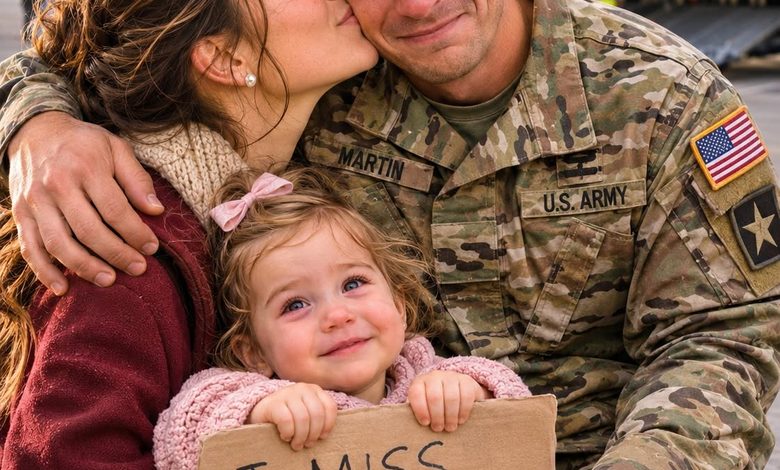
My husband whispered those words to our sixteen-month-old daughter at the airport, just minutes after holding her for the first time.
I was still crying from the relief of seeing him home. Then he reached into his uniform pocket and placed a little wooden plaque in my hands. Two names had been carved into the smooth surface: Willa & Grace. A small heart joined them.
And suddenly, the happiest day of my life became a day I could barely understand.
“Martin,” I whispered, “who made this?”
His expression changed. He looked down at Willa, who was investigating a button on his jacket, and then back at me.
“Someone who wanted her little sister to have it.”
My heart gave a painful thud.
Grace was my older daughter. She was nine. And I hadn’t seen her in almost three years.
I ran my thumb over the first letter of her name. The G leaned strangely to one side, just as it had on the wooden signs she used to make with me.
“Did Grace carve this?”
Martin nodded.
For a moment, the airport disappeared around me. I could hear people calling greetings, luggage wheels rattling across the floor, a baby crying somewhere behind us. But all I could see was that crooked letter.
“Please tell me what’s going on,” I said.
Martin held Willa a little closer. “I will. All of it. But can we sit down first?”
Eighteen months earlier, I had kissed him goodbye when I was seven months pregnant. His overseas deployment was supposed to end before our baby reached six months. Instead, the date kept moving. He missed Willa’s birth, her first Christmas, and the day she took her first wobbly steps across our living room.
I tried to make each milestone feel smaller when I told him about it. It seemed cruel to describe the wonderful things he couldn’t be there to see.
“She took her first steps today,” I told him during a call.
“Already? I can’t believe I missed that too.”
“You’ll see the next thousand.”
He smiled, but his eyes stayed sad. “I missed her birth, her first smile, her first Christmas. I’m missing everything.”
Before every video call, I held Willa up to his photograph.
“See this handsome guy? That’s Daddy.”
“Dada!” she would announce, sometimes while pointing at the dog next door instead.
On particularly hard evenings, I sat at my laptop after Willa finally fell asleep and tried to finish work. Once I dozed off while Martin was still talking.
“Emily? Honey, wake up.”
“I’m awake.”
“You’re drooling on your keyboard.”
“That’s how I water it.”
He laughed, then asked more softly, “Are you okay?”
I always told him we were fine. I didn’t tell him how often I stood outside the closed door of my workshop, unable to make myself go inside.
Woodworking had once been my favorite thing in the world. Now an unfinished dollhouse sat beneath a sheet in that room, gathering dust. It had been waiting for someone longer than Martin had been away.
When his final message arrived—I’m coming home. No more extensions.—I cried so hard I could hardly answer.
At the airport, I’d bundled Willa into a pink snowsuit and handed her a sign that read I miss you, Daddy. She promptly tried to eat one corner.
Then Martin appeared. He dropped his bag, wrapped me in his arms, and lifted the little girl he’d known only through a screen.
“Hey, baby girl. It’s Daddy.”
She studied his face and grabbed his collar as though testing whether he was real.
He kissed the top of her head. “Daddy kept his promise, sweetheart.”
I laughed through my tears. “What promise? Honey, you’ve never even met her!”
But he didn’t laugh. He gave me the plaque instead.
And now, seated on a bench near the airport windows, I was looking at the handwriting of the daughter I feared I had lost.
“Martin,” I asked, “have you been talking to Grace without telling me?”
“Yes,” he said. “For the last few months.”
I felt both gratitude and hurt rise inside me. “Then you know something I’ve been desperate to know for years.”
He nodded slowly. “I know she still thinks about you, Emily. And I know she’s been afraid to tell you.”
Afraid of me?
I looked at the little wooden heart between my daughters’ names, and I realized the plaque wasn’t the real mystery. The real mystery was what Grace believed would happen if she reached for her mother again.
Part 2: The Saturdays I Stopped Keeping
To understand why a wooden plaque could break my heart, you have to know what happened before Willa was born.
Grace was five when her father, Daniel, and I divorced. Our marriage had become a place where every disagreement turned into a contest over who loved our family more. Daniel was possessive, and when I finally said I wanted to leave, he took it as proof that I was abandoning everything we’d built.
“You’re destroying our family, Emily!” he shouted.
I told him that ending our marriage wasn’t the same thing as ending our responsibilities as parents. We agreed to share legal custody, and at first Grace lived primarily with me while spending regular time with him.
For a while, it worked. Our home was small, but every Saturday the workshop belonged to the two of us.
I taught Grace how to sand a rough wooden edge until it felt soft under her fingers. She chose paint colors that shouldn’t have looked good together and somehow made them beautiful. She insisted that every dollhouse needed more windows because “people deserve to see the stars.”
One afternoon, she put her hands on her hips and announced, “Mommy, can we build a castle?”
“We built one last week.”
“Then this one needs a dragon.”
“Where am I supposed to find a dragon?”
“You’re the grown-up. Figure it out.”
We laughed so hard that I had to sit down on the floor.
Those were the Saturdays I should have protected.
When Grace was six, I met Martin. He was patient, funny, and careful not to step into the role of father when Grace already had one. He asked before joining our family outings. He listened to her descriptions of every wooden castle. Once, when a shelf collapsed in my workshop, he spent an entire afternoon fixing it without asking to be thanked.
Grace liked him. That made me hopeful—and careless.
I began treating our weekends as though the time could always be rearranged. When Martin and I made plans, I told Grace we’d build something on Sunday instead. When Sunday became busy, I promised the following week.
“Mommy, can we finish the dollhouse?” she asked one Saturday.
“Not today, sweetheart. Martin and I already have plans.”
“What about tomorrow?”
“Of course.”
Tomorrow came, and I canceled again.
It wasn’t because I loved Martin more. It was because I foolishly assumed my little girl would understand that adults were busy, that relationships required attention, and that there would always be another Saturday.
Children hear a canceled promise differently. They don’t hear the reasons. They hear that something else came first.
Then came Grace’s school performance.
She’d spent days practicing a song and working on a small wooden surprise in her classroom’s craft corner. At breakfast, she bounced beside my chair.
“I made you something,” she said.
“What?”
“You’ll see afterward.”
“I’ll be there.”
“Promise?”
“Promise.”
That afternoon, a work deadline turned urgent. I convinced myself I could finish in thirty minutes, drive quickly, and still make the final song. But one problem led to another. I didn’t call the school or Daniel until it was already too late.
By the time I arrived, the auditorium was empty. Grace stood beside her father near the exit, clutching a little wooden object behind her back.
“Sweetheart, I’m sorry.”
“You missed it.”
“I know.”
“Everybody else’s mom was there.”
I tried to see what she’d made. “Can I look at your surprise?”
She drew her hands farther behind her.
“No.”
I reached toward her, but she stepped back.
“Grace, please. I’ll make it up to you.”
“You always say that.”
I remember the quiet ride home more clearly than the argument with Daniel afterward. He accused me of caring more about my new relationship than our daughter. I defended myself by listing every bill I’d paid, every appointment I’d attended, every lunch I’d packed.
None of those things answered Grace’s question: Why hadn’t I been there when she needed me?
A few weeks later, she asked to stay with Daniel.
“Just for a while?” I asked.
She nodded without looking up.
I agreed because I thought some breathing room would help. I packed her favorite pajamas, her drawing supplies, and the stuffed bear she’d slept with since preschool. I slipped a note into the side pocket of her bag: I love you. Our Saturdays are waiting whenever you are.
At first we spoke on the phone. But the calls grew shorter. Some went unanswered. When I asked Daniel whether something was wrong, he said she needed space.
One evening, Grace finally answered and said, “You have your new family now. You don’t need me anymore.”
“Grace, that’s not true.”
“You like Martin more.”
“Sweetheart, I love you.”
“Then why weren’t you there?”
She ended the call before I could answer.
I drove to Daniel’s house twice, hoping she would agree to see me. Both times he said she didn’t want to come outside. After the second visit, he told me she’d cried for an hour.
I began to fear that every attempt to reach her was hurting her again. Daniel told me not to push. I let my guilt persuade me that waiting was kindness.
But I didn’t stop trying altogether. I sent cards, letters, and small gifts. I kept the workshop exactly as we’d left it. When Martin asked whether I’d finished the dollhouse, I told him I hadn’t touched it in almost three years.
The truth was I couldn’t bear the thought of finishing it without Grace.
What I didn’t know was that while I waited for my daughter to forgive me, someone was making sure she never saw how hard I was trying.
Part 3: The Messages We Were Never Supposed to See
By the time Martin left for his deployment, Grace and I had been drifting apart for more than a year. I was seven months pregnant with Willa, hopeful about the baby and quietly ashamed that I couldn’t talk about my older daughter without crying.
After Willa was born, I took photographs of her tiny hands and wondered whether her sister would ever want to hold them. I bought two matching children’s books at a shop one afternoon, then sat in my car for ten minutes because I didn’t know where to send Grace’s copy.
I sent it anyway, with a note: You will always have a place beside me.
Daniel acknowledged receiving the package. He wouldn’t tell me whether Grace had opened it.
“She got it, Emily. Stop interrogating me,” he said.
I was tired. Raising a baby largely alone while working from home demanded more energy than I knew I had. Sometimes I didn’t trust my judgment. Perhaps Daniel really was shielding Grace from another disappointment. Perhaps my apologies had started to sound like excuses to her.
When Martin called, I gave him cheerful updates about banana purée and sleep schedules. Whenever he mentioned Grace, I changed the subject because I couldn’t explain why trying to do the right thing felt so much like surrender.
What I learned on the airport bench was that Grace had been asking questions of her own.
“A few months ago,” Martin said, “she found my contact information on an old family tablet she’d taken with her to Daniel’s place. I was still saved under my name.”
He showed me the earliest message he had kept.
Hi Martin. This is Grace. Please don’t tell Mom yet. Is it true I have a baby sister?
I read it twice.
“Why would she need to ask you that?”
“She’d overheard her dad talking about Willa. She wasn’t sure what to believe.”
Martin had answered carefully. Yes, she had a sister. Her name was Willa. She was loved, and Grace was still part of our family. With Grace’s permission, he sent a few pictures of Willa laughing in her high chair.
Grace sent back a drawing of a rabbit. Then another message.
Does Mom ever talk about me?
Martin told her the truth—that I still kept her drawings on the refrigerator and hadn’t finished the dollhouse because I wanted to do it with her.
Grace replied the following day.
Dad says she’s too busy and doesn’t want me bothering her.

I stared at the screen until the words blurred.
“Did you ask her to call me?”
“Several times,” Martin said. “She said she was scared you’d be angry. I couldn’t understand it either.”
“Why didn’t you tell me she was writing?”
He put his phone down. “Because she begged me not to. I told her I couldn’t keep her safety a secret, and I encouraged her to speak to a trusted adult. But she wasn’t in immediate danger. She was frightened of being rejected, and I thought earning her trust might help her find her way back to you.”
I could see the care behind his decision. I could also feel the sting of being excluded from news about my own child.
“You should have told me,” I said.
“Maybe I should have. I’m sorry. I was afraid she’d stop reaching out to anyone.”
He didn’t try to win the argument. He sat quietly while I read the rest.
Grace had told him about a school craft project. She was making a plaque with her name and Willa’s linked by a heart. A teacher had helped her package and mail it to the address Martin provided. His unit’s mail service delivered it weeks before he returned home.
Can you give this to my sister when you get back? she’d written.
I promise, he had replied.
Now I understood the words he’d whispered at the airport. He hadn’t been promising Willa something she’d asked for. He had been keeping a promise to the sister she didn’t yet know.
Near the end of their messages, Grace wrote:
You can show Mom the plaque. But please don’t tell her I’m bad for asking about Willa.
My hand went cold.
“Bad?” I whispered.
Martin nodded grimly. “She wouldn’t explain why she thought that.”
The final message was shorter.
Tell Mom I still remember how to make things.
I pressed the plaque to my chest.
All those months, I had thought the silence belonged to Grace. Now I knew she had been searching for a way through it. And I had to find out who had taught her that wanting her mother was something to be ashamed of.
Part 4: The Letters Neither of Us Received
That night, after Willa fell asleep, I laid out everything I had saved: birthday cards, postage receipts, photographs, copies of letters, and the little book I had mailed to Grace after Willa was born.
For three years, I had looked at those things as evidence of my own inadequacy. They reminded me of what I hadn’t managed to repair. Now they might help explain something neither Grace nor I understood.
Martin sat beside me. “What do you want to do?”
“Talk to my daughter,” I said. “And this time, I won’t let someone else tell me what she’s thinking.”
The next morning, I called Grace’s school. I didn’t ask the counselor to take sides. I explained that I shared legal custody, had been having difficulty communicating, and wanted to know whether a supported conversation would be possible. The office checked the custody information on file. The counselor agreed to ask Grace privately whether she wanted to meet me, without requiring her to say yes.
Two hours later, the counselor called back.
“She said yes.”
I had to sit down.
That afternoon, I waited in a small office after school. The counselor remained nearby, and when the door opened, I nearly forgot how to breathe.
Grace had grown taller. Her hair was tied back with a blue ribbon, and she wore a sweater I didn’t recognize. But when she looked at me, I saw the same serious eyes that used to inspect every crooked dollhouse window.
“Mom?”
“Hi, sweetheart.”
She stopped just inside the doorway. “Does Dad know you’re here?”
“Not yet. Why?”
Her fingers tightened around the straps of her backpack.
“Am I in trouble?”
“Of course not.”
“Dad said you’d get angry if I tried to see you.”
I felt my stomach drop. “Grace, I never said that.”
She looked at the counselor and then at me.
“He said you left because you wanted Martin. And when the baby came, you wouldn’t have time for me.”
I wanted to demand how Daniel could say those things. Instead, I looked at my child, who was watching my face as though one wrong word might confirm everything she’d been told.
“I did make mistakes,” I said. “I missed things that mattered to you. I broke promises, and I am sorry. But I never stopped being your mom, and I never stopped wanting you.”
She blinked rapidly.
“I wrote you letters.”
The words were almost too quiet to hear.
“What letters?”
“For your birthday. And Christmas. And when I got an award for reading.”
“I never received them, sweetheart.”
“Dad said you didn’t answer because you were busy.”
“I would have answered every single one.”
“Really?”
“Every one.”
She opened her backpack and pulled out a folded sheet of paper. It was a copy of her school award. On the back she’d drawn a woman and a little girl standing beside a wooden castle.
“I was going to send this one,” she said. “Then I thought maybe you didn’t want it.”
I put my hand over my mouth for a moment, afraid my tears would frighten her.
“I want it,” I said. “I want to hear about every book you read and every award you earn. Even the boring days. Especially those.”
We sat down. The counselor stayed within sight but gave us room to talk.
I told Grace about the cards I’d sent, the book, and the calls I’d made. I didn’t ask her to believe everything at once. I showed her a photograph of the two books I’d bought and a copy of the note that had gone with hers.
Her eyes settled on the words You will always have a place beside me.
“I never saw that,” she whispered.
“I believe you.”
The silence that followed was different from all our other silences. It wasn’t empty. We were both beginning to see what had been put between us.
“Then why did you stop coming?” she asked.
Because Daniel told me not to. Because I was frightened. Because I’d begun to believe I didn’t deserve another chance.
None of those reasons belonged on her shoulders.
“I thought my visits upset you,” I answered. “I should have asked for help instead of letting so much time pass. I’m the grown-up. Finding a safe way back was my responsibility.”
She studied my face. “Did you miss me?”
“Every day.”
“Even after Willa was born?”
“Especially then. I wanted you to know her.”
“Do you love her more?”
“No, sweetheart. Loving your sister doesn’t use up any of the love I have for you.”
Grace stared at me for a long moment before moving into my arms.
I held her gently at first, giving her the chance to pull away. Instead she hugged me tighter.
“Can I meet her?” she whispered.
“I would love that.”
“And can we make things again?”
I laughed through tears. “I still have our dollhouse.”
“The one with the crooked stairs?”
“The very same.”
She gave a small, uncertain smile. “Can we fix them?”
“We can try. And if we get them wrong, we can try again.”
After the meeting, I contacted a family attorney. We discussed how to document missed communication and arrange visits without putting Grace in the middle of a dispute. The attorney advised me to preserve messages and records and seek a clear parenting plan rather than confronting Daniel in front of our daughter.
I called him that evening, with Martin in the next room caring for Willa.
“I saw Grace today,” I said.
“You had no right!”
“Our custody arrangement hasn’t taken away my right to contact her. She also told me about the letters. Did you keep them from me?”
“She’s confused.”
“Daniel. Did you hide the letters?”
He was silent long enough to answer the question without words.
Then he snapped, “You walked away from our family!”
“Our marriage ended. I never stopped loving Grace.”
“You married someone else. You had another baby. What was I supposed to do—watch her get forgotten again?”
“You were afraid she’d be hurt,” I said, trying to keep my voice steady. “I understand that. But you made her believe I didn’t want her.”
“I was protecting her.”
“No. You were afraid of losing her, and you let her carry that fear for you.”
He said she wouldn’t be visiting me again.
“You don’t get to decide that alone,” I replied. “I’m asking us to work through the proper process, with Grace’s well-being first.”
He hung up.
My hands were shaking, but I didn’t call back to argue. For the first time in years, I knew what I needed to do next: keep showing up, even when the repair was slow, and let Grace see the evidence in my actions.
Part 5: The House We Began Again
The following weeks weren’t a miracle. Daniel did not suddenly apologize, and Grace did not forget three years of confusion because of one hug.
My attorney contacted his. After difficult conversations, both sides agreed to an interim schedule of regular calls and visits while the parenting arrangements were reviewed. The counselor also offered support so Grace wouldn’t feel responsible for settling disagreements between adults.
At first, she and I spoke for ten minutes at a time. We talked about school lunches, favorite books, and whether dragons should be allowed in dollhouses.
“Only if they have their own bedroom,” she informed me.
“That seems reasonable.”
“Not too small. Dragons need space.”
I kept our calls on the calendar and never promised a time I couldn’t protect. When I had a work deadline, I made arrangements in advance instead of pretending I could do everything at once. One afternoon, I turned down an extra assignment because it would have overlapped with our scheduled visit.
That decision wouldn’t have impressed anyone outside our family. To Grace, it mattered more than another grand apology.
Martin found his place in the process quietly. He told Grace he was sorry for keeping their conversations from me, though he was glad she’d trusted him enough to write. She told him he hadn’t done anything wrong. I told them both that important family truths shouldn’t have to travel through secrets again.
We began communicating in a way that gave Grace privacy without leaving either parent in the dark about her well-being. Martin understood he wasn’t there to replace Daniel. He was there to be someone kind and dependable in her life.
When our first Saturday visit was confirmed, Grace asked to meet Willa before we went into the workshop.
I was nervous enough to check the living room three times. I put away anything a toddler could grab, set a wooden puzzle on the floor, and nearly wore a path through the hallway waiting for the doorbell.
When Grace came in, she stood still for a moment. I could see her looking around for changes: the toys beside the sofa, the little shoes by the door, the photographs on the wall.
Then Willa toddled toward her holding a stuffed rabbit.
Grace crouched down.
“Hi, little sister.”
Willa considered this introduction, then thrust the rabbit into Grace’s hands with the solemn generosity only a toddler can manage.
“Thank you,” Grace said gravely.
Willa giggled. Grace laughed too, surprised by how quickly the awkwardness had broken.
“She likes you,” Martin said from the kitchen.
“I think she just wants me to babysit her rabbit,” Grace answered.
Then she noticed the wooden plaque on a shelf where Willa could see it but not reach it. I had placed it beside photographs of both girls.
“You put it up,” she said.
“Of course I did.”
“Dad said you might get upset.”
I knelt beside her. “I’m glad you made it. And I’m sorry you ever had to worry about that.”
She nodded, then took my hand.
“Can we see the dollhouse?”
I opened the workshop door for the first time in years without feeling that familiar wave of dread.
The room smelled faintly of sawdust and old paint. On the worktable, beneath its sheet, was our unfinished dollhouse. One window frame tilted sideways. The stairs leaned at a ridiculous angle. The upstairs bedroom remained unpainted because Grace hadn’t decided whether it should be blue or yellow.
“You kept it!”
“Every piece.”
She lifted the sheet and traced the edge of the roof. For a moment, neither of us spoke.
“Do you remember the dragon?” she asked.
“How could I forget? We never found one.”
“We should make him next.”
“We should.”
I brought out the small hand tools appropriate for her age and stayed beside her while we worked. Willa sat nearby with a set of large wooden blocks, supervised by Martin, occasionally knocking down a tower and announcing the result with a delighted squeal.
It would have been easy to declare that we were a family again and everything had healed. But when Grace’s first visit was almost over, she grew quiet.
“Mom?”
“Yes?”
“Will you really have time for me? Even with Willa?”
I set down the sanding block.
“I will make time. We’ve already put our next visit on the calendar.”
“You used to promise that.”
“I know.” I looked straight at her. “And you don’t have to trust a new promise just because I say it. You can watch what I do.”
She nodded thoughtfully.
Before she left, she slipped a small wooden piece into my hand. It was a roof tile she’d painted yellow on one side and blue on the other.
“So we don’t have to pick yet,” she explained.
I smiled. “That’s clever.”
“Maybe I want to change my mind later.”
“You’re allowed.”
Over the next several visits, we repaired the crooked stairs one step at a time. Grace sometimes wanted to talk about the missing letters; sometimes she wanted nothing more serious than to argue about paint. I followed her lead and reminded myself that rebuilding trust was not a project I could finish in a weekend.
Daniel and I still had difficult conversations ahead. I knew our parenting plan might need further changes, and I couldn’t control whether he would ever admit the harm he’d caused. I could control whether I listened to Grace, honored our arrangements, and asked for professional help when we needed it.
One Saturday, after Willa fell asleep on Martin’s shoulder, Grace placed the final roof tile on the dollhouse. It wasn’t perfect. A gap remained along one edge, and our miniature dragon looked more like a lopsided green puppy.
Grace stood back and considered it.
“Mom, the house is kind of crooked.”
“It is.”
“Do we have to start over?”
“No, sweetheart. We can keep making it stronger from here.”
She slipped her hand into mine, and together we looked at the little house that had waited so long for us.
I’d spent eighteen months counting the days until Martin came home. Grace had spent almost three years wondering if I would ever come back for her.
I couldn’t give her those lost Saturdays. But I could give her this one, and the next, and every honest effort after that.
And when Grace smiled and reached for another piece of wood, I finally understood what a promise was worth: not the words someone spoke when leaving, but the love they proved by returning.
Disclaimer: This story is a work of fiction inspired by real-life themes. Names, characters, places and events are fictionalized, and any resemblance to real persons is purely coincidental. It does not represent any person or organization and does not encourage inappropriate behavior. Images are for illustration purposes only.