My Daughter-in-Law Told My Whole Sunday Table, “People Only Come Because They Pity You” — So the Next Sunday I Set 14 Places, and Not One Was for Her
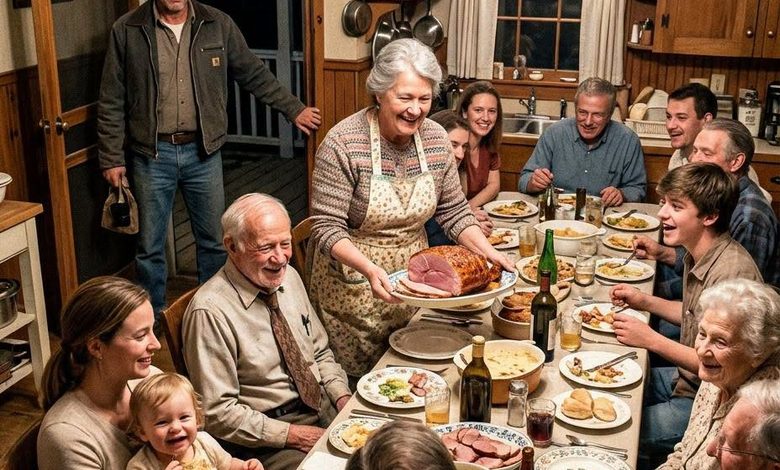
It was half past one on a Sunday in March. I was standing at the head of my kitchen table holding the gravy boat when my daughter-in-law set down her wine glass and said it.
“Let’s be honest for once, Peggy. Nobody actually wants to drive out here every week. People come because they feel sorry for you.”
She said it pleasantly. That’s the part nobody believes when I tell it. Whitney smiled while she said it, the way you smile at a waitress.
My son, Brent, was sitting right next to her. He’s forty-six. He looked down at his mashed potatoes and kept looking at them.
My granddaughter, Maddie, sixteen, stopped chewing. Her little brother put his fork down so carefully it didn’t make a sound.
I set the gravy boat on the trivet, because it was hot and because my hands needed something to do.
“Well,” I said. “That’s honest.” And then I asked who wanted more rolls.
Everybody took more rolls. Whitney took two.
Forty-five years of Sundays
My name is Peggy Tull. I’m seventy-one. My husband, Earl, and I bought this farmhouse outside of Bowling Green in 1980 for $29,000, and we paid off the last note in 2009. He passed in the back bedroom four years ago this October.
We started Sunday dinners when Brent was in diapers. Earl worked six days a week at the feed mill, and Sunday was the only day the house got to be full. I’ve missed five Sundays in forty-five years. Two funerals, one hip, one blizzard, and the week Earl died.
I live on $1,520 a month now. Earl’s pension and my Social Security together. The dinners cost me between $170 and $210 a week depending on the meat. I know that because I keep every grocery receipt in a shoebox on top of the fridge, like my mother did.
The secret I kept
There’s something I never told anyone in that family.
When Maddie started at Grace Christian Academy three years ago, the tuition was $10,800 a year. Brent and Whitney could only manage about $3,000 a semester. So I called the school office myself and set up the difference, $3,900 every semester, paid straight to the school, with my name kept off the statements. I didn’t want that child feeling like she owed anybody.
Three years. $23,400. It came out of the $35,000 life insurance Earl left me, the money that was supposed to make sure I’d never be a burden on anyone. I watched that account shrink every August and every January, and I never regretted one dollar.
The warning signs were there. I just sanded them smooth one at a time.
Whitney stopped eating my fried chicken and started bringing her own salad in a container. She asked me, in front of Maddie, whether I’d “looked at those senior apartments where they do your meals.” In February she told my neighbor, at the end of my own driveway, that I was “getting forgetful.” I heard it through the storm door and went back to folding towels.
I was seventy-one and a widow, and I was scared that if I made trouble, they’d just stop coming.
What Maddie told me on Thursday
That Thursday, Maddie stopped by after school like always. She ate two of my biscuits standing at the counter and wouldn’t look at me.
“Grandma,” she said finally. “Are you mad about Sundays moving?”
“Moving where, honey?”
She told me her mom had announced in the family group text two weeks earlier that Sunday dinners would be at their house from now on. A group text I’m not in. Whitney had told Brent’s sister it was because I was “too old to be trusted around a hot stove anymore.”
Two weeks. Whitney had already moved my Sundays before she ever said that thing about pity. She wasn’t breaking bad news at my table. She was locking a door that was already shut.
Maddie started crying. I told her to stop, that this wasn’t hers to carry, and I sent her home with the rest of the biscuits.
Then I stood in my kitchen and looked at the counter. I’d been to the grocery store that morning, like every Thursday. A ten-pound spiral ham. Four pounds of green beans. A sack of potatoes. Two pie pumpkins, shortening, a gallon of whole milk.
The receipt was lying beside the ham. $204.17.
I picked it up and turned it over. Then I got a pen out of the junk drawer and started writing names on the back.
Whose names do you think a 71-year-old widow writes on the back of a grocery receipt when her own family has quietly left her table?
By nine o’clock that night, there were four names on that receipt. Not one of them was family.
Walt Fenner, my neighbor, who lost his wife, June, in January and had been eating cereal standing at his sink every night since.
Jasmine Reyes across the road, twenty-five, with two little ones, whose husband left at Thanksgiving. She works nights at the distribution center.
Irma Kowalski from church, whose husband is in the memory care home out on the highway. She drives twenty-eight miles every day to feed a man who calls her by her sister’s name.
And Cody, the boy who bags groceries on Thursdays. In January, when I asked about his mom, he told me he’d been sleeping on his cousin’s couch since his parents split.
I called all four Friday morning. Every one of them said yes before I finished asking.
By Saturday it had grown, the way things do in a small town. Irma told two ladies from her prayer group. Jasmine told her sister. Walt asked if his buddy from the VFW could come.
Fourteen. I set fourteen places. Earl’s mother’s good china. The lace tablecloth. The cloth napkins I only use at Christmas.
The lawyer
I’d done one other thing that week. On Friday afternoon, I drove to the county seat and paid an attorney named Deborah Okafor $300 to teach me how to stop being quietly generous and start being properly generous.
She told me that paying tuition anonymously was the riskiest way to help a child. “It lives entirely on goodwill,” she said. “There’s no record. And it ends the day the goodwill does.”
So we did it right. What was left of Earl’s insurance, $11,600, went into an irrevocable education trust. Maddie is the only beneficiary. I’m the trustee. Her mother can’t touch a dollar of it. When Maddie turns twenty-one, it’s hers, no matter what anyone in that family thinks of me by then.
Then I called the school and told them to stop the anonymous payment starting with the spring bill.
The lady in the office asked if there was a problem with the account.
“No, ma’am,” I said. “I’ve just decided to put my name on it.”
Sunday
That Sunday, my kitchen was louder than it had been since Earl died.
Jasmine’s toddler was under the table with a biscuit in each fist. Cody had three plates of ham and apologized twice, and I told him if he apologized a third time, he was washing dishes. Walt wore a tie. Irma brought her husband’s famous corn pudding from the recipe card in his handwriting, and she cried a little when she set it down. Then she laughed at herself for crying, and Jasmine put a hand on her shoulder, and that was that.
At twenty to six, I heard a truck on the gravel.
Brent came up onto the porch. I opened the screen door with a dish towel over my shoulder. He looked past me at fourteen people eating at his father’s table, and I watched my son’s face fall apart.
“Mom. What is this?”
“It’s Sunday dinner,” I said. “There’s a chair at the end if you want it.”
He said Whitney had made a pot roast and five people came and it wasn’t— and then he stopped, because he couldn’t find the end of that sentence.
He didn’t stay.
“You should have told me”
He called on Tuesday. He called again on Thursday. The second time, he asked me, in a voice I hadn’t heard since he was a little boy, whether it was true about the tuition. Someone at the school had mentioned the change on the account to Whitney.
“Yes,” I said. “Three years. $23,400. I’m not sorry, I’m not asking for it back, and I’m not going to pretend about it anymore.”
He was quiet for a long time. “You should have told me, Mom.”
“Brent,” I said. “You were sitting at the table.”
We’re not fixed. I’ll be honest with you about that, because I’ve read stories where everybody hugs at the end, and that’s not what happened in my kitchen. Whitney hasn’t spoken to me since March, and I’ve stopped waiting for her to.
But Brent comes most Sundays now. He sits at the end of the table and washes the dishes without being asked. We’re working on it the slow way, which I’ve decided is the only real way.
Maddie comes every single week. Sometimes she brings a friend. Last month she asked me to teach her how to make the pie crust.
And the fourteen are still fourteen. Some weeks sixteen.
Here’s the one thing I know now that I didn’t know in March. For forty-five years I thought I was feeding my family. What I was really doing was buying a seat at my own table, one Sunday at a time. And the trouble with a seat you’re paying for is that somebody else always gets to set the price.
Set the table. See who comes hungry. That’s the whole of it.
Should Peggy have told her son about the tuition years ago? Tell us what you would have done.