“Dad, There’s a Man at Our Door—and He Knows My Name!” Then My Stepmother Recognized His Car and Asked Me to Keep It Secret
Part 1 — The Hand on the Other Side
The front door handle moved while my father was still speaking into my ear.
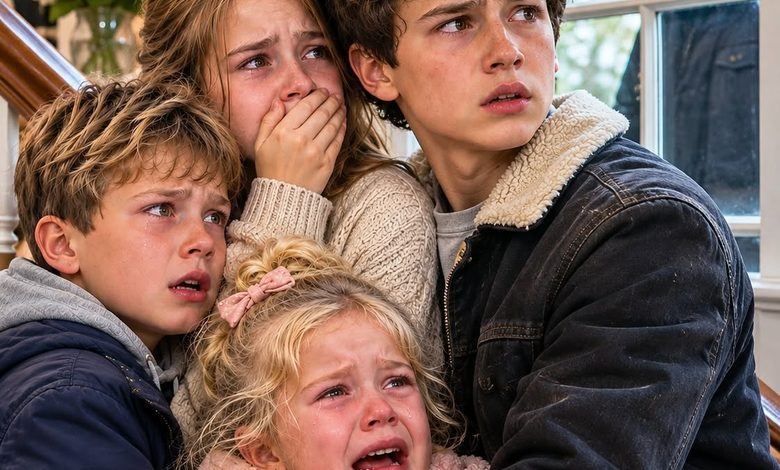
Behind me, Maya clutched Ivy’s hand so tightly that our little sister protested. Five-year-old Leo stood against the hallway wall, a stuffed rabbit pressed beneath his chin. Outside the narrow pane of glass, a man I had never seen before leaned toward the door and called me by name—as though we knew each other, and I was the one being unreasonable.
“Jordan, listen carefully,” Dad said. “I didn’t send anybody. Get away from that door.”
I backed away. My phone vibrated against my cheek, and a message from my stepmother appeared on the screen. I had sent Vanessa a photograph of the stranger’s car more than half an hour earlier. She had ignored it until now.
I know that car. Please don’t tell Daniel it came back. I can explain when I get home.
She knew that car.
It was Saturday, November 7, 2026. I was sixteen. Until that afternoon, my biggest concern had been a robotics demonstration at school. For three weeks, I had worked on an arm that could lift a foam block without crushing it. At 4:23 p.m., the only thing I cared about keeping in place was the locked door between a stranger and my three younger siblings.
That morning, Dad had been searching for the lid to his travel mug. He supervised maintenance on county vehicles, and an unexpected equipment problem had called him in on his day off. Ivy ate toast in her booster seat. Leo insisted socks counted as shoes if you stayed indoors. Vanessa stood at the sink slicing apples.
“Mrs. Talbot’s still coming while you’re out?” Dad asked Vanessa. “Jordan needs to leave before two.”
She nodded without looking up. “It’s handled.”
Dad turned to me and asked whether our robot was ready. I told him the arm worked perfectly whenever nobody important was watching. He laughed and asked me to send him a video.
I believed the afternoon had been arranged. Mrs. Talbot lived across the street, had our emergency numbers, and sometimes helped with the younger children. She knew that Leo wanted the crusts left on his sandwiches and that Ivy insisted her rabbit needed a chair at the table. If Vanessa said the arrangement was confirmed, why would I doubt her?
At 12:52, Vanessa appeared in the bathroom doorway, comparing two bottles of nail polish against her wrist.
“Mrs. Talbot can’t make it,” she told me. “You’ll have to stay with the kids. I’ll be home by five.”
I looked from the time on my phone to the backpack waiting beside the stairs.
“I have the demonstration.”
“Jordan, it’s one afternoon.” She sighed as though I were bargaining over a chore.
I explained that my team needed me to calibrate the mechanism. Vanessa said the salon had already moved her appointment twice. When I suggested calling Dad to find another solution, she told me he was busy and knew I could manage.
I had never said yes. Somehow the conversation moved on as if I had. Vanessa put the polish back in a drawer and picked up her handbag. “They’re your siblings,” she said. “Please don’t turn every favor into a question of whether I belong here.”
That silenced me more effectively than an argument.
Mom died in December 2023, when Ivy was still a baby. Vanessa had entered our lives carefully. She had never insisted we call her Mom, and she remembered which songs calmed Ivy and how Leo liked his toast. When he got a stomach bug, she had stayed up with Dad to help. They married in May. I wanted our family to work. At sixteen, I still couldn’t always tell the difference between setting a boundary and sounding ungrateful.
“That isn’t what I’m saying,” I told her.
“Then we’re fine.” She glanced toward the living room, where Maya was helping Leo sort puzzle pieces. “Lunch is in the refrigerator. Don’t bother your dad unless it’s a real emergency.”
Her car pulled away at one. I watched it go, then texted my teammate Aaron that I was stuck at home.
He replied with a picture of our empty workstation. Beneath it he wrote, Coach needs the arm calibration. Can you come later? I started typing an answer, but Leo spilled juice across a box of crayons. Ivy tried rescuing the crayons by putting them in her pockets. By the time I had cleaned everything, the demonstration had started without me.
The younger three weren’t trying to make my afternoon difficult. Maya wanted to help, Leo wanted to build a parking garage out of books, and Ivy wanted someone to read the same rabbit story until she knew when to turn every page. I made sandwiches, found dry socks, and negotiated whose turn it was to choose a cartoon. I loved them. I also kept checking the time.
At 3:47, Maya came into the kitchen without her usual thundering footsteps. “Jordan,” she said, “the dark car’s back.” I followed her into the living room but stopped her before she could move the curtain. Standing well back from the window, I saw a black sedan parked near the corner. A strip of silver trim hung loose beneath one headlight.
I recognized that detail because this wasn’t the first time I had noticed the car. On October 23, the sedan had waited across the street for almost an hour. On October 28, Maya spotted it near the park. On November 2, I saw a man standing beside it near our mailbox. Each time, I had mentioned it to Vanessa.
The first time, she suggested a delivery driver was waiting for directions. The second time, she said plenty of people drove similar cars. The third time, she told me to stop spying on strangers and frightening the children. I felt foolish, but I kept the photographs. Now the same damaged trim was visible beneath the streetlight.
From the upstairs landing, I took one more photograph without getting close to the glass. I sent it to Vanessa: That car is here again. Do you recognize it? Then I brought everyone into the kitchen. I told myself that staying together was sensible, not dramatic. We ate crackers, and I let Maya choose another book.
At 4:19, three deliberate knocks interrupted Maya’s reading. Through the narrow glass beside the front door, I saw a man in a dark jacket. He smiled when he caught sight of me.
“Hey, buddy. Your dad sent me to pick up his red toolbox from the garage.”
Dad’s toolbox was blue molded plastic, with a broken latch he kept promising to fix.
“What’s your name?” I asked through the locked door.
“A friend of Daniel’s. He knows I’m here.” The man glanced down the driveway. “Open up a second.”
I told him nobody had warned us. His smile vanished.
“Jordan, don’t make this difficult.”
Behind me, Maya gripped my sleeve.
He knew my name.
I told the man to leave and moved the children into the hallway before calling Dad. A part of me still expected an ordinary explanation: a coworker who had confused the toolbox, perhaps, or a harmless mistake. Instead, Dad said he hadn’t sent anyone. His voice changed so sharply that I stopped trying to sound calm for him. I told him the man had already tested the handle once.
“Call 911,” Dad said. “Keep the kids together. Stay away from the windows. I’m leaving now.”
Then Vanessa’s message arrived, asking me not to tell him about the car. For a second, I stared at the words instead of moving. She wasn’t asking whether we were safe. She was asking me to keep something from the person coming to help us.
I ended the call with Dad and pulled up the emergency keypad. Maya asked whether the man was going away. I said we weren’t going to wait at the door to find out. A faint metallic scrape came from the porch. The handle moved again. Whoever the stranger was, he was no longer content to knock.
Part 2 — The Room at the End of the Hall
I took everyone to my bedroom because it was away from the front entrance and had a working lock. It was the room we used when severe weather warnings came through, so Maya understood when I said we were doing our storm routine. Leo went first, then Maya and Ivy. I closed the door behind us and turned the small brass lock.
The dispatcher asked for our address first. I gave it, then told her my name, my age, and that three younger children were with me. Saying their ages aloud—seven, five, and three—made the danger feel more real. There was no adult in the house, and the man outside knew enough about us to pretend there should be.
“Has he entered the home?” she asked. “No. Everything’s locked.” I explained the toolbox story, Dad’s answer, and the handle moving. She told me officers were being sent and asked me to describe the visitor and his car. When I said I couldn’t see him from where we were, she told me not to leave the room to look.
I switched to speaker, turned the volume low, and sat on the floor. Ivy immediately climbed halfway into my lap, dragging her rabbit by an ear. Leo stepped onto my bed, then stepped down again, as if being higher up might be breaking a rule. Maya stayed beside the door until I asked her to sit with us.
“Are we hiding?” Maya whispered.
For a second I wanted to call it a game. But she was seven, not oblivious, and she could see my face.
“We’re staying together somewhere safe until the police come,” I told her. “You don’t have to do anything else.”
For the first few minutes, we could hear footsteps somewhere near the front of the house. Then there was a knock that sounded farther away, perhaps at the side entrance. I told the dispatcher what I heard without claiming I knew where the man was. She repeated that we should remain together and tell her if we heard anyone enter.
I kept looking at my bedroom door. It was an ordinary hollow door with a lock meant for privacy. Until that afternoon, the most it had protected me from was Leo borrowing my flashlight without asking. I moved my body so Ivy could lean against me, then realized I was trying to make myself cover all three children at once.
Maya picked up the rabbit book from the bed and began reading. She stumbled over a long word, started again, and kept going. Leo corrected her when she used the wrong voice for the rabbit’s grandfather. It was such a normal disagreement that I almost laughed. Then a voice carried through the house from outside.
“Jordan! Your stepmom knows me! Ask her!”
I stopped breathing for a moment. The dispatcher heard it too, faintly, and asked what he had said. I repeated the words and told her about Vanessa’s message. She asked me to preserve the message and show it to an officer later. “Right now, concentrate on staying inside,” the dispatcher said. “You don’t have to answer him.”
Dad called while I was still speaking to the dispatcher. I didn’t answer, but I sent him a quick text: Police coming. All four in my room. Vanessa says she knows his car.
His reply appeared almost immediately: I’m on my way. I love you. Stay with the dispatcher. I read it twice before putting the phone down.
After Mom died, when I was thirteen, people often told me I was good with the little ones. They meant it kindly. I could warm a bottle, get Maya ready for preschool, and keep Leo entertained while Dad made calls nobody wanted to make. Being helpful gave me something to do when grief made the rest of the house feel impossible.
But helping had gradually become something people expected. If a child needed a jacket, someone asked me where it was. If Dad was busy, I could start dinner. If Vanessa needed a quick errand, I was already there. Nobody had ever appointed me a third parent. It simply happened, one hard-to-refuse favor at a time.
Sitting on my bedroom floor, I couldn’t remember the last time anyone had asked what I needed when I was frightened. Ivy’s rabbit had a damp patch where she was chewing its ear. Leo kept asking whether our back door was locked, even after I answered. Maya watched me whenever the dispatcher paused. I tried to keep my own hands out of their sight.
“Bunny’s scared,” Ivy said. “Bunny can stay right here.” I tucked the rabbit between us. Leo leaned against my shoulder, careful not to crowd her. Maya stopped reading and put a hand on his knee. None of them needed me to invent a victory. They needed me to stay with them and listen to the person who knew how to help.
The dispatcher asked whether we had any immediate medical needs. I said no. She asked whether anyone else was expected at the house. I mentioned Dad, Vanessa, and the neighbor who was supposed to have been there. Saying that last part brought back the morning conversation, clear as a recording: Mrs. Talbot was coming. Everything was handled.
I wondered whether Vanessa had called our neighbor after leaving. Had the visitor known we were alone? How long had he been watching us? Every question wanted to pull me away from the one task I could manage. I pressed my palm against the carpet and repeated our address when the dispatcher asked.
Then the knocking stopped. The silence was worse than the sound. I whispered that I couldn’t hear him anymore, and the dispatcher reminded me that quiet wasn’t a reason to investigate. Somewhere outside, a car door closed. I couldn’t tell whether it belonged to the sedan, a neighbor, or someone arriving to help.
Around 4:36, the dispatcher told me officers were nearby. Soon afterward, a voice called out that it was the police. Maya started to rise. I touched her arm and shook my head. We had been told to wait, and I wasn’t going to replace a clear instruction with a guess just because I desperately wanted the waiting to end.
Several minutes passed while the dispatcher remained with us. Officers were speaking with someone outside, she explained. They were checking the entrances. No one had reported a second person, but they wanted to establish what had happened before asking us to move. I listened to her measured voice and let it set the pace of my breathing.
When she finally told us we could approach the front door, she gave me the name of the officer waiting there. I took the children down the hallway and confirmed the name through the locked door before opening it. Officer Grant introduced himself and asked whether anyone was hurt. I shook my head. My knees felt strange beneath me.
“You stayed inside?” Officer Grant asked.
“The whole time.”
“That was the right decision,” he said. Over his shoulder, I could see another officer standing near the black sedan. The man from our porch was talking with his hands. Without the door between us, he looked disappointingly ordinary. I had expected fear to leave some visible mark on him.
I showed Officer Grant the messages and photographs. When he saw the dates on the older pictures, he asked whether I had told an adult about the car before that day. “Every time,” I said. My voice came out sharper than I intended. He didn’t tell me to lower it. He asked whom I had told and wrote down my answer.
Dad arrived at 4:54. His truck stopped crookedly in the driveway, and he left the door open when he got out. I had planned to give him a clean explanation, beginning with the time of the first knock. Instead, I walked straight into him. He held me while Ivy tugged at his trouser leg and Leo started talking all at once.
“Nobody got inside,” Maya told him. “Jordan kept it locked.” Dad crouched, pulled the younger three close, and asked each of them whether they were all right. Then he looked at me again, as though checking that I hadn’t vanished while he was hugging them. I hadn’t realized until then how hard I had been working not to cry.
Mrs. Talbot came across the street after noticing the police vehicles. She was wearing slippers and carrying a container of cookies, the way she did when she didn’t know what else might help. Dad greeted her with obvious relief. “I thought you were here this afternoon,” Dad said. “Vanessa told me she’d arranged childcare.”
Our neighbor stopped at the edge of the driveway. “Daniel, she never asked me about today,” Mrs. Talbot said. “I’ve been home since lunch.” Dad turned toward me. I looked at Mrs. Talbot, trying to fit her words around what I had been told. There hadn’t been a canceled babysitter. There hadn’t been a last-minute emergency that only I could solve.
Nobody had called the babysitter.
Before Dad could ask another question, Vanessa’s car turned onto our street. She parked behind his truck and stepped out with a salon bag hanging from her freshly painted fingers. Her eyes moved from the police vehicles to the sedan. The man beside it looked up. Vanessa stopped walking. “Marcus?” she said. Dad’s hand tightened around my shoulder.
Part 3 — The Warnings We Had Already Given
Vanessa looked at Dad after saying the stranger’s name, and I watched her realize there was no way to take it back. Officer Grant asked whether she knew the man. “Someone from before,” she answered.
Dad didn’t raise his voice. “Before what?”
Vanessa looked at us. “Daniel, please. Not in front of the children.”
For once, Dad didn’t let that end the conversation. He asked Mrs. Talbot to take the younger three into the kitchen while he spoke with Vanessa and the officers. Then he looked at me. “You can go inside too,” he said. “You don’t have to figure this out.” I told him I still had the pictures. “You’ve already helped,” he answered.
I followed the others inside, although every part of me wanted to remain where I could hear. Maya was helping Ivy wash her hands. Leo asked Mrs. Talbot whether the cookies had raisins, then apologized because he thought asking might be rude. Our neighbor told him there was nothing rude about needing accurate cookie information.
I laughed once, unexpectedly. Then Maya asked why Vanessa knew the man’s name. I told her I didn’t know the full answer yet. “She said the car wasn’t important,” Maya said.
I sat beside her. “You were right to tell me you saw it. You weren’t making trouble.”
Officer Grant came to the kitchen to ask whether I could provide copies of the pictures and messages. Dad had agreed to help with that. The officer gave us an official way to submit them, explained that the dates mattered, and asked me not to delete anything. I submitted the original files, without cropping or changing them.
Opening the older conversations felt different with someone waiting to read them. On October 23, I had written, “This car has been across the street a long time.” Vanessa’s answer was casual: “Probably a delivery driver. Leave people alone.” At the time, that had sounded reasonable. Looking back, it seemed less like an explanation than a door closing.
The October 28 photograph was blurry because I had taken it through a window after Maya pointed toward the park. Vanessa had replied, “Lots of cars look alike. Don’t get Maya worked up.” Maya had been embarrassed afterward. She had asked me whether she was bad at remembering things. I had told her no, but I hadn’t known how to prove it.
The clearest photograph was from November 2. The sedan was beside the mailbox, and a man stood near the driver’s door holding a paper coffee cup. I had sent Vanessa the picture and written, “I’m sure it’s the same one.” Her reply said, Stop taking pictures of people minding their business. Don’t scare the little ones or drag your dad into it.
I read that sentence again before sending it. I had obeyed the last part. Dad had been tired that evening, and Vanessa had already made me feel as though bringing it up would be unfair. At dinner, when I started to mention the man, she asked Dad about a repair at work. The conversation moved on, and I let it.
Dad returned to the kitchen while I was still looking at the screen. I handed him my phone. He read all three exchanges without speaking. At the November 2 message, his thumb stopped moving. “You tried to tell us,” he said.
I stared at the cookie crumbs on the table. “I tried to tell somebody.”
He pulled out a chair. I expected a defense of Vanessa, or at least a reminder that people made mistakes when they were frightened. Instead, he asked me to tell him exactly how the babysitting arrangement had changed. I repeated the conversation from the bathroom doorway, including the part about him knowing I could handle it.
“I didn’t know you were staying home,” Dad said. “I thought you were at school.” I asked why he hadn’t called when he didn’t get a video of the robot. He accepted the question without looking away. “I was working. I assumed the plan was happening.” He paused. “I should have checked.”
Outside, Vanessa stood beside an officer with her arms folded tightly. Dad explained that she and Marcus had dated before she met him. Their relationship had ended in 2024. She said Marcus had refused to accept that ending, but the officers were still establishing the details. Dad was careful to separate what Vanessa had told him from what had been verified.
That mattered to me. All afternoon, adults had spoken as though certainty was something they could create by sounding confident. The car was nothing. Childcare was handled. Dad knew. Now Dad was saying there were things he didn’t know, and somehow that made him easier to believe.
Mrs. Talbot took the younger children into the living room so they could build a puzzle away from the kitchen conversation. Before she left, Maya looked at me. “Do I have to remember the dates too?” she asked. I shook my head. “No. The pictures have them. You can do the puzzle.” Her shoulders dropped.
An officer asked Dad to step outside again. Through the kitchen window, I saw Vanessa speaking rapidly, then looking down while another officer checked something in a patrol vehicle. I couldn’t hear the words. I knew better than to turn movements into facts, but I still felt my stomach tighten when Dad rubbed a hand over his face.
When he came back, he closed the kitchen door gently. “There’s a court order,” he said. “It restricts Marcus from contacting Vanessa or approaching her residence. The officers are checking the exact terms and confirming the record.” I stared at him. Vanessa had known enough about this man to go before a judge.
There was already a court order.
Dad explained that Vanessa had obtained it in April, before their May wedding. Police were verifying the record showing Marcus had been formally notified of it. Dad hadn’t known any of this. I remembered helping choose a frame for their wedding photograph. Vanessa had stood beside us that day while carrying a problem none of us knew existed.
“Did he know where we lived?” I asked. Dad said they didn’t yet know how he had learned the address. Vanessa believed he might have followed her. “She didn’t invite him here,” he added. I understood why he said it. Marcus had chosen to come to our home, lie about Dad, and touch the door. Those actions belonged to him.
But Vanessa had seen the photographs. She had recognized the car. She had told me not to tell Dad. I asked whether being afraid explained all of that. Dad sat down again before answering. “It may explain some of it,” he said. “It doesn’t make it all right.”
We waited while the officers continued their work. There was no speech from the driveway and no instant announcement that everything had been solved. Officer Grant eventually told Dad that Marcus was being arrested on suspicion of violating the existing order after officers confirmed the relevant restrictions. Other aspects of the incident would be documented and reviewed.
From well inside the house, I watched the police vehicles drive away. The sedan remained until someone came to remove it. I expected relief to arrive all at once, but it came in smaller pieces: Leo asking for water, Ivy laughing at a puzzle piece, the realization that nobody was standing on our porch anymore.
Dad ordered dinner because none of us had the energy to decide what to cook. Mrs. Talbot stayed until the food came. She didn’t ask me to describe the stranger again. Before crossing home, she told Dad she could help the next morning if he called and they agreed on a time. She looked at both of them while saying it.
Vanessa stood near the kitchen counter, still clutching her salon bag. I noticed the burgundy polish on her fingers and looked away. The appointment itself wasn’t the whole betrayal. It was the hours she had chosen to protect while leaving us to manage information she already knew mattered.
After the younger three had eaten, Dad put a movie on upstairs and sat with them until they settled. Then he returned to the kitchen and told me Vanessa wanted to explain. “You don’t have to stay for it,” he said. “And you don’t have to make anybody feel better.” I stayed because there was one question I needed answered.
Vanessa sat opposite me and placed her phone facedown on the table. She began with Marcus, his calls, and how frightened she had been. I listened until she paused. Then I asked, “When did you first recognize his car?”
Her eyes moved toward Dad. He didn’t answer for her.
“The first time you showed me,” she admitted.
She had known for fifteen days.
I opened Vanessa’s message from that afternoon and pushed my phone across the table.
“Then why,” I asked, “when you knew he was outside with us, did you tell me to keep it from Dad?”
Part 4 — What an Apology Could Not Fix
Vanessa stared at the message. Upstairs, the movie music began, and Leo protested that Ivy had stolen his cushion. The ordinary sound almost made me get up and join them. But I stayed. For once, nobody was going to change the subject before answering my question.
“I panicked,” she said. “I thought if Daniel saw it before I could explain, he would think—”
“Think what?” Dad asked quietly.
“That I’d brought this into the family. That I knew it could happen and married you anyway.”
Dad glanced at the phone. “You needed help. You didn’t need to make Jordan keep a secret.”
Vanessa told us that Marcus had begun contacting her again early that year. He had used different numbers after she blocked him, appeared near her workplace, and continued after she told him to stop. She had kept records, made a report, and eventually obtained the order. Those were sensible steps. I could understand why she had wanted protection, even while I was angry about what she’d hidden.
She said the months afterward had been quiet. She had let herself believe the court order marked an ending. By October, she wanted the life in our wedding photograph to be the only life anyone saw. When I showed her the first picture, she recognized the damaged headlight trim and told herself he might have been passing through.
“But you watched him drive past that night,” Dad said. She nodded. She had admitted that to the officer outside. After we went to bed, she had looked from the front window and seen the sedan again. She had sent a message to an old number telling Marcus to stay away, then blocked it without reporting the sighting.
“I thought ignoring him would make him leave,” she said.
Dad leaned back. “But you weren’t just ignoring him. You were asking the children to ignore him.”
She flinched. He continued, “They brought you something that worried them. You told them they were the problem.”
I remembered Maya asking whether she was bad at remembering cars. I told Vanessa about that question. Her face changed, and for a moment I saw that she had never followed her words all the way to their effect on Maya. She had been trying to close a conversation. Maya had heard that she couldn’t trust her own eyes.
“I was afraid of him,” Vanessa said.
“I believe you,” I answered. “I was afraid of him too. But you knew who he was. I didn’t. And you told me not to say anything.” Dad let the silence after that remain. Nobody asked me to understand more quickly.
Then he asked about the childcare. Vanessa began by saying she had meant to ask Mrs. Talbot. She had mentioned occasional Saturdays to her weeks earlier and assumed it wouldn’t be difficult. The salon called with an available appointment, and she accepted it before confirming anyone. When Dad asked that morning, she said it was handled because she expected to handle it.
“But you never called her,” Dad said.
“No.” Vanessa pressed her palms together. “By the time I realized, it was late. Jordan was there. I thought he could help.”
“You didn’t ask him,” Dad replied. “You invented a canceled arrangement and told him I knew.”
She didn’t deny it. I couldn’t decide whether that made me feel better or worse. I had missed the demonstration because the adults’ plans supposedly left no alternative. Now I learned that there had been time to call Dad, ask Mrs. Talbot, move the appointment, or simply tell the truth. Vanessa had chosen the option least inconvenient for herself.
“I’m not the backup parent,” I said.
Vanessa began to cry. I didn’t enjoy seeing her cry. I also didn’t take the words back. Dad reached for a box of tissues and set it within her reach without ending the conversation. He could be concerned for her and still expect an answer. Until then, I hadn’t known what that looked like.
I showed him Aaron’s photograph of the empty workstation. Dad enlarged the image, looking at the robot’s unfinished arm. “You worked on that every night,” he said. I nodded. The tears I had held back while talking about the stranger finally came when he asked whether the team had managed without me.
After what had happened at the house, crying over a school demonstration felt ridiculous. I couldn’t stop. Dad moved his chair beside mine. “You’re allowed to care about what you missed,” he said. “Keeping your siblings safe doesn’t mean the rest of your day stopped mattering.” I put my face in my hands and let him stay there.
After a while, Vanessa apologized. She named the things she had done without hiding them inside a general statement about mistakes. She had left me responsible without my agreement. She had misled Dad about the babysitter. She had dismissed the photographs and asked me to keep information from him while a possible danger was at the house.
I waited for the word but. It never came. Still, I didn’t feel ready to say everything was all right. “I hear you,” I said. “I don’t know what to do with the apology yet.”
Dad nodded before she could reply. “He doesn’t owe anyone forgiveness tonight.”
He said the marriage was an adult responsibility and would be dealt with by adults. Vanessa would use the guest room while they worked out immediate boundaries and sought professional guidance. Childcare plans would be shared and confirmed directly with the person providing care. For now, Dad would oversee those arrangements himself instead of relying on assumptions.
I asked the question I had been saving for him. “Why didn’t you check that someone was here?” Vanessa lowered her gaze, but Dad kept looking at me. “Because I trusted what I was told,” he said. “And because I’ve got used to you managing more than I should ask.”
He didn’t pretend he could have guessed there was a court order. He said there were things he could have done without knowing that: confirm the caregiver, check that I reached school, ask before treating my time as available. “I’m responsible for you too,” he said. “I let that get blurred.”
On Sunday morning, the younger children went across the street for crafts and lunch. This time, Dad called Mrs. Talbot himself, confirmed the hours, and walked them over. He told me I could come or remain home. I stayed. For the first time all weekend, nobody needed me to find a shoe, open a juice box, or answer a frightening question.
I sat at the kitchen table and looked at the engineering sketch beside my laptop. I didn’t work on it immediately. My body seemed determined to keep listening for the next knock. When a delivery truck stopped outside, I was on my feet before remembering that checking every vehicle on our street wasn’t my job.
Ms. Keene called late that morning. Aaron had told her I was dealing with an unexpected family situation. She said the robot had passed the demonstration with some awkward adjustments, and the arm still needed calibration. I apologized. She asked whether I was safe before asking when I might return to the workshop.
“Tuesday, if you feel up to it,” she said. “We still need the person who built this thing.” She didn’t ask for a full account or tell me I was mature beyond my years. She gave me a time, a place, and a problem I actually knew how to solve. After the call, I opened the sketch.
Later, Dad spoke by phone with an officer about follow-up steps. Vanessa contacted the support number she had been given, and a victim-services advocate arranged a fuller meeting for Monday. They discussed preserving messages, avoiding further responses to Marcus, reporting new contact, and keeping our household informed. There was no promise that paperwork could make someone harmless.
Dad asked for advice on what the younger children needed to know. He told them the man had broken rules about contacting Vanessa and that police were handling it. They weren’t expected to watch for him or remember a license plate. If something worried them, they could tell an adult, and that adult’s job was to listen.
Maya wanted to know whether Vanessa had been wrong about the car. Dad answered yes. He didn’t call it a misunderstanding. Vanessa sat beside him and told Maya she should have believed her. Maya listened, then asked to go back to coloring. Nobody followed her demanding a hug or a sign that the apology had worked.
That evening, Dad brought a blank sheet of paper to the kitchen table. “We need rules the adults follow,” he said. I looked at it warily. Families could write anything on paper. We had already proved that saying a plan existed wasn’t the same as having one. Dad placed a pen beside the sheet and waited.
“What if I say no next time?” I asked. “Not because there’s an emergency. Just because I have somewhere to be.”
“Then we arrange something else,” Dad said.
“And if you can’t?”
Part 5 — The Place Where I Belonged
“Then the adult changes their plans,” Dad said. He didn’t look toward Vanessa for permission. “You can help when you agree to help, Jordan. Being home doesn’t mean your time belongs to everyone else.”
I waited for the exception. Instead, he picked up the pen and wrote down what he had just promised.
On Monday morning, he took a personal day. A locksmith checked the exterior locks and the loose strike plate on the side entrance. An installer added a video doorbell and cameras covering the front walkway and rear entrance. Dad said cameras and better locks were precautions—not substitutes for responsible adults making plans.
I woke early when the locksmith’s van stopped outside. For a second, my stomach tightened before I recognized the company name. Dad was already at the door, speaking to the man through the glass before opening it. He didn’t call upstairs for me to manage anything. I watched for a moment, then went back to getting ready for school.
Beside the refrigerator was a schedule with names, phone numbers, and confirmed times. Dad would stay with Ivy. Mrs. Talbot would help after school. Vanessa had the advocate appointment. Dad showed me the schedule so I would know where everyone was, then made it clear that checking it wasn’t my responsibility.
At school, the noise in the corridor felt strangely loud. A locker slammed behind me, and I turned too quickly. Then I felt embarrassed for turning. I spent first period checking my phone beneath the desk until I remembered Dad was at home. Knowing that didn’t settle me immediately, but I put the phone in my backpack anyway.
Aaron found me at lunch with a sketch of the grabbing arm. He said the encoder reading drifted whenever the mechanism closed under load. For twenty minutes, we argued about whether the problem was the sensor or the mount. Neither of us mentioned the porch. I ate my sandwich and drew a revised bracket in the margin.
When I got home, Maya showed me the new doorbell camera. “We didn’t open up for the installer,” she said. “Dad did.” I told her that was exactly how it should work. Leo asked whether the camera could see inside his bedroom, and Dad explained that it couldn’t. Even useful changes needed explanations the children could understand.
That evening, Dad put the finished household plan on the refrigerator. It said adults would arrange and confirm childcare before leaving. Unexpected visitors would stay outside while an adult checked their identity and purpose. Everyone could report a concern without being mocked or punished for honestly being mistaken. Emergencies did not require permission before calling for help.
Vanessa signed it first. Dad signed beneath her. They didn’t ask me to sign as though keeping the promises would be my responsibility. Maya drew a star beside the emergency numbers. Leo added a car with an enormous red line through it, then changed it because Dad explained that most visitors weren’t dangerous. Ivy placed a rabbit sticker at the bottom.
Their additions made the page look less official and more like something that belonged in our kitchen. That helped. I didn’t want the house to become a place where everyone waited for trouble. I wanted adults who could take sensible precautions and then let us have dinner, finish homework, and argue about whose turn it was to choose a movie.
Vanessa spoke to me later while I worked on the controller. She said she had given the advocate the dates and preserved the messages. She was following the reporting guidance and would not contact Marcus again. She also said she understood that doing those things now didn’t erase what she had said to me in October.
“It doesn’t,” I answered. She nodded. Then she asked whether I wanted her to leave me to my work. I said yes. She went upstairs without looking wounded or asking whether I still cared about her. It was a small thing, but it was the first apology I could see continuing after the words were finished.
Dad sat beside me a little later and asked whether I wanted help finding someone to talk to about Saturday. I told him I wasn’t sure. He offered the school counselor or another professional and said I could choose. I kept tightening the same screw until he gently pointed out that it was already secure.
“I keep hearing the handle,” I admitted. He didn’t say it was over, so I should stop thinking about it. I told him how I had imagined Maya opening the door, Leo running toward a sound, or Ivy becoming too upset to stay quiet. I had felt as though one mistake would mean I had failed all three of them.
“You were a frightened kid making good decisions,” Dad said. “You weren’t in control of everything that could happen.” I put the screwdriver down. “I love them. I would never leave them.” He nodded. “I know. That doesn’t give us permission to hand you our responsibilities.”
I asked whether he would have believed me without the photographs. He was quiet long enough that I knew he was choosing an honest answer. “You should never have needed proof to make me listen,” he said. “If you tell me something worries you, we start there. We ask questions together. You don’t have to build a case first.”
I didn’t need proof to deserve protection.
On Tuesday, I went to the workshop. The room smelled of solder and the pizza someone’s parent had brought. Ms. Keene greeted me, asked whether I wanted to start with the controller or the bracket, and handed me a pair of safety glasses. Nobody made a speech about how brave I’d been. I was grateful for the normality.
The arm dropped the foam block on its first attempt. Aaron looked at me, waiting. I checked the mount, adjusted the settings, and ran the sequence again. This time, the mechanism closed, lifted, turned, and set the block on the platform. It was an ordinary little success, and exactly what I had spent three weeks working toward.
For two hours, my biggest problem was an overheating motor. I forgot to check my phone. When practice ended, Dad was outside at the time he had promised. Before saying anything about the house or the investigation, he asked how the robot had performed. I played him the video, and he watched it twice.
“You ought to be proud,” he said. I looked at the screen, where the arm placed the block neatly on its mark. “I am.” The words came easily. I hadn’t realized how much I had missed having something that mattered to me for reasons unrelated to being useful at home.
The legal process continued beyond that week. Dad explained the updates we needed without making us responsible for following the case. Marcus’s release conditions included restrictions the adults reviewed with police, and the existing order remained in effect. Nobody promised he could never return. The promise was that concerns would be reported and the children would not manage them alone.
There were no further visits to our house during the following months. When the criminal case eventually reached a plea resolution, Dad told me Marcus had been held accountable for violating the order. I didn’t ask for every detail. By then, I had learned that safety wasn’t a single dramatic ending. It was also the quieter work people kept doing afterward.
Dad and Vanessa began counseling. Their marriage did not become my project. Some conversations happened behind closed doors, and sometimes Dad looked tired afterward. But he kept arranging childcare, kept checking plans, and kept asking about school. Vanessa continued working with the advocate and accepted that rebuilding trust meant letting us remain angry without making that anger another problem to solve.
I met with the school counselor a few times. We talked about the sound of the handle and the habit of listening for footsteps when I should have been sleeping. The conversations didn’t erase Saturday. They helped me understand why my body sometimes reacted before I could remind myself where I was. Gradually, a truck stopping outside became just a truck again.
I also babysat again, eventually. Dad asked me a week in advance, told me the exact hours, and offered payment from the family’s childcare budget. I agreed because I was free and wanted to earn money for a robotics trip. Being asked—and being able to refuse—changed everything. When I said no another time because of a workshop, he simply thanked me for letting him know.
Vanessa and I rebuilt smaller things first. She asked before moving my schoolwork from the table. She stopped referring to my plans as something I could miss just once. When Maya mentioned an unfamiliar car waiting outside one afternoon, Vanessa checked from inside, contacted Dad, and established that it belonged to a neighbor’s visiting relative. She thanked Maya for speaking up.
Nobody hailed Maya as a hero, and nobody laughed at her for raising an alarm. The adults checked, explained, and moved on. Watching that ordinary exchange did more for my trust than any speech could have. It showed me that being wrong about a danger didn’t have to mean being wrong to ask.
One evening, Maya brought a folded drawing to my room. Six stick figures stood in front of our house. Dad and Vanessa were on the outside, nearest the walkway. The four of us were between them, holding hands. Beside the door, she had drawn a tiny square with a blue dot for the camera.
Underneath, in uneven capital letters, she had written: JORDAN KEPT THE DOOR CLOSED. THEN HE CALLED FOR HELP. I read it twice. Maya watched my face. “I was scared,” she said. I told her I had been scared too. She looked relieved, as though she had been waiting to discover that both things could be true.
“Can you still be my big brother when you’re at robotics?” she asked.
I put an arm around her shoulders. “Of course.”
“Good.” She nodded solemnly. “Because Leo says he can be in charge, but he can’t find his shoes.” I laughed, and this time it didn’t feel strange coming out of my mouth.
I put her drawing above my desk, next to the engineering sketches. Later, Dad stopped in my doorway and read it. I waited for the familiar praise about being the man of the house. People had used that phrase after Mom died, as though losing her had quietly promoted me into a position nobody had asked whether I wanted.
Dad didn’t say it. He looked at the drawing, then at the half-built controller on my desk.
“You’re their brother,” he said. “And you’re my kid. You get to be both.”
He asked whether I wanted the door open or closed when he went downstairs. For the first time in a long time, it felt like an ordinary question.
I was his kid, not his replacement.
I left the door open.
Downstairs, Dad helped Leo search for a missing shoe. Vanessa listened while Maya read aloud. Ivy demanded a good-night kiss for her rabbit.
I turned back to the machine on my desk. The house still needed looking after. So did the children. But for once, the adults were doing their part, and I was free to build something that belonged to me.
Disclaimer: This story is a work of fiction inspired by real-life themes. Names, characters, places and events are fictionalized, and any resemblance to real persons is purely coincidental. Images are for illustration purposes only.