My Neighbor Dumped a Bucket of Paint on My Car at 2 A.M. — By Breakfast, Three Police Cars Were at Her House
This is a fictional story.
Linda and I had been fighting about my driveway for six months.
Not the whole driveway. Just the strip of concrete beside my garage — wide enough for one car — that she had decided was “basically shared.”
It wasn’t shared. It was on my property survey, in black ink, with my name on it.
My name is Joanne. I’m forty-four, a dental hygienist, and I moved onto Larkspur Court three years ago, right after my divorce. I wanted a quiet street, a small yard and a garage where nobody would bother me.
For two and a half years, that’s exactly what I had.
Then Linda’s grown son, Kyle, moved back in with her.
The Spot Beside My Garage
Linda was in her late sixties, always in a purple cardigan, always watering the same rosebush whenever I came home. At first, she was friendly. She brought me zucchini bread. She told me about her late husband.
After Kyle came back, things changed.
Cars started showing up in the spot beside my garage. Late at night. Different cars every few days. A black sedan. A gray pickup. Once, a red sports car with no license plate.
When I knocked on Linda’s door, she waved it off.
“Kyle fixes cars for friends. Our driveway is too small. That spot is basically shared, honey. Everybody on this street knows that.”
“It’s not shared, Linda. It’s mine.”
She smiled the kind of smile that isn’t really a smile.
Then it got worse. Her own SUV started parking there too. Some mornings, I couldn’t even back out of my garage without inching around her bumper.
I left polite notes. I left less polite notes. I showed her the survey. She tore the copy in half in front of me.
So last week, after her SUV blocked me in for the third morning in a row and made me late for work, I called a towing company.
Linda came flying out onto her porch in her robe as the tow truck pulled away.
“You’ll regret this!” she screamed across the yard.
I didn’t answer. I went inside and locked the door.
2:13 A.M.
Six nights later, a loud metallic clang woke me up.
The clock on my nightstand said 2:13.
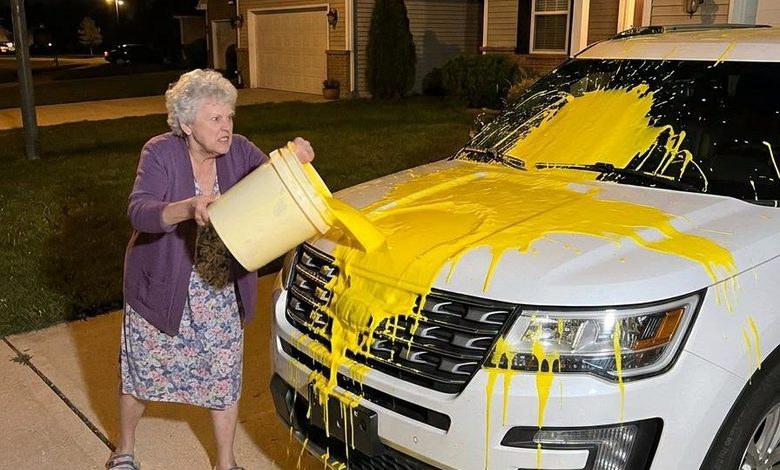
I went to the bedroom window and pulled back the curtain. Under the streetlight, I saw a small figure in a purple cardigan running across my lawn toward the house next door.
Then I looked down at my driveway.
An empty bucket lay on its side beside my car.
My white SUV was covered in bright yellow paint. The roof. The rear window. The tailgate. Thick yellow streams were still dripping down the sides and pooling on the concrete.
By the time I got downstairs and out the door, Linda’s porch light was off. Her house was dark and silent.
I stood barefoot in my driveway, shaking.
I had no camera on the driveway. I’d always meant to put one up. Nobody else on the street was awake. I had seen a shape in a cardigan in the dark, and that was it.
Nothing that would ever prove it was her.
I took pictures with my phone, filed an online report, and lay awake until dawn listening to every sound outside.
Three Police Cars
At 7:20 a.m., someone knocked on my front door. Hard. Over and over.
I was sure it was Linda, coming over to gloat.
Instead, when I opened the door, I saw three police cars parked in front of her house, lights flashing silently.
Her garage door was wide open. Two officers were inside, going through shelves and boxes with flashlights.
Linda stood on her front lawn in her pajamas, barefoot, her hair wild.
“I didn’t do anything!” she was shouting. “I didn’t do anything!”
An officer stood on my porch. “Ma’am, is that your vehicle?”
“Yes.”
He walked over and looked at the yellow SUV for a long moment.
“Don’t wash it,” he said.
“Why?”
Just then, one of the officers came out of Linda’s garage holding a half-empty can of yellow paint with dried drips down the side.
I almost laughed. “Well,” I said. “I guess that’s my evidence.”
Nobody laughed with me.
The older officer — gray mustache, tired eyes — looked at me strangely.
“Ma’am,” he said quietly, “this isn’t about your car.”
Then he asked me something I didn’t expect.
“When did you buy this vehicle?”
“Three years ago. Why?”
He didn’t answer. He walked slowly around my SUV and crouched down by the rear bumper.
The thick paint had settled into something I had never noticed before — a faint, filmy white patch on the bumper, almost invisible against the white paint. The yellow had soaked around its edges and made it stand out like a stencil.
And underneath it, letters had appeared. Scratched into the surface.
The officer took a cloth from his pocket and wiped carefully.
His radio crackled.
He read the letters out loud into it — slowly, one at a time.
Then he stood up so fast his knee cracked.
“Get her away from the vehicle,” he said.
Another officer gently took my arm and walked me back toward my porch.
My heart was pounding. What was written on my car? And why did Linda’s garage suddenly matter more than a bucket of paint?
What did the letters say — and what was hiding in Linda’s garage? Continue to the next page…
The Letters on the Bumper
For twenty minutes, I sat on my porch steps in my bathrobe while officers photographed every inch of my SUV.
Finally, the older officer came over and sat down beside me. His name tag said SGT. HOLLIS.
“Ma’am, I need to ask you some questions. You’re not in trouble. But I need you to be very honest with me.”
“Okay,” I whispered.
“Where did you buy the car?”
I told him. A small used car lot across town. Good price. Clean title. The salesman had been so friendly. I’d paid cash from my divorce settlement.
He nodded slowly, like I’d just confirmed something.
“Those letters on your bumper are part of an anti-theft etching,” he said. “Some manufacturers and insurance companies etch a vehicle’s real identification number into hidden spots — bumpers, windows, panels — so a stolen car can be identified even if the thieves change everything else.”
“Somebody covered that etching with a clear film and white touch-up paint. That’s why you never saw it. But your neighbor’s paint is oil-based. It didn’t stick to the film. It slid off the edges and outlined every letter.”
He paused.
“The number on your bumper doesn’t match the number on your dashboard. Your SUV was stolen four years ago in Indianapolis. Somebody gave it a new identity and sold it to you.”
I felt the blood drain from my face.
“I didn’t know. I swear, I had no idea.”
“I believe you,” he said. “Because I know exactly who sold it to you.”
Why They Were in Linda’s Garage
For eight months, a regional task force had been tracking a ring that stole cars in one state, swapped their identification numbers, and sold them through small used lots in another.
The used lot where I’d bought my SUV was one of them.
And the man who did the identity swaps — removing plates, re-stamping numbers, covering etchings — was Linda’s son. Kyle.
That’s why there had been strange cars beside my garage every few nights. Linda’s driveway could fit only two cars, and Kyle needed somewhere to keep the vehicles waiting for “work” — somewhere that didn’t look like it belonged to him.
My driveway.
“Basically shared.”
The task force had a search warrant for Linda’s house and garage. They’d planned to serve it that morning anyway. When they pulled up at 7 a.m., the first thing they saw was a white SUV next door, dripping with fresh yellow paint — and a trail of yellow footprints leading straight across the lawn to Linda’s front door.
In her rush, she had stepped in her own puddle.
“She tracked paint right up her own porch steps,” Sgt. Hollis said, almost smiling for the first time. “We didn’t need a camera.”
“Get Her Away From the Vehicle”
I asked him why he’d told the other officer to get me away from my car so suddenly.
“Because the number I read into my radio came back flagged,” he said. “That vehicle isn’t just stolen. It’s evidence in an open federal case. Every inch of it has to be documented before anybody touches it again. Including you. If you’d washed it this morning, you would have washed away the one thing that proves where it came from.”
I stared at my yellow SUV.
Linda had tried to ruin my car.
Instead, she had uncovered her own son’s secret.
Kyle
Kyle wasn’t home that morning. He was arrested two hours later at the used car lot across town — standing next to a silver pickup with a freshly peeled bumper.
Inside Linda’s garage, investigators found stamping tools, rolls of clear film, cans of white touch-up paint, a stack of blank title forms and a notebook listing more than forty vehicles.
Mine was number twenty-three.
Linda swore she had no idea what her son was doing. Investigators weren’t so sure. Her name was on the lease for the storage unit where Kyle kept spare plates.
She was charged with criminal damage to property for the paint. The rest is still being sorted out by the prosecutors.
What Happened to Me
I lost the SUV. It went back to the insurance company in Indianapolis that had paid out the original owner four years ago.
For about a week, I thought I’d lost everything I’d paid for it too.
Then the task force’s victim advocate called. Because I had bought the car in good faith from a licensed dealer, the state’s dealer recovery fund covered my loss. The court also ordered restitution from Kyle and the lot owner when they were sentenced.
Three months later, I drove a brand-new white SUV into my driveway.
Linda’s house has a “For Sale” sign out front now.
The strip of concrete beside my garage is empty again. It’s mine. It always was.
And yes — I finally put up a camera.
Some nights I still think about that bucket of yellow paint. Linda wanted revenge so badly that she couldn’t wait one more day. If she had just let it go, the task force might never have connected my car to Kyle’s work.
Sometimes the people who try hardest to bury you are the ones who end up digging up their own secrets.
This story is a work of fiction. Names, characters and events are invented.