My Son Had Never Played Outside in Daylight—Then Grandpa Brought a Farm to His Window, and Everything Changed
Part 1: The Window Between Them
“Oliver. Step away from the window.”
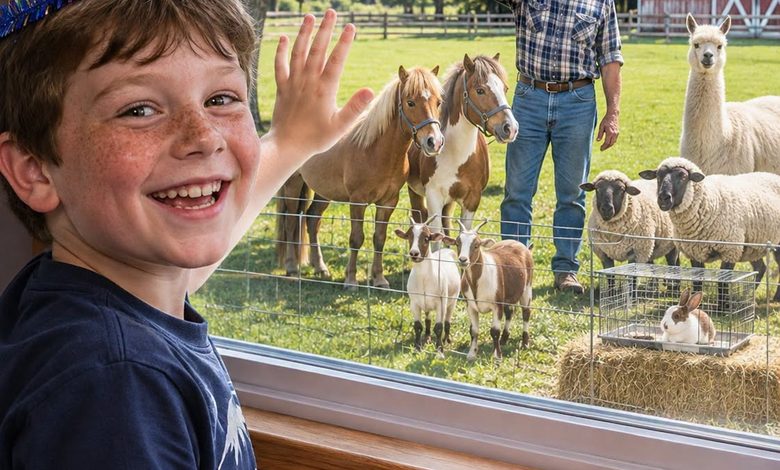
I tried to keep my voice steady. My seven-year-old son had one hand on the raised sash, and daylight fell across the sleeve of his birthday shirt. Beyond him, our backyard held two miniature ponies, goats, sheep, and my father, who had stopped waving. Oliver wasn’t looking at any of them anymore. He was staring at another boy standing beside a brown horse.
“Mommy,” he said, “why does he get to be out there?”
I crossed the room, guided Oliver back, and closed the window. Then I lowered the blind with fingers that wouldn’t work properly. Through the glass, the birthday animals kept moving. A goat tugged at its handler’s pocket. Someone outside laughed before realizing something was wrong.
Oliver had xeroderma pigmentosum, or XP. His body could not properly repair certain damage caused by ultraviolet radiation. The protective film on our closed windows helped make home safer. An open window removed that protection.
I checked the time, moved him away from the window, and called his specialist’s office. The nurse asked how long it might have been open, what he had been wearing, and whether I noticed any changes. I answered as carefully as I could. She explained what to watch for and arranged follow-up. The absence of an immediate reaction, she reminded me, did not mean exposure was harmless.
Oliver stood beside the sofa, twisting the hem of his shirt.
“Am I in trouble?”
I knelt before him.
“You broke an important safety rule. But first we’re making sure you’re okay.”
“Grandpa said there was another surprise. I wanted to hear.”
That nearly undid me. For three weeks, Dad and I had planned a birthday animal visit Oliver could enjoy through closed, protected glass. We had discussed handlers, fencing, parking, and keeping the animals away from the house. Apparently, we had not discussed how a delighted child would hear his grandfather outside.
“You can always ask me to help,” I said. “You don’t have to open it.”
He nodded, then looked toward the blind.
“But that boy has my kind of shield.”
I had seen him only for a moment: a taller child in protective clothing, gloves, and a clear face shield, standing with a woman near a covered area. Beside them waited a full-sized horse that wasn’t part of the little animal group I had approved.
“I’ll find out,” I promised.
I called Daniel at work. He asked the necessary questions before asking the one I had been dreading.
“How did he get the window open?”
“The latch wasn’t a lock.”
There was a pause.
“We should have changed that years ago,” he said. “I’m coming home.”
Not you. We. I held on to that word while I put Oliver’s favorite indoor program on and asked my sister, who had come early with the cake, to stay beside him.
Outside, Dad approached me with a small wooden box held against his chest. At seventy-nine, he still walked as though he expected every room to be glad to see him. Now he stopped several feet away.
“Is he all right?”
“We’ve spoken to his medical team. Who’s the child, Dad?”
The woman beside the shelter stepped forward.
“I’m Rachel. My son’s Noah. Your father invited us.”
“Does Noah have XP?”
She nodded.
“He’s eleven.”
I looked at his covered hands, his protected face, the quiet way he waited while the horse’s handler adjusted a lead rope. He wasn’t doing anything reckless. His mother stood close enough to notice every movement.
“How can he be here?” I asked.
Rachel’s expression changed—not offended, exactly, but careful.
“With planning specific to him. We checked our arrangements before coming, and we’re keeping this brief. The equipment isn’t a cure, and the shelter isn’t enough by itself.”
Dad shifted the box.
“I thought meeting another boy might help.”
“Then you should have asked us.”
“I know.”
“You knew before today, too.”
He looked down. I had expected an explanation about good intentions. His silence made it harder to stay angry in the clean, uncomplicated way I wanted.
The birthday itself had begun so beautifully. Oliver had walked into his room, seen a pony through the glass, and clapped both hands over his mouth. Then he had laughed so hard he could hardly ask whether it was real. For a few minutes, I had watched my son forget to be careful about happiness.
Now Rachel was quietly suggesting that Noah could meet Oliver indoors, if we were comfortable with that. They would use our checked entrance and follow our household routine. There was no pressure, she said. They could leave a phone number instead.
I looked through the protected window. My sister had raised the blind again without opening anything. Oliver stood beside her, waiting.
“Would Noah like to come in?” I asked.
Rachel turned to her son rather than answering for him. He nodded immediately.
Dad offered me the box. Inside lay a small carved horse and a photograph of Noah beside a pony. On the back, in a child’s uneven handwriting, were the words: For Oliver. Maybe we can meet one together.
“He helped choose the horse,” Dad said.
I ran my thumb over its wooden mane.
“You should have told me about all of this.”
“I was afraid you’d say no.”
Through the window, Oliver saw Noah approaching the house. He smiled, then caught sight of my face and let the smile shrink, as though he had already learned not to want too much.
I went inside carrying the little horse, suddenly afraid of a question I knew my son was about to ask.
Part 2: The Shape of a Smaller World
“Have you really touched one?” Oliver asked.
Noah sat on the rug opposite him, his outdoor equipment put away according to Rachel’s routine. Daniel had arrived while the handlers were loading the animals. Upstairs, my sister was cutting cake that nobody had remembered to photograph.
“Three times,” Noah said. “A pony tried to chew my sleeve once.”
Oliver laughed.
“Did it taste good?”
“I didn’t ask.”
They examined the carved horse together. Noah pointed out that its ears leaned in different directions. Oliver decided that meant it was listening to two conversations at once. Within minutes, they were arguing cheerfully about whether a horse would enjoy living beside a railway.
Then Oliver asked the question.
“How come you get to go places?”
Noah glanced at his mother.
“We plan them.”
“We plan things, too,” Oliver said quickly. “We look at stars in our yard. And sometimes I go to a room at school.”
He considered that list for a moment.
“That’s mostly it.”
Daniel lowered his eyes. Across the room, Rachel didn’t look at me with pity. I was grateful enough to nearly cry.
Oliver’s world had not become small in one decision. It had happened through hundreds of reasonable ones. An unfamiliar building with unassessed lighting. A birthday party moved outdoors at the last minute. A school trip whose organizers couldn’t accommodate the precautions he needed. We had declined each thing for a reason.
Eventually, people had stopped asking.
We had discovered Oliver’s condition when he was an infant. After a short stroller walk, his skin developed a reaction we couldn’t explain. What followed was a frightening progression of appointments, tests, and words I wrote down because I couldn’t trust myself to remember them.
When the specialist explained XP, Daniel asked about treatment. I asked whether Oliver would live.
The doctor did not offer easy promises. She explained lifelong protection, specialist surveillance, and the importance of preventing UV damage. She also told us that families could develop routines supporting learning, friendships, and carefully assessed activities.
I remembered the warnings with terrible precision. The possibilities were harder to hold on to.
We installed protective window film and had it checked. We assessed lighting, learned to use a suitable UV meter, and established routines for transport and appointments. I left my job because coordinating Oliver’s care and education had become more than we could manage around our working hours. Daniel took additional shifts, then came home to forms, equipment orders, and my lists.
We loved our son. We were exhausted. Those facts had become so tangled that I sometimes mistook exhaustion for evidence that we had considered every possibility.
Across the rug, Noah was explaining an indoor model-building club. Oliver listened with his whole body tilted forward.
“Could I go?” he asked me.
“We’d need to learn more about it.”
His shoulders dropped.
I recognized the answer he had heard, because I had used those words before when I meant not now, not this, please don’t make me disappoint you again.
“I mean that,” I added. “We can ask questions.”
He looked up.
“Real questions?”
“Real ones.”
After Rachel and Noah left, with promises to exchange drawings, Dad stayed at the kitchen table. Oliver and my sister were upstairs arranging toy animals around the wooden horse. Daniel set three untouched pieces of cake between us.
“The animal visit was approved,” I told Dad. “The introduction wasn’t. Neither was bringing a full-sized horse.”
“Leah had room in the trailer,” he said. “When I told her about Oliver, she offered to bring Daisy for him to see.”
“That isn’t the point.”
“I understand.”
“Do you? Because Oliver opened that window trying to hear you.”
Dad pressed his lips together.
Daniel spoke before either of us could go further.
“The window is our responsibility. We’re fixing that. But surprises involving his health or another family need to stop.”
Dad nodded.
“No more.”
“And no promising him outings,” I said.
He reached into his pocket, then hesitated.
“What is it?”
A folded sheet emerged. There were three possibilities written on it: a private evening farm visit, an indoor animal education center, and a family gathering arranged through an XP organization. Beside each were questions about transport, lighting, protective measures, and medical advice.
Nothing was booked. Nothing had been promised.
“I rang the support organization because I didn’t know what to ask,” Dad said. “They passed my number to Rachel after she agreed. I should have brought you in then.”
“Why didn’t you?”
He stared at the cake.
“Because I thought if you met her first, it might be easier.”
“Easier for whom?”
That made him look up.
“For me,” he admitted. “I wanted to be the grandfather who brought good news.”
My anger shifted. It didn’t disappear.
“I need you to be the grandfather who tells us the truth. Even when you think we won’t like it.”
He folded his hands.
“All right.”
We agreed that future plans would come to Daniel and me first. Dad would not supervise new activities alone, and he would learn the precautions rather than simply trusting that somebody else had handled them. He accepted that without bargaining.
That evening, Daniel fitted temporary window stops while we arranged a proper child-resistant solution that preserved our emergency escape plan. I sat nearby, turning Dad’s list over and over.
“Do you think I’ve kept him home too much?” I asked.
Daniel put down the screwdriver.
“I think we stopped reviewing what was possible.”
“We?”
“He’s my son, too.”
From upstairs, Oliver called for help spelling a word. He was making Noah a card. Beneath two stick figures stood a horse, much larger than the house beside it.
The sentence he wanted to write was simple: Next time, can I come with you?
I held the pencil while he waited, knowing that whatever answer came next would have to be more than something I said to get us through bedtime.
Part 3: A Promise With Conditions
The next morning, I called Oliver’s specialist and asked for something different from reassurance.
“We need help making an activity plan,” I said. “Not just a list of what to avoid.”
The appointment did not produce permission to live as though XP had vanished. We reviewed the window incident, his follow-up, ongoing surveillance, and the protection he still needed. Then we discussed specific activities, transportation, protective equipment, environmental checks, and how to assess places beyond our house.
“A plan belongs to Oliver,” the doctor said. “Another child’s routine can give you questions to ask. It cannot replace his own assessment.”
I wrote that down. It was tempting to turn Noah into proof that something was safe. That would have been another way of avoiding the harder work of finding out.
Rachel understood immediately when I called.
“I’m glad you said that,” she told me. “Noah likes being a friend. He doesn’t want to be a demonstration.”
I winced.
“I don’t want to make him one.”
“Then let the boys talk about trains sometimes.”
They did. Over the next two weeks, they built competing cardboard stations during video calls. Oliver mailed Noah a drawing in which Daisy drove a locomotive. Noah returned it with a ticket collector’s cap drawn between her ears.
Meanwhile, Daniel and I spoke to Leah, Daisy’s handler and the owner of a nearby teaching farm. She listened without interrupting while I explained what we needed to investigate.
“I can tell you about the horse and the building,” she said. “Your team tells us about the medical precautions. If the pieces don’t fit, we don’t do it.”
That answer made me trust her more than a cheerful guarantee would have.
We considered a short private evening visit. The timing alone was not enough; the route, entrances, lighting, and available spaces all needed review. Daniel visited first, while I joined by video. Leah walked him through the proposed area and showed us an adjoining room where we could stop if necessary.
Dad asked whether he could help.
I gave him the least magical task imaginable: write down questions and wait for answers.
He did it.
He checked distances from parking to the entrance, asked where other animals would be, and learned why ordinary shade could not simply be treated as protection. When he didn’t understand something, he asked again. The man who had once tried to arrange everything behind my back began sending messages that ended, Nothing promised. Please review.
Oliver noticed all this preparation.
“Is Daisy difficult?” he asked one evening.
“No,” I said. “We’re making sure the visit works for you.”
He considered that.
“Can I ask something, too?”

We gave him his own page.
He wanted to know whether horses liked being stroked on the nose, whether Daisy would mind his gloves, and whether he could stay behind me until he felt ready. Leah answered each question in a short video. He watched the part about taking his time four times.
We set a tentative date, subject to the final checks. I put it on the calendar in pencil.
On the afternoon before the visit, Leah called.
An electrical fault meant the agreed area could not be used. Someone had offered temporary lighting, but it was not the equipment we had assessed. She could move us elsewhere on the property, she said, or we could postpone.
My heart sank before she finished.
Oliver was standing in the kitchen doorway with his stuffed elephant under one arm. He had heard enough.
“We’ll postpone,” I told Leah.
After I hung up, he laid the elephant on a chair with exaggerated care.
“You said we could go.”
“I said we could if the arrangements were ready. They aren’t.”
“But it’ll be dark.”
“Dark doesn’t answer every safety question.”
His face tightened.
“You always find another question.”
I wanted to explain everything at once. Instead, I sat down so he didn’t have to look up at me.
“You’re right that I’ve sometimes used questions to put things off. This time there’s a specific problem, and we need it fixed.”
“What if there’s always a problem?”
I had no answer that could make the evening painless.
“Then we’ll keep looking for an option that works. I’m not crossing it out.”
He went upstairs without the elephant.
For a long time, I stayed beside the calendar. Every old instinct offered the same bargain: erase the visit, remove the disappointment, return to a routine I understood. I could call the whole idea impractical and stop feeling responsible for hope.
Daniel found me holding the eraser.
“We can be disappointed without being finished,” he said.
We left the penciled horse where it was.
Dad came over that evening, but I asked him not to cheer Oliver up with promises. He nodded and went upstairs. A few minutes later, I heard him ask whether the cardboard station needed another platform.
Oliver said yes.
They worked for nearly an hour. When Dad came down, there was glue on his cuff.
“He asked whether I could make the sun behave,” he told me.
“What did you say?”
“That I couldn’t. But I could help carry things when we found somewhere to go.”
Three weeks later, six weeks after the birthday, the repaired area had been reassessed and our plan reviewed. Rachel and Noah could join us. The necessary checks held. Our bags waited beside the door, packed with equipment, spare supplies, and a copy of the agreed arrangements.
Oliver approached the calendar with his pencil.
“Can I draw the horse darker now?”
“Yes,” I said.
That evening, he sat beside Grandpa in the car, elephant on his lap. He had been quiet for ten minutes when he finally spoke.
“Mommy, if we get there and I’m scared, will you still let me come home?”
I turned in my seat.
“Always.”
He nodded and looked out through the protected window. Ahead of us, the farm entrance appeared, and I realized that after all our preparation, the final choice would belong to him.
Part 4: The Warmth Beneath His Hand
Leah met us at the agreed entrance. Before Oliver left the car, Daniel and I completed our arrival routine and confirmed that the arrangements matched what we had assessed. Nobody hurried us. Beyond the entrance, Noah waited with Rachel, holding a drawing rolled into a tube.
“It’s a map of Daisy’s railway,” he told Oliver.
Oliver’s shoulders loosened.
“Did you put the tunnel in?”
“Obviously.”
The boys’ ordinary disagreement steadied me more than any speech could have. We were not arriving at a miracle. We were taking our children to meet a horse, with more preparation than most families needed and the same possibility that one of them might change his mind.
Inside the prepared area, Daisy stood beside Leah. She was a brown mare with a dark mane and a patient way of shifting her weight. Oliver stopped several paces away.
“She’s bigger when there isn’t a window,” he said.
“She is,” Leah agreed.
She explained where we would stand and how to approach. There would be no feeding from his hand tonight and no riding. If Daisy needed space, we would give it to her. If Oliver needed space, we would give him that, too.
He nodded solemnly.
Then he stepped behind me.
I felt the small pull of his hand against mine. For six weeks, I had imagined the moment he touched Daisy. I had imagined taking a photograph, imagined Dad crying, imagined bringing home proof that all the work had been worth it.
Now I understood how easily that picture could become another demand on him.
“We can just watch,” I said.
“But everybody came.”
“They came to be with you.”
Dad pulled up a chair at a comfortable distance.
“Good view from here,” he said.
Noah sat on the floor beside Rachel and unrolled his railway drawing. Daniel put the camera away. Nobody told Oliver to be brave.
For several minutes, Leah talked about Daisy’s routine. Oliver asked whether she slept standing up. Noah asked whether she could pull a train. Leah answered the first seriously and the second with enough seriousness to make both boys laugh.
Daisy lowered her head slightly. Oliver stepped out from behind me.
“Could you show me again?” he asked.
Leah demonstrated the approach once more. I stayed where he could reach me, but I didn’t guide his arm.
He took one step, then another.
For an instant I saw the birthday window again: Oliver motionless, my own fear arriving faster than thought. I let the memory pass without allowing it to decide what this moment meant. We had checked this place. We were following his plan. Leah was watching Daisy. Oliver was allowed to take his time.
He reached out his gloved hand and touched the mare’s neck.
Nothing dramatic happened. Daisy breathed. Leah kept the lead relaxed. A car passed somewhere beyond the building.
Oliver looked back at me.
“She’s warm.”
I nodded because I couldn’t speak.
He stroked her again, more confidently this time.
“I knew she’d be soft. I didn’t know about the warm.”
Dad took off his glasses and cleaned them with a handkerchief that didn’t need to be unfolded so carefully.
Oliver noticed.
“Grandpa, are you crying?”
“A little.”
“You can have a turn.”
That made Daniel laugh, and then I was laughing too, with tears caught embarrassingly in my throat. Dad stood only when Leah invited him forward. He asked Oliver where to put his hand, and Oliver repeated the instructions with great authority.
They touched Daisy together.
The visit stayed short, as planned. Near the end, Oliver wanted another few minutes. I felt the familiar ache of being the person who said no.
“We’re finishing while everything’s going well,” I told him.
He frowned, but he stepped back.
Leah thanked him for listening to her instructions. Noah handed over the railway drawing. Before we left, Daniel asked whether Oliver wanted a photograph.
“With everyone,” he said.
It wasn’t the picture I had imagined. Oliver’s elephant was tucked under Daniel’s arm. Dad’s glasses sat crookedly. Noah held the drawing upside down. Daisy turned an ear toward something outside the frame.
It was better.
On the drive home, Oliver fell asleep before he could finish explaining where a stable should go on the cardboard railway. Dad sat beside him with both hands folded around the little carved horse.
“Thank you for letting me come,” he said quietly.
I looked back.
“Thank you for helping us do it properly.”
He nodded. We had not erased the birthday argument. We had done something more useful: made agreements and begun keeping them.
In the weeks that followed, Oliver still had appointments. His equipment still needed checking. Invitations still arrived that we could not accept. There were days when he hated the precautions, days when I hated how much planning an ordinary hour could require.
We did not pretend that meeting Daisy had made those things easy.
But Rachel and I arranged regular visits between the boys. Daniel took responsibility for researching an indoor activity instead of waiting for me to bring him a finished plan. Dad learned our routines and became dependable in ways that could not fit inside a birthday box.
At our next school meeting, we asked about adapting an upcoming project so Oliver could take part with classmates. His teacher brought questions. We brought questions back. This time, none of us treated uncertainty as the end of the conversation.
One afternoon, I found Oliver beside his closed bedroom window. Outside, two children were racing bicycles along the pavement. The carved horse stood on the sill.
“I still wish I could do that,” he said.
I sat beside him.
“I know.”
He leaned against me without looking away.
“I liked the farm. But I still wish.”
“You’re allowed to want both.”
He considered that, then picked up the wooden horse.
“Noah says we should build Daisy a station before he comes over.”
“That sounds important.”
“It needs a ramp. She can’t use stairs.”
He carried the horse to his desk, where a sheet of paper waited beneath a blunt pencil. I watched him draw a long platform, two small figures, and a horse so large her ears nearly touched the top of the page.
“Can you help?” he asked.
I pulled up a chair.
For years, I had stood beside that window listening for the latch. I would still check it. I would still protect him. But that afternoon, with the glass safely closed behind us, my son handed me a pencil and made room for me in the world he was building.
Disclaimer: This story is a work of fiction inspired by real-life themes. Names, characters, places and events are fictionalized, and any resemblance to real persons is purely coincidental. Images are for illustration purposes only.