My Ex-Mother-in-Law Said I Didn’t Deserve a Chair at the Will Reading — Then the Lawyer Opened an Envelope Marked “May 7”
This is a fictional story.
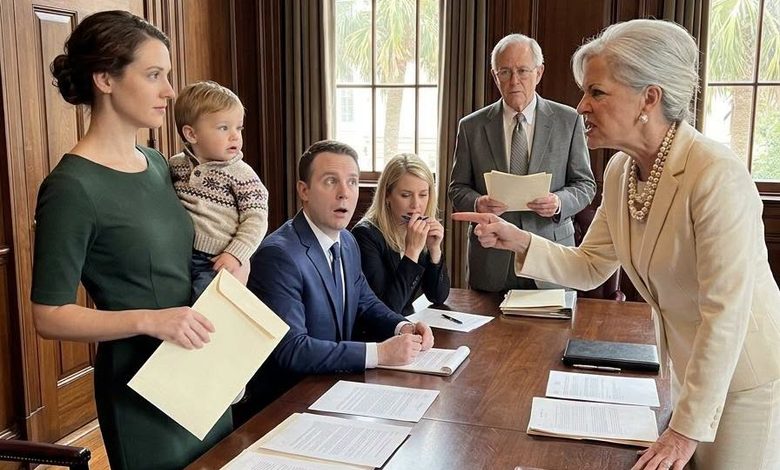
“That woman doesn’t deserve a chair in this office! She divorced my son, and now she’s come to take my husband’s money!”
Marguerite Prescott’s voice bounced off the tall windows of the law office. Her finger was pointed straight at me, her pearls trembling at her throat.
I stayed where I was, just inside the door.
My name is Eleanor Hayes. I was thirty-three years old, wearing the dark green dress I’d bought for a client presentation, holding a small handbag in both hands like a shield.
I hadn’t come to fight.
I had come because Thomas Prescott — the only person in that family who ever treated me like a daughter — had asked me to be there.
The Man Who Brought Me Dinner
Thomas died three weeks earlier in Charleston. He was seventy-one. His heart simply gave out one morning while he was reading the paper on his porch.
I found out from a cousin’s Facebook post.
Nobody in the family called me.
I met his son, Warren, six years ago while I was restoring the brass fittings and old light fixtures in a historic hotel his family owned downtown. I grew up in North Charleston, in a small house where my mother sewed other people’s clothes at the kitchen table until midnight so my brothers and I could eat.
Warren grew up with a pecan business, rental properties and an old family estate outside Summerville called Magnolia Hollow.
His mother made it clear from the first dinner what she thought of me.
“A girl without an important last name always ends up wanting something,” she said to a table full of guests, smiling as she passed the rolls.
Thomas was different.
When I worked late on job sites, he’d show up with a paper bag of fried chicken and sit on an overturned bucket to make sure I actually ate it. When I signed my first big restoration contract, he was the first one to raise a glass.
“A person’s worth isn’t in her bank account, honey,” he told me once. “It’s in what she does when nobody’s watching.”
Warren never defended me. Not once in four years of marriage. Every time his mother cut me down, he looked at his phone.
Twenty-two months ago, I finally walked away. I was four months pregnant with our son, Theo, when I signed the papers. Warren barely looked up.
Five months later, he married Camille — the polished, wealthy woman his mother had always picked out for him.
But Thomas never stopped coming around. He came to the hospital the day Theo was born. He brought cinnamon rolls from a bakery in Summerville every other Sunday. He still called me “honey.”
That’s why I was in that office.
The Reading
Marguerite sat at the head of the table in a cream suit. Warren sat to her right. Camille sat beside him, glancing at me like I was a stain she couldn’t remove.
“I don’t understand why my father insisted on inviting you,” Warren muttered. “You’re not part of this family anymore.”
“I didn’t come for you,” I said quietly.
That seemed to bother him more than if I’d screamed.
The attorney, Gerald Whitaker, adjusted his glasses and began to read.
Warren received his father’s shares in the company and the largest part of the estate. Marguerite kept her marital property and several additional benefits.
Marguerite smiled. Warren relaxed into his chair.
Then Mr. Whitaker read my name.
“To Ms. Eleanor Hayes, from the portion of the estate subject to the testator’s free disposition, I bequeath the house in Summerville known as Magnolia Hollow and the sum of $142,000.”
Marguerite shot out of her chair so fast it tipped backward.
“That’s impossible! That house is worth a fortune!”
Warren had gone white.
“My father was sick,” he said. “She must have talked him into it.”
I couldn’t even speak. Magnolia Hollow was the house Thomas had grown up in. The house with the wraparound porch and the swing where he taught Theo to say “bird.” I had never once asked him for anything.
Mr. Whitaker raised one hand.
“Mr. Prescott documented his capacity and his wishes with his physician and with this office. He also left a letter to be opened in your presence.”
He held up an ivory envelope.
Across the front, in Thomas’s slanted handwriting, were the words:
“If Marguerite accuses Eleanor of deceiving me, read first what happened on May 7.”
Marguerite froze. For a moment, she didn’t seem able to breathe.
Warren looked at his mother. Then at the envelope. Then back at his mother.
“Mom,” he said slowly. “What happened on May 7?”
She didn’t answer.
But I knew.
Because I was the one Thomas had called that night.
What really happened on May 7 — and why did Marguerite go pale? Continue to the next page…
The Night He Called Me
Mr. Whitaker unfolded the letter and began to read Thomas’s words out loud.
“On May 7 of last year, I had chest pains at Magnolia Hollow. Marguerite was with me. So was a man I had never met — a real estate broker from Atlanta.”
Marguerite gripped the back of her chair.
“While I sat on the porch unable to catch my breath, my wife placed a stack of papers in front of me and told me they were insurance forms for the hospital. She asked me to sign quickly. I could not read them. My vision was blurry and my left arm had gone numb.”
“I refused. I asked her to call an ambulance.”
“She told me I was being dramatic and went inside with the broker.”
Warren’s mouth opened. Nothing came out.
“I called the only person I knew would come without asking a single question. Eleanor drove forty minutes with her baby in the back seat. She found me on the porch floor. She drove me to the hospital herself and held my hand until the doctors took me in.”
I remembered every second of it. Theo crying in his car seat. Thomas gray and sweating, trying to joke so I wouldn’t be scared. The nurse who told me afterward that another thirty minutes might have been too late.
Mr. Whitaker turned the page.
“Three weeks later, my bank called. Someone had tried to take out a $600,000 loan against Magnolia Hollow. The application carried my signature. I did not sign it.”
“The papers my wife pushed in front of me on the porch were the loan documents. When I wouldn’t sign them, she signed them herself.”
The room went completely silent.
Camille slowly moved her chair a few inches away from her mother-in-law.
The Secret She Tried to Bury
The letter went on. Thomas had hired a private accountant. He discovered that Marguerite had been quietly moving money out of the family accounts for almost two years — first small amounts, then large ones — to cover debts she’d built up at a private card club in Savannah and a string of failed investments she’d made behind his back.
The Atlanta broker was supposed to sell Magnolia Hollow as soon as the loan went through.
“I stopped the loan,” Thomas wrote. “I paid her debts quietly, because I did not want my son to grow up ashamed of his mother. I told no one. That was my mistake.”
“But I changed my will. Magnolia Hollow goes to the person who saved my life when my own family left me on that porch. And one day, it will go to my grandson, Theo.”
Mr. Whitaker set the letter down and opened a folder.
“Mr. Prescott left copies of the forged loan application, the bank’s fraud report, the hospital admission records from May 7, and a sworn statement from the broker,” he said calmly. “He also left instructions. If anyone contests Ms. Hayes’s inheritance, this folder goes directly to the county prosecutor.”
Marguerite sank into her chair. All the color had drained out of her face.
“Thomas was confused,” she whispered. “He didn’t know what he was saying.”
“His cardiologist and two psychiatrists confirmed his capacity in writing,” Mr. Whitaker replied. “Twice.”
Warren
Warren stared at his mother for a long time.
“You told me he had a little indigestion that night,” he said. “You told me Eleanor overreacted and dragged him to the ER to make herself look good.”
Marguerite didn’t answer.
Warren turned to me. For the first time in six years, he looked at me like he actually saw me.
“You never said anything,” he said. “Why didn’t you tell me?”
“Your father asked me not to,” I said. “He wanted to handle it himself. And honestly, Warren — would you have believed me?”
He looked down at the table. That was answer enough.
There was one more envelope in the folder. It was addressed to Warren. Mr. Whitaker handed it to him, and Warren read it silently. By the time he reached the end, his eyes were wet.
He folded it and put it in his jacket.
“Dad says I owe you an apology,” he said quietly. “He’s right. I’m sorry, Eleanor. For all of it.”
Then he said something I never expected.
“Could I meet my son?”
Magnolia Hollow
Marguerite never contested the will. Within a month, she had sold her house in town and moved to her sister’s place in Savannah. The family accounts are now overseen by an outside trustee.
My neighbor had been watching Theo in the lobby during the reading. When I walked out of that office, I picked him up and held him so tightly he giggled and grabbed my nose.
Behind me, through the glass doors, I could see Warren still sitting at the table. Marguerite stood beside him, demanding he do something. He didn’t move. He just watched me carry his son down the steps.
Today, Magnolia Hollow is my restoration workshop. The old carriage house holds my tools, and the front parlor is where I meet clients. I kept Thomas’s reading chair exactly where he left it.
Warren visits Theo every other Saturday now. He’s slow and awkward and still learning. But he shows up. Camille sometimes comes too, and she’s kinder than I ever gave her credit for.
Every Sunday morning, Theo and I sit on the porch swing with cinnamon rolls from the bakery in Summerville.
He points at the birds and says, “Pop-pop’s birds.”
And I tell him about the man who taught me that a person’s worth is in what she does when nobody’s watching.
Because on May 7, nobody was watching.
Except Thomas.
This story is a work of fiction. Names, characters and events are invented.