I Stopped a Man From Leaving With a Crying 3-Year-Old — He Sued Me for $250,000, Then a Young Woman Stood Up in Court
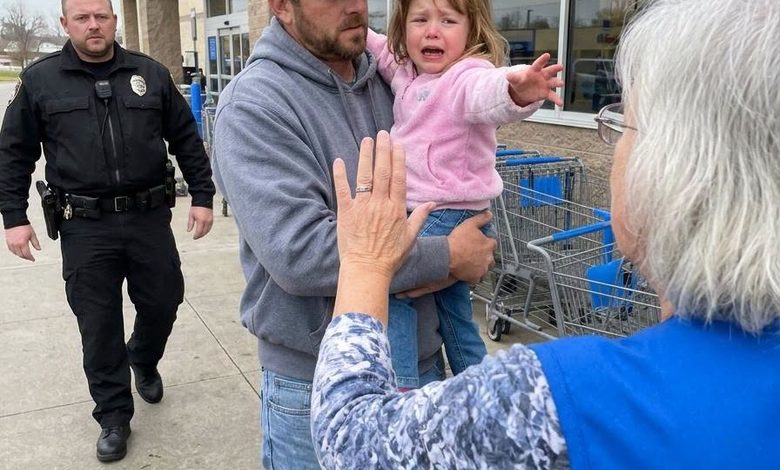
This is a fictional story, inspired by everyday courage.
“He’s not my daddy! I want Mommy!”
I can still hear that little voice when the house is quiet at night.
My name is Mavis Keller. I’m sixty-seven years old, and for nine years I stood by the sliding doors of a big store in Fort Smith, Arkansas, saying “Welcome in” to everyone who walked through them.
Before that, I carried mail for thirty-one years. I knew every dog, every porch and every grandmother on my route. When I retired at sixty, I thought I’d finally rest.
Instead, I lost my husband, Walt, the spring after.
The house got so quiet I started leaving the television on just to hear a voice. So I took the greeter job. Part-time. Blue vest. Name tag. A pocket full of yellow smiley-face stickers.
The kids were my favorite part. Some of them dragged their parents back just to get a sticker from “Miss Mavis.” One little boy told me I was the “door grandma.”
I wore that title like a medal.
The Tuesday Everything Changed
It was a rainy Tuesday afternoon in March. The store was slow. I was straightening the carts when I heard crying coming toward the exit.
A man in a gray hoodie and a baseball cap was walking fast, carrying a little girl on his hip. Curly hair. Pink rain boots. Maybe three years old.
At first I thought what any grandmother would think. A tired toddler who didn’t want to leave the toy aisle. I’ve seen a thousand of those meltdowns.
Then I heard what she was saying.
“You’re not my daddy! I want Mommy!”
It wasn’t a tantrum cry. It was a scared cry. The kind that comes from deep in the chest.
I stepped into their path and held out a sticker, the way I always did.
“Hi there, sweetheart. Would you like a smiley face?”
She didn’t even look at the sticker.
She reached out with both hands and grabbed the front of my blue vest like it was a life raft.
The man tightened his grip on her and forced a smile.
“She’s exhausted. She’s going through a phase. Excuse us.”
He tried to step around me. I stepped with him.
“Sir, could you tell me her name?”
His face changed. Just for a second. Like a door slamming shut.
“Get out of my way.”
“What’s her name?”
“Quinn,” he snapped. “Her name is Quinn. I’m her father.”
I bent down so I was at her eye level.
“Quinn, honey, is this your daddy?”
She shook her head so hard her curls bounced.
“No! He took me from Miss Corliss’s house!”
My stomach dropped all the way to my shoes.
“Mavis, Move.”
The man said she was too little to understand. That she called every babysitter’s house “home.” Then he leaned closer and lowered his voice.
“Lady, if you don’t move, I’ll move you.”
My knees were shaking. I didn’t move.
“I’m calling my manager,” I said. “Just to make sure everything’s okay.”
Mr. Darby showed up a minute later. He was thirty-five, wore his lanyard like a badge, and hated anything that might turn into a customer complaint.
The man pulled out his wallet and showed him a driver’s license. Then he held up his phone. On the screen was a photo of him holding a newborn baby in a hospital blanket.
“See? She’s mine. This woman is harassing me in front of my kid.”
Mr. Darby glanced at the license. Glanced at the photo. Then he looked at me like I was a spill on aisle seven.
“Mavis, step aside. You’re embarrassing the store.”
“But she says he took her!”
“Mavis. Move.”
I have never hated two words more in my life.
I stepped aside. Quinn’s little fingers slid off my vest one by one. She kept her eyes on me the whole way out the doors.
I couldn’t let it go.
I followed them into the parking lot, keeping my distance. My hands were trembling so badly I nearly dropped my phone. But I took three pictures.
His face.
Quinn, crying, through the back window of a dark blue pickup.
And his license plate.
As the truck pulled out, I dialed 911.
“I don’t know if I’m right,” I told the dispatcher. “Maybe I’m a foolish old woman. But a little girl just told me a man took her, and nobody would listen.”
Fired After Nine Years
The next morning, Mr. Darby called me into his office before I’d even clocked in.
He didn’t offer me a chair.
“The gentleman from yesterday called corporate,” he said. “He says you physically blocked him, accused him of kidnapping his own daughter, followed him into the parking lot and took photos of his child.”
“I called the police because I was worried about her.”
“You disobeyed a direct instruction from management.” He slid a piece of paper across the desk. “Corporate wants you gone. Effective today.”
Nine years.
I turned in my vest. I left the stickers on the counter for whoever came next.
Three weeks later, a man in a suit knocked on my front door and handed me an envelope.
I was being sued.
Defamation. Emotional distress. Harassment.
Two hundred and fifty thousand dollars.
I sat down on my porch steps and read the papers until the words blurred. I didn’t have two hundred and fifty thousand dollars. I had a paid-off house, Walt’s old truck and a postal pension.
And the worst part wasn’t the money.
The worst part was that nobody ever told me what happened to Quinn.
The police had thanked me for the call. They said they would “look into it.” And then — nothing. No phone call. No news. Not one word.
Some nights I wondered if I really had gotten it all wrong. If I’d ruined my own life over a toddler’s bad mood.
Then I’d remember those little fingers sliding off my vest.
Seven months later, I walked into the Sebastian County courthouse in my Sunday dress, holding my late husband’s handkerchief.
The man sat at the other table in a brand-new suit, whispering with an expensive lawyer. He didn’t look at me once.
His lawyer stood up and called me “a confused elderly woman who decided to play detective and destroyed an innocent father’s reputation.”
My throat closed up.
And then, from the back row of the courtroom, a chair scraped against the floor.
A young woman was standing up. Early twenties. Pale. Her hands were shaking.
“Your Honor,” she said, her voice cracking, “I need to say something. Because that man is lying.”
Every head in the courtroom turned.
And when I saw who was holding her hand, I couldn’t breathe.
Who was the young woman — and what did she know? Continue to the next page to find out…
She was holding the hand of a little girl in a yellow dress.
Curly hair. Pink rain boots.
Quinn.
She saw me across the courtroom, and her whole face lit up.
“Sticker lady!”
I pressed Walt’s handkerchief to my mouth and cried right there in front of the judge.
“My Name Is Tessa Monroe”
The judge called for order. The man’s lawyer objected. The young woman didn’t sit down.
“My name is Tessa Monroe,” she said. “Quinn is my daughter. And that man is not her father.”
The courtroom went dead silent.
The judge allowed her to speak after a short recess, and what she told the court that afternoon is something I will carry with me for the rest of my life.
The man’s name was Brandon Pike. Tessa had dated him for a few months when Quinn was a baby. He’d been charming at first. Then controlling. Then frightening. When she ended things, he wouldn’t accept it.
She got a protective order. He was ordered to stay away from her and her daughter.
The baby photo on his phone? He had taken it from Tessa’s social media years earlier. He’d held Quinn exactly once, at the hospital, before Tessa even knew what kind of man he was.
On that rainy Tuesday in March, Tessa was at work. Quinn was at her daycare provider’s home — Miss Corliss, a sweet older woman who watched four children in her living room.
Brandon knocked on the door and said Tessa had sent him to pick Quinn up early. When Miss Corliss hesitated, he showed her an old photo of himself with Tessa and said he was “the boyfriend.” While she went to call Tessa to check, he picked Quinn up and walked out.
He stopped at the store because Quinn wouldn’t stop crying. He needed diapers and snacks for the long drive he’d planned — out of state, to a place where nobody knew either of them.
“By the time Miss Corliss reached me, he was already gone,” Tessa said. “I called the police screaming. I gave them his name. But I didn’t know what he was driving. I didn’t know which direction he went.”
She turned and looked straight at me.
“And then twenty minutes later, a dispatcher called me back. She said an older woman at a store in Fort Smith had just reported a crying little girl with curly hair and pink rain boots. She had his face. His truck. His license plate.”
Her voice broke.
“State troopers pulled that truck over forty miles outside of town. My daughter was asleep in the back seat, still holding a yellow smiley-face sticker in her fist.”
I hadn’t even realized I’d slipped one into her hand.
Why Nobody Told Me
Tessa explained the rest through tears.
Because Quinn was a minor and the criminal case against Brandon was still open, the police couldn’t share details with me. Tessa had begged them for my name so she could thank me. They couldn’t give it to her.
For seven months, she’d been searching for “the sticker lady.”
Then, two weeks earlier, a coworker showed her a small article in the local paper’s court listings: “Former store greeter sued for $250,000 by Fort Smith man.”
The man’s name was Brandon Pike.
“He was out on bond,” Tessa said, staring at him. “And he was using that time to punish the one person who stopped him.”
Brandon’s lawyer had gone gray. He leaned over and whispered something urgent to his client. Brandon shook his head and stared at the table.
The judge took off her glasses.
“Counsel,” she said, “were you aware that your client is currently facing criminal charges for the incident at the center of this lawsuit?”
The lawyer cleared his throat.
“I — Your Honor, I’d like to request a moment with my client.”
Within the hour, the lawsuit was withdrawn.
The judge didn’t stop there. She dismissed the case with prejudice, which my lawyer later explained means he can never file it again. She ordered him to pay my legal fees. And she forwarded the record of what he’d tried to do to the prosecutor handling his criminal case.
A few months later, Brandon Pike pleaded guilty. He will not be anywhere near Quinn or her mother for a very long time.
The Hug
Outside the courtroom, Quinn ran down the hallway and threw her arms around my knees.
Tessa hugged me so hard my glasses went crooked.
“Everyone walked past us,” she whispered. “Your manager walked past us. You were the only one who stopped.”
I told her what I’d told myself every night for seven months.
“She asked for help. Somebody had to listen.”
What Happened at the Store
A reporter was sitting in the back of that courtroom.
By Friday, the story was everywhere. People lined up outside the store holding signs that said “BRING BACK MISS MAVIS.” Customers left smiley-face stickers stuck all over the front doors.
The following Monday, a regional vice president drove four hours to sit in my kitchen.
He apologized. He told me Mr. Darby was no longer with the company. He offered me my job back, full back pay for every week I’d missed, and a new position: training every greeter and manager in the region on what to do when a child says they’re in danger.
“The policy now,” he said, “is simple. If a child says they don’t know the adult they’re with, you call the police first and ask questions second. We’re calling it the Keller Rule.”
I said yes.
I’m back at the doors now, three days a week, in a brand-new blue vest.
And every Saturday morning, a little girl with curly hair and pink rain boots comes running through the sliding doors yelling, “Sticker lady!”
I always save her the very first one.
Because sometimes the smallest voice in the room is the one telling the truth. And sometimes all it takes to change a life is one person who refuses to step aside.
This story is a work of fiction. Names, characters and events are invented for storytelling purposes.