When I Was Six, I Promised My Best Friend With Down Syndrome We’d Go to Prom Together—12 Years Later, My Mother Locked My Bedroom Door and Told Me a Secret He’d Kept From Me
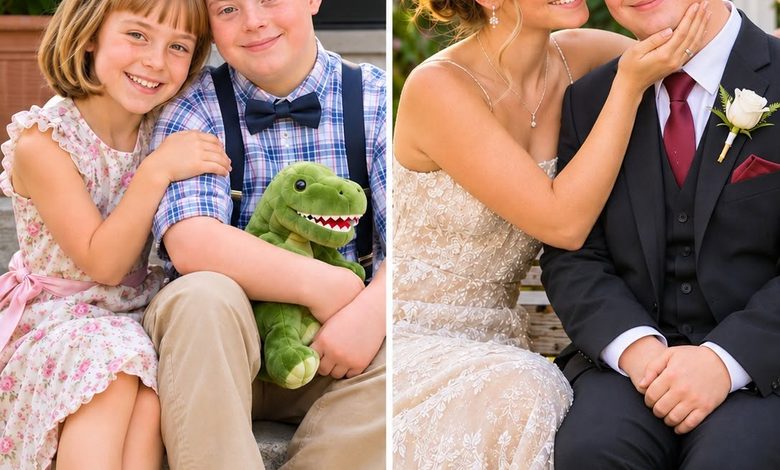
Part 1 — The Secret Behind My Locked Bedroom Door
The evening of my senior prom, my mother locked me inside my bedroom and told me something about my best friend that changed the way I understood the previous twelve years of my life.
At first, I thought she was going to forbid me from going with him.
I couldn’t have been more wrong.
My name is Evelyn Lawson, although almost everyone calls me Evie. I was eighteen that spring, and I had been looking forward to prom for months.
Not because I had the perfect dress or because I expected some magical evening straight out of a movie.
I was excited because I would finally be keeping a promise I’d made when I was six years old.
My date was Miles Parker.
Miles had Down syndrome. He was also the funniest, most stubborn, wonderfully unpredictable person I knew.
We had grown up together, sharing everything from school lunches and birthday parties to arguments, disappointments, and the kind of secrets that only childhood friends understand.
Some people seemed surprised that I wanted to attend prom with him.
A few even told me how generous I was being.
Those comments always irritated me.
Going to prom with Miles wasn’t an act of kindness. I genuinely wanted him there.
In fact, I couldn’t imagine sharing that evening with anyone else.
That afternoon, my mother helped me into a long emerald-green dress we’d found at a small boutique downtown.
She carefully fastened the tiny buttons along my back, then stepped away to admire her work.
“Oh, Evie,” she whispered. “You look beautiful.”
I turned toward the mirror.
For once, I didn’t feel like the awkward teenager who spent too much time worrying about her hair.
I felt grown up.
My mother stood behind me, smiling.
Then, quite unexpectedly, her eyes filled with tears.
“Mom?”
She shook her head.
“Nothing. I’m just thinking about how quickly you’ve grown.”
I laughed.
“You say that every birthday.”
“I know.”
She gently smoothed the fabric over my shoulder.
“But tonight feels different.”
Before I could ask what she meant, the doorbell rang.
I immediately glanced at the clock.
Six fifteen.
Miles was right on time.
“That’s him!”
I reached for my shoes, but Mom caught my wrist.
“Evie, sweetheart, wait.”
Something in her voice made me stop.
“What?”
She looked toward the hallway, then back at me.
“I need to tell you something before you go downstairs.”
“Can it wait? Miles is here.”
“No.”
Her answer was so firm that I stared at her.
Mom walked to the door, closed it, and turned the lock.
The small click sounded unusually loud.
“Mom, what are you doing?”
She didn’t answer immediately.
Instead, she sat on the edge of my bed, folding her hands tightly in her lap.
I had seen my mother worried before.
I’d seen her frightened during thunderstorms, angry over unpaid bills, and exhausted after long workdays.
But I’d never seen quite that expression on her face.
She looked guilty.
“Is something wrong with Miles?” I asked.
“No. He’s fine.”
“Then why are you acting like this?”
Mom drew a shaky breath.
“Because there’s something you should have known a long time ago. Something about what happened when you were little.”
I frowned.
“What happened?”
She looked down.
“It involves Miles.”
My stomach tightened.
“Mom, please don’t tell me you don’t want me going with him.”
She immediately raised her head.
“Evie, no. That’s not it at all.”
“Then what?”
Her lips trembled.
“Twelve years ago, when your father and I separated, I went through a very difficult time.”
I already knew that.
Or at least, I thought I did.
Dad had moved away when I was six. Afterward, my mother worked longer hours, we moved into a smaller house, and some evenings she was too tired to do anything except sit quietly on the sofa.
I remembered being confused.
I remembered asking when Dad was coming home.
But I had never understood how deeply those months had affected her.
Mom reached for my hand.
“There was an afternoon when I felt completely overwhelmed. I was struggling more than you realized, and I hadn’t told anyone how bad things had become.”
She paused.
“That afternoon, Miles found me crying.”
I blinked.
“Miles?”
She nodded.
“He was six years old, Evie. Just a little boy. But what he said to me that day reminded me there were still good things ahead.”
My mother began crying.
“And all these years, I’ve allowed him to believe he was responsible for making sure you and I stayed happy.”
I stared at her.
“What are you talking about?”
She wiped her cheeks.
“That’s what I need to explain.”
And then, while Miles waited downstairs in his prom suit, my mother told me a story that had been kept from me for twelve years.
Part 2 — The Boy Who Never Forgot a Promise
To understand why my mother’s confession affected me so deeply, you need to know something about Miles.
We met on the first day of first grade in a small elementary school outside Asheville, North Carolina.
I remember sitting alone at a table with a box of crayons, trying to decide whether I wanted to draw a house or a horse.
A boy with sandy-blond hair sat across from me.
He looked at my paper.
“What’s that?”
“A horse.”
He studied it carefully.
“Why does it have five legs?”
I looked down.
My horse did, in fact, have five legs.
“Because it’s special,” I answered indignantly.
He considered that.
“Okay. Mine is going to have eight.”
Then he picked up a purple crayon and began drawing what looked like a giant potato with legs.
I laughed.
He laughed.
And somehow, that was the beginning of everything.
His name was Miles Parker.
He loved music, memorized movie dialogue after hearing it once, and could identify almost any bird by its call.
He also had strong opinions about food.
He thought mushrooms were disgusting, insisted that pineapple belonged on pizza, and believed every birthday cake should contain chocolate.
I disagreed with him about almost all of those things.
We became inseparable anyway.
Miles had Down syndrome, which meant certain tasks took him longer to learn. Sometimes he needed extra support in class or more time to organize his thoughts.
But he had his own strengths, interests, and opinions, and he was never particularly interested in being treated as though he couldn’t make decisions for himself.
Even at six, he knew what he liked.
And he wasn’t afraid to say so.
Our friendship became a regular part of both families’ lives.
His mother, Karen, often drove us to the library on Saturdays.
My mother made pancakes when Miles came over for sleepovers with my cousins.
During summer vacations, we spent afternoons building elaborate forts in our backyard.
We argued over whose turn it was to choose a movie.
We accused each other of cheating at board games.
Sometimes we got angry and refused to speak for an hour.
Then one of us would apologize, and everything would return to normal.
The prom promise happened near the end of first grade.
Our teacher, Mrs. Whitfield, had brought photographs from her son’s high school graduation to show the class.
In one picture, her son stood beside a girl wearing a beautiful dress.
“That’s from his senior prom,” she explained.
Naturally, everyone had questions.
What was prom?
Why did people wear fancy clothes?
Did they have to dance?
Was there cake?
That last question came from Miles.
Mrs. Whitfield laughed and explained that prom was a special dance for older students.
A boy sitting nearby announced that he would someday arrive in a limousine.
Another girl said she wanted a pink dress with diamonds.
Then someone turned toward Miles.
“You probably won’t have a date.”
The words weren’t shouted.
They weren’t even particularly dramatic.
But I remember the sudden change in Miles’s expression.
He looked down at his desk.
Before I could think of anything clever to say, I blurted out, “He already has one.”
Everyone turned toward me.
Miles did too.
“I do?”
“Yes,” I said.
“Who?”
“Me.”
He looked genuinely surprised.
Then he smiled.
“Okay. But I get to pick one song.”
“Fine.”
“And we have to eat cake.”
“Obviously.”
He extended his little finger across the desk.
“Promise?”
I hooked mine around his.
“Promise.”
To two six-year-olds, it was a wonderfully simple agreement.
I had no idea how much that tiny moment would come to mean to him.
Or to my mother.
Over the following years, life changed around us.
We grew taller.
Our interests changed.
We entered middle school, then high school.
Miles joined a community theater group and discovered he loved performing.
He had a remarkable memory for dialogue and an ability to deliver funny lines with perfect timing.
I joined the school newspaper, then became interested in photography.
Sometimes our schedules barely matched, but we made time for each other.
When my grandmother died, Miles came to the funeral and sat beside me without saying much.
Afterward, he gave me a photograph he’d taken of Grandma laughing at my thirteenth birthday party.
“I thought you’d want this,” he said.
I still have it.
When Miles auditioned for his first speaking role in a theater production, I helped him practice every evening for two weeks.
He got the part.
On opening night, I was in the front row, cheering louder than anyone.
He later informed me that I had embarrassed him.
I told him he was welcome.
And when my first serious boyfriend broke up with me during junior year, Miles appeared at our door carrying a pizza.
He took one look at my swollen eyes.
“Was he mean?”
I nodded.
Miles placed the pizza on the table.
“Then we are eating his half.”
I couldn’t help laughing.
“His half of what?”
“The pizza. He doesn’t deserve any.”
That was our friendship.
Not perfect.
Not always easy.
But real.
As senior year approached, people began talking about prom.
Several boys asked whether I already had a date.
I told them I did.
Miles.
I never seriously considered breaking our childhood agreement.
Then, three months before prom, something happened that introduced a tension between us I’d never experienced before.
Miles received an acceptance letter from a college-based theater and independent living program several hours away.
He was thrilled.
The program offered classes in stage production, communication, independent living skills, and opportunities to work with a local theater company.
He showed me the letter one Saturday afternoon.
“Evie, look!”
I read it twice.
“Miles, this is incredible!”
He grinned.
“I know.”
But after the initial excitement, I made a mistake.
I asked whether he was sure he wanted to move so far from home.
He frowned.
“Why wouldn’t I?”
I hesitated.
“Because it’s a big change. You’ll have to manage a lot of things yourself.”
“That’s why I’m going.”
“I know, but—”
“But what?”
I struggled to explain that I was worried about him.
Instead, I said something I regretted immediately.
“I just don’t want you to get overwhelmed.”
His smile disappeared.
“You sound like everybody else.”
“Miles, I didn’t mean—”
“Everybody thinks I need someone to tell me what I can do.”
“That’s not what I’m saying.”
“Then why can’t you just be happy for me?”
I had no good answer.
He left early that afternoon.
We apologized a few days later, and things seemed to return to normal.
Still, I noticed that Miles sometimes became unusually quiet whenever I talked about our plans after graduation.
I assumed he was nervous about moving away.
I never imagined he was questioning the very foundation of our friendship.
And I certainly didn’t know he had been carrying another secret since we were six.
Part 3 — The Afternoon My Mother Never Forgot
Back in my bedroom on prom night, my mother sat beside me with tears on her cheeks.
“I should have told you this years ago,” she whispered.
I squeezed her hand.
“Then tell me now.”
She took a deep breath.
After my father left, Mom explained, our lives had become much more difficult than she’d allowed me to see.
Money was tight.
She had lost a part-time job, and our savings were disappearing faster than she could replace them.
Some nights, she barely slept.
Other days, she struggled to concentrate on even the simplest things.
She tried to act cheerful around me.
But the effort of pretending everything was fine left her exhausted.
“I thought asking for help would mean admitting I couldn’t handle my own life,” she said.
I shook my head.
“Mom, you were going through a divorce. Nobody expected you to handle everything alone.”
“I know that now.”
She looked toward the window.
“Back then, I didn’t.”
One afternoon, she had picked me up from school and dropped me off at my aunt’s house.
Then she drove to the community center where Miles attended an after-school activity.
She was supposed to speak to his mother about an upcoming class trip.
But before going inside, she received a difficult phone call about our finances.
When the call ended, she sat in her parked car and cried.
She was frightened.
Frightened about our future.
Frightened about the bills.
Frightened that no matter how hard she worked, she would never be able to give me the childhood she wanted me to have.
She didn’t notice Miles approaching until he knocked gently on her window.
His mother was a few steps behind him.
Mom wiped her face and lowered the window.
“Hello, sweetheart.”
Miles held up a piece of paper.
“I made a map.”
Normally, Mom would have admired it and asked him to explain.
But that afternoon, she could barely manage a smile.
Miles noticed.
“Why are you crying, Mrs. Lawson?”
“I’m just having a difficult day.”
He frowned.
“Did somebody hurt your feelings?”
She gave a weak laugh.
“Not exactly.”
He looked at her thoughtfully.
Then he unfolded his drawing.
It was a colorful map of an imaginary town, complete with houses, parks, a bakery, and a large building labeled HELP CENTER.
He pointed to it.
“This is where people go when they’re stuck.”
Mom smiled faintly.
“That sounds like a useful place.”
“It is.”
He tapped the drawing again.
“If you’re stuck, you should tell someone.”
By then, Karen had reached the car.
She immediately noticed Mom’s distress.
“Joanna, are you all right?”
Mom tried to say yes.
But something about the concern in Karen’s voice made it impossible to keep pretending.
“No,” she admitted.
“I’m really not.”
Karen asked whether she wanted to come inside and talk.
For the first time in weeks, my mother said yes.
As they walked toward the building, Miles suddenly stopped.
“Mrs. Lawson?”
Mom turned.
“Yes, sweetheart?”
He looked unusually serious.
“Evie said she’s going to prom with me when we get big.”
Despite everything, Mom smiled.
“She did?”
He nodded.
“And you have to come see us.”
“I wouldn’t miss it.”
He held up his little finger.
“Promise?”
My mother linked hers around it.
“I promise.”
Mom told me that the conversation with Miles hadn’t magically solved her problems.
There were still bills to pay.
There were still painful conversations with my father.
There were still mornings when getting out of bed felt difficult.
But that afternoon became a turning point.
Karen helped her contact my aunt, who had been worried about her for months.
With their encouragement, Mom found a counselor and began getting professional support.
She also accepted practical help from family members instead of trying to solve everything alone.
Things improved gradually.
Some days were better than others.
But eventually, the fear and exhaustion that had dominated her life began to ease.
“And all that started because Miles noticed you were crying?” I asked.
Mom nodded.
“He was part of what helped me finally admit I needed support.”
I felt tears gathering in my own eyes.
It was difficult to imagine the cheerful, confident mother I’d known for most of my life feeling so lost.
Then another thought occurred to me.
“Why didn’t you ever tell me?”
She hesitated.
“Because I didn’t want you to worry. And because I was embarrassed that I’d needed so much help.”
“But Miles knew?”
“He knew I’d been upset. He didn’t understand all the circumstances.”
She paused.
“And I asked him not to tell you.”
I stared at her.
“You asked a six-year-old to keep that secret?”
Mom lowered her eyes.
“Yes.”
“Mom…”
“I know.”
Her voice broke.
“I didn’t understand what I was asking of him.”
She told me Miles had taken his promise seriously.
As the years passed, he occasionally reminded her that she had to attend our prom.
At my tenth birthday party, he asked whether she was still planning to come.
When we entered high school, he reminded her again.
She always smiled and assured him that she would be there.
But something changed when Miles was fourteen.
That year, my mother had been especially grateful for the friendship between our families.
One afternoon, she told Miles how much his kindness had meant during those difficult years.
She said she sometimes wondered where she would be without him.
She called him the person who had helped keep our family together.
Mom had intended those words as heartfelt appreciation.
But she now understood that Miles had heard something else.
A responsibility.
He began checking on her whenever she seemed tired.
He worried if I was upset.
He sometimes canceled his own plans when he thought I needed company, even when I insisted I was fine.
At the time, Mom interpreted his behavior as ordinary concern.
Only later did she realize how deeply he’d absorbed the idea that taking care of us was his job.
“He’s been carrying that feeling for years,” she whispered.
I looked at her in disbelief.
“Why didn’t you tell him it wasn’t his responsibility?”
“I thought I had. I thanked him, and I told him we were doing well.”
She shook her head.
“But I never sat down and explained that the adults in my life were the ones responsible for helping me. I should have done that.”
I stood and walked toward the window.
Outside, the evening sun was turning the sky pale orange.
Somewhere downstairs, Miles was waiting.
The same boy who had made me laugh through the hardest moments of my childhood had apparently spent years worrying that he needed to protect me.
I felt both grateful and heartsick.
Then Mom said something that made me turn around.
“There’s another reason I decided to tell you tonight.”
“What?”
“Miles called me this morning.”
I froze.
“What did he say?”
She looked directly into my eyes.
“He asked me to tell you the truth before you went to prom together.”
“Why?”
Mom’s expression softened.
“Because he doesn’t want either of you making choices out of obligation anymore.”

Part 4 — The Letter He Was Afraid to Give Me
For a long moment, I could only stare at my mother.
“Miles wanted you to tell me?”
She nodded.
“He said he was tired of wondering whether people spent time with him because they genuinely wanted to or because they believed it was the right thing to do.”
Her words brought back our argument about his college program.
I remembered his disappointed expression.
His frustration.
The way I’d spoken as though I knew better than he did what kind of future he could manage.
I felt ashamed.
Mom stood and gently unlocked the door.
“Evie, I love you. And I know Miles does too. But I don’t want either of you to feel trapped by something that happened when you were children.”
I looked at her.
“What am I supposed to do?”
“Talk to him.”
She squeezed my shoulder.
“Listen to what he wants. Tell him what you want. And remember that neither of you owes the other person a particular future.”
I nodded.
Then I took a deep breath and walked downstairs.
Miles stood near the front window in a charcoal-gray suit.
He wore a white shirt, a dark green tie that matched my dress, and polished shoes.
His hair was neatly combed.
In one hand, he held a small box containing a corsage.
When he saw me, his face lit up.
“Evie!”
Then he noticed my expression.
His smile faded.
“Your mom told you.”
I nodded.
“She did.”
He looked down at the box.
“Oh.”
For once, Miles seemed genuinely unsure of what to say.
I walked toward him.
“Can we talk outside?”
He nodded.
We stepped onto the porch and sat on the wooden bench beside the front door.
For a while, we listened to the distant sound of a lawn mower.
Then I turned toward him.
“Miles, I’m sorry.”
He looked surprised.
“Why?”
“Because I didn’t understand what you’ve been carrying all these years.”
He shrugged.
“I didn’t understand it either. Not at first.”
“Why didn’t you tell me?”
He stared at his hands.
“Because your mom asked me not to talk about that day.”
“But that was twelve years ago.”
“I know.”
He hesitated.
“And later, I thought maybe if I stopped looking after you, I would be letting everybody down.”
Something tightened in my chest.
“Miles, you don’t have to look after me.”
“I know that now.”
He glanced toward the driveway.
“But for a long time, I thought that was why I mattered.”
I felt my eyes fill.
“That’s not true.”
He nodded slowly.
“Karen told me that too.”
His mother had clearly been helping him work through these feelings.
Then he looked at me.
“Can I ask you something?”
“Anything.”
“Do you really want to go to prom with me?”
The question hurt more than I expected.
“Of course I do.”
“Not because you promised?”
“No.”
“Not because your mom likes me?”
“No.”
He hesitated.
“And not because you feel sorry for me?”
“Miles.”
My voice cracked.
“You’re my best friend.”
He looked at me carefully.
“I know. But sometimes people say nice things about you for being friends with me.”
I nodded.
I’d heard those comments for years.
People calling me wonderful.
Generous.
Patient.
As though friendship with Miles were some difficult volunteer assignment.
“I don’t like those comments either,” I admitted.
He gave a small, humorless smile.
“I don’t want to be somebody’s project.”
“You’re not.”
“I don’t want to be the reason people think you’re a good person.”
“You’re not that either.”
I reached for his hand.
“Miles, you’re the person I call when something wonderful happens. You’re the person I want to talk to when everything goes wrong. You make me laugh when I’m annoyed, and you drive me absolutely crazy when you insist on being right about things you know nothing about.”
He grinned slightly.
“That’s not true.”
I raised an eyebrow.
“Remember when you insisted you could teach me to cook?”
“That spaghetti was good.”
“It was crunchy.”
“Some people like crunchy.”
I burst out laughing.
So did he.
For a moment, we were simply Evie and Miles again.
Then I grew serious.
“I am proud of you for getting into that college program. I was wrong to make you feel like you couldn’t handle it.”
He nodded.
“Thank you.”
“I was worried about losing my best friend.”
He looked surprised.
“Why would you lose me?”
“Because everything’s changing. You’re moving away. I’m going to college. We won’t be able to see each other every weekend.”
He considered that.
Then he said, “We can still be friends when we’re in different places.”
“I know.”
“And I need to try things on my own.”
“I know that too.”
He smiled.
“Good. Because I already told the program I’m coming.”
I stared at him.
“You accepted?”
“Last week.”
“Miles!”
I threw my arms around him.
“That’s amazing!”
He hugged me back.
“I was going to tell you tonight.”
When we separated, he reached inside his jacket.
“Actually, there was something else I wanted to give you.”
He pulled out a small envelope.
My name was written across the front.
“What’s this?”
“A letter.”
“About what?”
He gave me a nervous smile.
“You have to read it.”
I opened the envelope.
Inside was a handwritten letter, carefully folded.
It wasn’t particularly long.
But every word felt unmistakably like Miles.
He wrote about growing up together.
About the silly arguments.
The birthday parties.
The time I’d accidentally spilled orange juice all over his homework and blamed the dog.
He wrote about how much our friendship meant to him.
Then he explained something he had never said aloud.
His feelings for me had changed.
He wasn’t certain exactly when it happened.
Maybe during sophomore year, when we’d gone to a school concert together.
Maybe during the summer we’d spent volunteering backstage at the community theater.
Or maybe it had happened slowly, over years of ordinary afternoons.
But he knew he liked me as more than a friend.
And he was afraid to say so.
Not because he thought I’d be cruel.
Because he didn’t want me to feel obligated to return his feelings.
Near the bottom, he wrote:
Evie, I know we made a promise when we were little. I’m glad we’re going to prom, but that promise doesn’t mean you owe me anything else. I want us to be honest with each other, even when the truth is difficult. So I’m asking you something new. Would you like to go on a real date with me sometime? You can say no, and we’ll still be friends.
I read the last sentence twice.
Then I looked up.
Miles’s cheeks were bright red.
“Well?” he asked.
I couldn’t speak immediately.
For years, Miles had been such a natural part of my life that I hadn’t stopped to consider whether my feelings had been changing too.
I knew I cared about him deeply.
I knew I felt happiest when we were together.
But now he was asking me to look at our relationship differently.
And for the first time, I understood how important it was to answer honestly.
“Miles?”
“Yeah?”
“I think I’d really like that.”
His eyes widened.
“You would?”
I nodded.
“Yes.”
He looked so surprised that I laughed.
“Why are you looking at me like that?”
“Because I practiced asking you about forty times, and I never got this far.”
“Forty times?”
“Maybe forty-seven.”
I started laughing again.
Then I reached for his hand.
“But I want us to take things slowly. We’re both starting new chapters.”
He nodded.
“I want that too.”
“And if something doesn’t work, we talk about it.”
“Agreed.”
“And you have to stop acting like it’s your job to keep me happy.”
He considered that.
“Can I still bring you pizza when you’re sad?”
I smiled.
“Absolutely.”
“Okay. Because I already know how to do that.”
I squeezed his hand.
Then he opened the corsage box.
Inside was a delicate arrangement of white flowers with a tiny silver charm attached.
The charm was shaped like a star.
“Why a star?” I asked.
He smiled.
“Because you used to say you wanted to photograph the whole sky.”
I stared at him.
I’d told him that years earlier.
I hadn’t even remembered the conversation.
But Miles had.
And standing there on our porch, I realized that the most beautiful part of our friendship wasn’t some promise we’d made as children.
It was the simple fact that, after twelve years, we still paid attention to each other.
Part 5 — The Night We Finally Made Our Own Choice
By the time Miles and I returned inside, my mother was standing near the staircase.
She looked nervous.
The moment Miles saw her, he stopped.
“Mrs. Lawson?”
Mom stepped forward.
“Miles, sweetheart, I owe you an apology.”
He looked at her quietly.
She took a breath.
“I should never have asked you to keep my struggles a secret for so many years.”
Miles said nothing.
“And I should never have made you feel responsible for what happened to me afterward.”
Her eyes filled.
“You were a child. You offered kindness when I needed it, and I’ll always remember that. But getting help and taking care of my family were my responsibilities, not yours.”
Miles listened carefully.
Then he asked, “Are you okay now?”
Mom smiled through her tears.
“Yes. And when I’m having a hard time, I know how to ask for help.”
He nodded.
“Good.”
Then he gave her a small smile.
“Because you still have to come to my theater shows.”
Mom laughed.
“Wouldn’t miss them.”
“And Evie’s graduation.”
“Of course.”
“And maybe my graduation too.”
“I’ll be there.”
He thought about that.
Then he extended his hand.
“Okay. New deal.”
Mom took it.
“New deal.”
A few minutes later, Karen arrived to take photographs.
She had brought a small camera and enough enthusiasm to direct an entire wedding party.
“Stand closer!”
“Fix your tie, Miles!”
“Evie, turn toward the light!”
“Miles, stop making that face!”
“This is my good face!” he protested.
We all laughed.
In one photograph, Mom stood between us with her arms around our shoulders.
In another, Miles and I stood beneath the flowering tree beside the driveway.
Then Karen asked us to hold hands.
Miles looked at me.
“Is that okay?”
I smiled.
“Of course.”
He took my hand.
The camera flashed.
And just like that, the moment we’d imagined as six-year-olds became real.
Our prom was held at a hotel ballroom downtown.
When we arrived, the entrance was crowded with students taking pictures beneath an enormous arch of flowers and balloons.
Music floated through the open doors.
Girls adjusted their dresses.
Boys tugged nervously at their ties.
Teachers reminded everyone not to block the staircase.
Miles looked around, impressed.
“Wow.”
I smiled.
“What?”
“This is fancy.”
“It is.”
He studied the decorations.
“Still no chocolate fountain, though.”
I laughed.
“We haven’t even been inside yet.”
“That doesn’t mean I can’t be concerned.”
The evening unfolded in a series of wonderful, imperfect moments.
We ate dinner with friends.
We took ridiculous photographs in the photo booth.
Miles insisted on trying every dessert available, then declared the lemon cake surprisingly excellent.
During one fast song, he danced so enthusiastically that I could barely keep up.
Several classmates cheered.
He responded by taking an exaggerated bow.
I laughed until my stomach hurt.
Later, a girl from my chemistry class approached us.
She smiled at me.
“Evie, you’re such a wonderful person for bringing Miles.”
The words made my smile fade.
I knew she probably meant well.
But after everything we’d discussed, I couldn’t let the comment pass.
I looked at her.
“Miles is my date because I want him to be.”
She blinked.
“Oh, I didn’t mean—”
“I know. But you don’t have to congratulate me for spending time with my best friend.”
Beside me, Miles smiled.
“Also, I brought her,” he added.
The girl laughed awkwardly.
Then she apologized and moved away.
I turned toward him.
“You okay?”
He nodded.
“Very.”
Then he grinned.
“Especially because I did bring you.”
I rolled my eyes.
“Technically, your mom drove.”
“Details.”
Near the end of the evening, the music slowed.
Couples began moving toward the center of the dance floor.
Miles held out his hand.
“One dance?”
I accepted.
We moved beneath the warm lights, stepping carefully around other couples.
Neither of us was a particularly graceful slow dancer.
At one point, I stepped on his shoe.
“Sorry!”
He smiled.
“I’ve survived worse.”
I laughed.
Then, for a while, neither of us said anything.
I looked across the ballroom at the decorations, the teachers, the friends we’d known for years.
Everything felt strangely different.
Not because the room had changed.
Because I had.
For so long, I’d assumed that keeping a promise was always the honorable thing to do.
But that evening had taught me something more complicated.
Promises could be meaningful.
They could offer comfort.
They could remind us of the people we wanted to become.
But they shouldn’t turn love into an obligation.
Miles deserved the freedom to build his own future.
So did I.
And whatever happened between us next needed to come from genuine affection, not childhood expectations.
He noticed my expression.
“What are you thinking about?”
I smiled.
“How different everything is from when we were little.”
He nodded thoughtfully.
“We were shorter.”
I laughed.
“That’s true.”
“And you had terrible hair.”
“Miles!”
He grinned.
“You did.”
I shook my head.
“You’re impossible.”
“I know.”
Then his expression softened.
“Evie?”
“Yeah?”
“I’m glad we came.”
“Me too.”
He hesitated.
“And I’m glad your mom told you.”
I squeezed his hand.
“So am I.”
When the last song ended, we walked outside into the cool night air.
The sky was clear.
Above the hotel, a few stars shone through the city lights.
Miles looked up.
“Remember when you said you wanted to photograph the whole sky?”
I nodded.
“That’s why you picked the charm?”
“Yeah.”
He smiled.
“I thought maybe someday you could take a picture of the stars from wherever I end up living.”
I felt my throat tighten.
“Maybe I will.”
“And I’ll show you my theater.”
“I’d love that.”
We stood quietly for a moment.
Then he turned toward me.
“So. About that date.”
I laughed.
“What about it?”
“Saturday?”
“Saturday works.”
“There’s a little Italian restaurant near the theater.”
“Sounds perfect.”
He paused.
“And afterward, there’s an observatory open to visitors.”
I looked at him.
“You planned this?”
“Some of it.”
I smiled.
“Miles Parker, you are full of surprises.”
He shrugged.
“I’ve had twelve years to practice.”
Our first official date was the following Saturday.
It wasn’t extravagant.
We shared pasta, argued over dessert, and spent nearly an hour looking through a telescope at the moon.
Miles told me about the theater program he would begin in the fall.
I told him about my plans to study photography.
We talked about how strange it would feel living in different cities.
Neither of us pretended to know exactly what the future would hold.
We didn’t make enormous promises about staying together forever.
We simply agreed to keep communicating, to respect each other’s independence, and to discover what our relationship could become.
In August, Miles moved into student housing near his program.
I left for college two weeks later.
Saying goodbye was difficult.
But it wasn’t the end of our friendship.
It was the beginning of something different.
We called.
We exchanged photographs.
He sent me videos of rehearsals, and I sent him pictures from my photography classes.
Sometimes we disagreed.
Sometimes we missed each other terribly.
And sometimes we were so busy with our own lives that several days passed before we found time for a proper conversation.
That was okay.
We were learning.
A few months later, I came home for Thanksgiving.
While helping Mom clean the kitchen, I noticed an old photograph on the refrigerator.
It showed two six-year-olds standing outside their elementary school.
One had messy brown hair and a missing front tooth.
The other wore a crooked smile and held up a drawing of a strange purple animal.
Our little fingers were linked together.
I smiled.
Mom noticed.
“Remember that day?”
“Of course.”
She stood beside me.
“I used to think that promise was what held everything together.”
I turned toward her.
“And now?”
She looked at the photograph thoughtfully.
“Now I think the important thing wasn’t the promise. It was that you two kept choosing to be part of each other’s lives.”
I nodded.
Because that was exactly how I felt.
Miles hadn’t stayed my friend because I once promised to take him to prom.
I hadn’t stayed beside him because he had helped my mother during a difficult time.
We had grown together because our friendship was filled with laughter, honesty, trust, arguments, forgiveness, and countless ordinary moments that mattered more than either of us understood.
And the most important lesson of all came from something Miles said during one of our phone calls that autumn.
“I don’t need you to take care of my whole life, Evie.”
“I know.”
“And you don’t need me to take care of yours.”
“I know that too.”
There was a brief silence.
Then he added, “But we can still show up for each other.”
I smiled.
“Always.”
At six years old, I’d made a promise to a little boy who wanted someone to accompany him to a dance.
Twelve years later, we fulfilled it.
But the real gift wasn’t the dance.
It was discovering that we didn’t have to spend the rest of our lives trying to repay the kindness we’d once shown each other.
We could simply keep caring.
Keep growing.
Keep choosing.
And whatever the future brought, that was a much more beautiful beginning than any promise we could have made as children.
The End.
Disclaimer: This story is a fictionalized retelling created for entertainment and reflection. Character names, dialogue, settings, and narrative details have been adapted.