My Housekeeper’s 3-Year-Old Told Me the Lady in My Late Mother’s Portrait Was Crying—When I Took It Off the Wall, the Man Who Raised Me Stopped Smiling
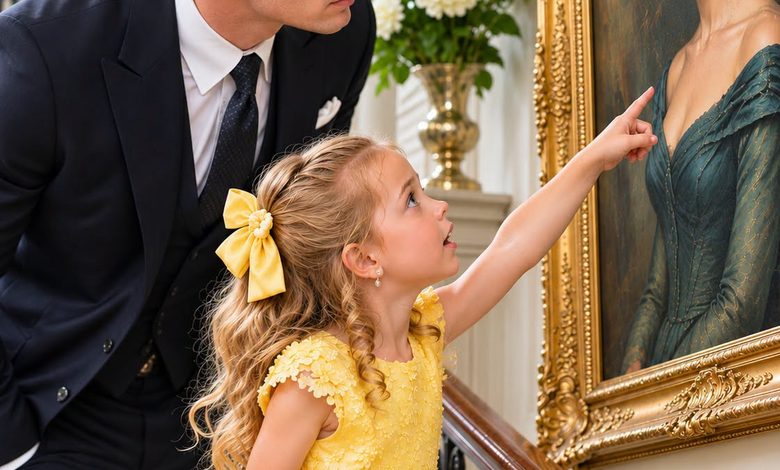
Part 1: The Lady on the Landing
“Sir, the lady in the painting is crying.”
The voice came from somewhere near my knee at 4:40 on a Tuesday afternoon. I was standing in my front hall with my phone to my ear, listening to our company lawyer explain why Saturday’s board vote was “a formality.”
Then a small hand tugged my sleeve, and I looked down.
A little girl in a faded yellow dress was pointing up the staircase. She held a gray velveteen rabbit by one ear.
“She’s crying,” she said again, quieter, like it was a secret between the two of us. “Right there. See?”
I told the lawyer I’d call him back.
The portrait had hung on the staircase landing since before I could walk. My mother, Katarina Moretti, painted at thirty-two, in a dark green dress, one hand resting on the arm of a chair. She died the following February. I was twelve.
I had walked past that painting maybe forty thousand times. I’d stopped seeing it years ago.
But the girl was right. A thin, wet line ran from the corner of my mother’s left eye, down her cheek, and into the collar of the green dress. It caught the light from the window.
“Lily!”
A woman hurried out of the dining room with a dust cloth in her hand. Olivia Carter. My housekeeper for six weeks. Twenty-nine, quiet, hired through an agency in Highland Park at twenty-four dollars an hour.
I knew almost nothing else about her.
“I’m so sorry, Mr. Moretti,” she said. “Her sitter canceled this morning. I told her to stay in the kitchen—”
“It’s fine,” I said. “She’s fine.”
I didn’t take my eyes off the painting.
For twenty-two years, I had carried one sentence about my mother.
Richard Bellini gave it to me the week of her funeral, sitting on the edge of my bed in a black suit. He was my father’s best friend and the chief financial officer of Moretti Lake Freight, the Great Lakes shipping company my grandfather started in 1951.
“Your mom was tired, Gabe,” he’d said. “The doctors wanted to operate, and she said no. Sometimes people are just too tired to fight.”
I was twelve. I believed him.
I believed him so completely that I spent my twenties angry at a woman in a green dress. I didn’t visit her grave. I didn’t ask my father about her. When he died three years ago, I let Richard box up her things for storage, and I never opened a single box.
Richard taught me to tie a tie. He taught me to read a balance sheet. He sat in the front row when I became CEO at thirty-one.
On Saturday night, at our company’s 75th anniversary dinner, the board was going to name him chairman. I had already written my toast.
I climbed the stairs. Lily followed one step behind me, holding the banister with her rabbit hand.
Up close, the line on the canvas was water. Not paint. When I touched it, my fingertip came away damp and smelling faintly of lemon wood cleaner.
“Ms. Carter,” I said. “Have you been cleaning this painting?”
She was standing at the bottom of the stairs. Her knuckles were white around the dust cloth.
“Just the frame,” she said. “Tuesdays. I must have used too much water. I’m sorry. I’ll be more careful.”
“It’s an oil painting,” I said. “Water ruins it. Please don’t touch it again.”
“Of course.”
Lily looked up at me with the solemn face of someone who had been waiting a long time to be taken seriously.
“Why is she sad?” I asked her. I don’t know why. It was a ridiculous question to ask a three-year-old.
“Because nobody was helping her,” Lily said.
At the bottom of the stairs, Olivia looked at the floor.
I couldn’t sleep that night.
At 11:50 p.m., I went back to the landing with a flashlight. I told myself I was checking for water damage. I run a company with 340 employees and a fleet of eleven vessels. I know when I’m lying to myself.
The frame was heavy, maybe forty pounds. I lifted it off its hooks and leaned it against the railing.
The wall behind it was not just a wall.
There was a rectangle of wood paneling, about the size of a cereal box, painted the same cream as the plaster. Along its right edge, there were fresh scratches. Small ones. The kind a fingernail or a butter knife might make if someone had been trying, quietly, for weeks, to find a way in.
I pressed the panel’s lower corner. Something clicked.
Inside was a shallow steel box. In it lay a bundle of five envelopes tied with a faded blue ribbon, a photograph with one corner torn away, and a small brass key stamped with a single letter: K.
The top envelope said Gabriel in my mother’s handwriting.
I sat down on the landing, right there on the carpet, and opened it.
The first line read:
If you are reading this, someone finally listened to Margaret.
I didn’t know anyone named Margaret.
Part 2: The Serpent Ring
I read all five letters twice before the sun came up.
Four of them were short. Birthday letters, one each for thirteen, sixteen, eighteen, and twenty-one. She told me to wear sunscreen on the boat. She told me my father loved me more than he knew how to say. She told me she was sorry about missing my graduation, and that she would have cried through the whole thing and embarrassed me.
The fifth one was different. It was dated February 9, twenty-two years ago. Ten days before she died.
My Gabriel,
The doctors say my heart is the problem. Dr. Reed has scheduled surgery at Northwestern for March 3, and I am going to do it. I want you to know that. Whatever anyone tells you later, I chose to fight.
I am leaving these with Margaret Carter, my nurse and my friend. I trust her more than I trust anyone in our company right now. The papers that matter are somewhere safe, and the key is here with you.
Don’t let the man with the silver serpent ring be the one who tells you who I was.
—Mom
I chose to fight.
I read that line until the words stopped looking like words.
Richard Bellini had worn a silver signet ring on his right hand for as long as I could remember. A coiled snake, the Bellini family crest from some village outside Naples. He used to let me spin it on the table when I was small.
I told myself there could be other rings. Other men.
Then I turned over the photograph. On the front was my mother at a company picnic, laughing, with my father’s arm around her. The torn corner had taken away whoever stood on her other side, except for one hand on her shoulder.
A hand with a silver ring.
On the back, in the same handwriting as the letters, it said: First Lakes Bank, Lake Forest. Box 409. Key K.
Olivia came in at 7:55 the next morning, like always. She stopped in the kitchen doorway when she saw the letters spread across the table.
Lily was holding her hand. The rabbit was holding nothing.
“Who is Margaret?” I asked.
Olivia set her purse down very carefully, as if it might break. She asked Lily to go color in the breakfast nook. Then she sat across from me.
“She was my mom,” she said.
I waited.
“She was your mother’s private-duty nurse for the last eight months. Mom was thirty-nine. She’d come here every morning at seven and leave at seven.” Olivia folded her hands on the table. “Your mother asked her to put those letters behind the painting. She said the man who was handling her affairs went through everything in the house, and the one place he’d never look was behind her own face.”
“And your mother just left them there? For twenty-two years?”
“No.” Her voice went flat. “When you were twenty-one, she came to the gate. She’d waited until you were an adult. Mr. Bellini met her in the driveway. He told her if she ever came back, he’d report her to the nursing board for stealing from a dying patient.”
“Did she?”
Olivia looked at me for a long moment. “My mother worked nights at Lake Forest Hospital for thirty years. She had two kids and a mortgage on a two-bedroom in Waukegan. She never stole a paper clip.”
I believed her. That’s what bothered me. I had known her six weeks, and I believed her faster than I wanted to.
“She died in January,” Olivia said. “Pancreatic cancer. The last week, she kept saying, ‘Behind the painting. I promised Kat.’ When I saw the agency listing with your address on it, I applied the same day.”
“So you took a job in my house under false pretenses.”
Her chin came up.
“I took a job in your house,” she said, “and I’ve cleaned every room of it for six weeks. That part was real. I was trying to find the latch on my own. I didn’t know how to walk up to a man like you and say, ‘Your mother left you something, and the person you trust most is the reason you never got it.’”
From the breakfast nook, Lily said, “Mama, the purple’s broken.”
“Coming, baby.”
Olivia stood. At the doorway, she turned back.
“If you want me gone, I’ll go today. I just need until Friday for my pay. Lily’s daycare is $310 a week, and it’s due Monday.”
I didn’t answer. I didn’t know what to say yet.
Then the doorbell rang.
It was 8:30 a.m. on a Wednesday, which meant it could only be one person. For eleven years, Richard had brought me coffee from the same bakery on Western Avenue every Wednesday morning so we could “go over the week.”
I slid the letters into the inside pocket of my jacket. I left the photograph and the key on the table under a newspaper.
Richard came in smiling, holding two cups. He was seventy-one, silver-haired, tall, in a camel overcoat. The ring was on his right hand, where it always was.
“You look like you haven’t slept,” he said.
“Long night. Shipping numbers.”
“Saturday’s going to be easy, Gabe. Seven board members, and I’ve got the votes before we sit down to dinner.” He handed me a cup. “You still giving the toast?”
“I’m still giving the toast.”
He walked past me into the front hall, the way he’d walked through my house since before it was my house. At the foot of the stairs, he stopped.
He looked up at the landing for a long time.
“The painting’s crooked,” he said.
I hadn’t hung it back perfectly at midnight. A quarter inch, maybe less.
Richard turned the silver ring on his finger, once, the way some men check a watch.
“Somebody’s been touching Katarina,” he said.
Part 3: Box 409
Richard straightened the frame himself. It took him two tries.
When he came back down, Olivia was crossing the hall with a laundry basket. He watched her the whole way, the way you watch a dog you’re not sure about.
“New?” he asked me.
“Six weeks.”
“What’s her name?”
I could have lied. I thought about it.
“Olivia Carter,” I said.
Something moved behind his eyes. It was gone almost as fast as it came.
“Carter,” he repeated. “Make sure that agency did a real background check, Gabe. People see a house like this and get ideas.”
He finished his coffee in the kitchen and talked about fuel prices. He never once looked at the newspaper on the table. Somehow that felt worse than if he had.
At 1:15 that afternoon, Olivia and I sat in a small private room at First Lakes Bank on Deerpath Road. Lily was in the lobby with a teller named Denise and a lollipop the size of her face.
The branch manager, a careful man in his fifties, opened a folder.
“Box 409 was rented twenty-two years ago,” he said, “in the name of Margaret A. Carter. A co-renter was added in 2019.” He looked at Olivia. “That’s you, Ms. Carter. With your mother’s death certificate and your letters of office as executor, you have full access.”
“My mom never told me about a box,” Olivia said. “She just said I should be listed on ‘the bank thing.’ I thought she meant her checking account.”
The manager turned a page. “The annual fee has been paid every year. Eighty-five dollars. By personal check, from Mrs. Carter, every March.”
Twenty-two checks. Eighty-five dollars each. One thousand eight hundred seventy dollars, from a night-shift nurse in Waukegan, to protect a promise she’d made to a dying woman.
Olivia didn’t say anything. She looked down at her hands.
I took out the brass key with the K on it. It turned on the first try.
Inside the box was a manila envelope, an index card, and a cassette tape.
The envelope held a twelve-page legal document, notarized and signed by my mother on February 2, twenty-two years ago. I’d read enough contracts in my life to understand it on the first pass.
My mother had owned thirty percent of Moretti Lake Freight. Her shares, not my father’s. She’d inherited them from my grandfather.
The document put those shares into a trust. Richard Bellini was named trustee. He was to vote them and manage them until I turned thirty. Then they became mine. Outright.
Half the dividends each year were to go to a fund for children’s cardiac care at Northwestern. My mother had named it in her own handwriting in the margin: For the kids who aren’t as lucky as I was to have Dr. Reed.
The document had two witnesses. Margaret A. Carter, RN. And Thomas J. Reed, MD.
I turned thirty four years ago.
Nobody had told me. Not Richard. Not my father, who maybe never knew. For twenty-two years, Richard had been voting my mother’s thirty percent as if it belonged to him. And on Saturday, those same votes were going to make him chairman.
“He’s been voting your shares,” Olivia said quietly. “To elect himself.”
“I know.”
“Who’s Thomas Reed?”
“My mother’s cardiologist.” I turned the page back to the signatures. “The letter says he scheduled her surgery.”
Olivia’s face changed. “Thomas Reed is my uncle. My mom’s older brother. He moved to Indianapolis about twenty years ago. He never talks about why.”

The index card was in Margaret’s handwriting. Shakier than my mother’s. Tom has the letter R. sent him. Ask him. —M.C.
The cassette had no label at all.
We sat in my car in the bank parking lot with the engine running and the heater on. Lily fell asleep in the back seat almost immediately, the rabbit under her chin.
Olivia called her uncle on speaker. He was seventy-four, retired, and he answered on the fourth ring sounding like a man who had been expecting this call for two decades.
“Livvy,” he said. “Did you find Kat’s box?”
She told him. He was quiet for so long I thought the call had dropped.
“Three months after Katarina died,” Dr. Reed said finally, “I wrote to the estate. I said there was a trust document, that I had witnessed it, and I asked who was handling the children’s fund. Richard Bellini wrote back. He said the trust had been ‘superseded by a later instrument,’ and that pursuing it would be ‘unwise for a physician of your standing.’ A month later, someone filed a complaint against me with the state medical board. Anonymous. It took eleven months to clear my name.”
“So you left,” I said.
“I left. I had a practice and three kids in college.” He paused. “I gave Margaret a copy of his letter. I’m not proud that I stopped there.”
“Dr. Reed,” I said. “Can you be in Chicago on Saturday night?”
Another long pause.
“It’s three hours,” he said. “I’ll be there by six.”
On Thursday morning, I canceled a meeting in Gary, Indiana, with the steel mill that accounted for fourteen million dollars of our annual business. Richard had brokered that contract eleven years ago. He took the cancellation personally.
Richard (9:12 a.m.): You skipped Gary? They called me. What’s going on with you?
Richard (9:40 a.m.): I hear you were at First Lakes yesterday with the housekeeper.
Richard (9:41 a.m.): Call me. Today.
I didn’t call.
At 7:06 on Friday morning, my phone rang. It was the staffing agency in Highland Park.
“Mr. Moretti,” the owner said, “we’ve received a serious report regarding Ms. Carter. A member of your household says several pieces of jewelry are missing from your late mother’s estate inventory. Pearl earrings and a gold bracelet. He’s prepared to call the Lake Forest police this afternoon unless she’s removed from the placement.”
“A member of my household,” I said.
“A Mr. Bellini. He says he’s co-executor of the estate.”
He was. My father had named him. I’d never had a reason to change it.
Ten minutes later, Richard texted me himself.
Richard (7:17 a.m.): Margaret Carter’s daughter. Do you know what her mother tried to pull twenty years ago? Let her go quietly, and this goes nowhere.
Richard (7:18 a.m.): And Gabe, don’t make Saturday harder than it needs to be.
Part 4: The Seventy-Fifth Toast
Olivia came to work on Friday anyway. I found her in the laundry room at nine, folding towels like nothing was wrong. Her hands were shaking so badly she had to fold one of them three times.
“The agency called me too,” she said. “They said I don’t have to come back on Monday.”
“You didn’t take anything.”
“I know I didn’t. But he’s co-executor, and I’m the housekeeper with a dead mother he already called a thief once.” She set the towel down. “Just let me go, Mr. Moretti. It’s easier. You can find the rest without me.”
“I can’t,” I said. “The box is in your name.”
She almost laughed.
Lily wandered in holding a sheet of construction paper. She’d been in the breakfast nook all morning with a new pack of markers I’d bought at the drugstore on the way home from the bank.
“For you,” she said, and handed it to me.
It was a yellow umbrella. Under it stood three figures. A small one with long hair. A tall one in a green dress. And a very tall one with what I think was supposed to be a tie.
“That’s Mama,” Lily said, pointing. “That’s the painting lady. And that’s you. So nobody gets rained on.”
I held that drawing for longer than a grown man probably should.
At noon, I met our general counsel, Ken Alvarez, in my office downtown. I showed him everything except the cassette, which neither of us had a machine to play.
He read the trust document twice. Then he took off his glasses.
“This is real,” he said. “And it’s a mess. If you stand up at that dinner tomorrow, you’re accusing a seventy-one-year-old man who has run our finances for thirty years in front of the entire board, two hundred guests, and the Gary people.”
“I know.”
“They’ll walk. Fourteen million dollars, Gabe. That’s eleven percent of revenue. And the board could decide you’re the problem. They’ve known Richard longer than they’ve known you.”
“And if I wait?”
“Then he’s chairman by 8:30 p.m., and he controls the audit committee by Monday. Anything we find after that, he gets to investigate himself.”
I thought about my mother writing I chose to fight ten days before she died. I thought about twenty-two checks for eighty-five dollars.
“Then I’m giving the toast,” I said.
Ken nodded slowly. “Then I’m sitting next to you.”
That evening, I drove to Olivia’s apartment in Waukegan. It was a second-floor two-bedroom. Lily’s rain boots were lined up neatly outside the door.
I didn’t go in. We talked on the landing.
“Tomorrow, I’m going to say your mother’s name in front of two hundred people,” I said. “I won’t do that unless you want me to. It’s her name. It’s yours, too.”
Olivia looked at me for a long time.
“For twenty years, people only said her name when they were accusing her of something,” she said. “Say it right. And I’ll be there.”
“You don’t have to come.”
“Yes,” she said. “I do.”
The Moretti Lake Freight 75th Anniversary Dinner was held in the Lakeview Room of the Edgewater Club in Chicago, on Saturday night. There were twenty-two round tables, a string quartet, and a three-foot ice sculpture of a freighter that was already dripping by seven.
Dr. Thomas Reed arrived at 5:52 p.m. He was a tall, thin man in a sport coat that was too big in the shoulders. He shook my hand and said, “You have her eyes,” and then sat down at the back table next to his niece without another word.
Richard spoke first. He thanked my grandfather, my father, and the crews. He told a story about the winter of 1996, when the Katarina M. froze in at Duluth for nine days. People laughed in the right places.
He did not look at the back table once.
At 8:05, I stood up for the toast.
I didn’t use the one I’d written.
“Twenty-two years ago,” I said, “my mother, Katarina Moretti, signed a trust. Thirty percent of this company. She put it in the care of a man she trusted for one reason: so it would come to me at thirty, and so half of every dividend would pay for children’s heart surgery at Northwestern.”
The quartet had stopped. Somebody set down a fork.
“I turned thirty four years ago. Nobody told me. And for twenty-two years, the fund my mother created has received nothing. Not one dollar.”
Ken stood and handed a copy of the document to the board chair, Eleanor Hughes, who had known my mother.
“The witnesses were her nurse, Margaret Carter, who paid eighty-five dollars every year for twenty-two years to keep it safe,” I said. “And her cardiologist, Dr. Thomas Reed, who’s here tonight.”
Richard stood up.
“Gabe, this isn’t the place,” he said, warm and calm, the voice he used on bankers. “Your mother was very ill at the end. She signed a lot of things. That document was superseded—”
“By what?” Dr. Reed said from the back.
Every head turned.
“I was her doctor,” he said. “She was sick, Richard. She was never confused. I watched her read every page of that trust. You told me it was superseded twenty-two years ago, and I’ve been waiting twenty-two years to see the paper that superseded it.”
Richard opened his mouth. Closed it.
“Show us the later document, Richard,” Eleanor Hughes said quietly. “That’s all. Show the board the later document.”
Richard didn’t move for almost a full minute. Then he looked down at his right hand. He slid the silver serpent ring off his finger and set it on the white tablecloth beside his bread plate, very gently, the way you put down something you no longer want to be holding.
“The vote is postponed,” Eleanor said. “Pending an independent audit of the trust.”
Richard picked up his overcoat. On his way past my table, he stopped.
“You don’t know what she was really like,” he said, very low.
“No,” I said. “Because you made sure of it. You’re going to tell me. Tomorrow. At my house. Ten a.m.”
Part 5: Somebody Listened
Richard came at 10:04 a.m. on Sunday. He didn’t bring coffee.
We stood in the front hall, under the portrait. I didn’t invite him to sit.
“Did she refuse the surgery?” I asked.
He looked up at my mother for a long time.
“No,” he said. “Her heart gave out on February 19. Two weeks before the date.”
“Then why did you tell me she did?”
“Because you were twelve and you were angry, and if you were angry at her, you’d never go through her things.” He said it flatly, like a man reading back a number he had memorized. “I told myself I was protecting the company. Your father was falling apart. Someone had to vote those shares. After the first year, it got easier. After ten, I stopped thinking about it.”
“You stopped thinking about the children’s fund too.”
“I moved the dividends into consulting fees. The audit will find one point nine million.” He met my eyes for the first time. “I was going to fund it someday.”
“You called Margaret Carter a thief.”
He didn’t answer that. It was the closest thing to shame I saw on him all morning.
“Here’s what happens now,” I said. “You resign from the company tomorrow, in writing. You call the agency today and withdraw the jewelry report, and you put that in writing too. You repay every dollar the audit finds, into my mother’s fund. Ken has already sent everything to the state’s attorney, and that part isn’t up to me anymore.”
“And us?”
“You don’t come to this house. You don’t contact Olivia Carter or her family. Not a card, not a call.”
He nodded slowly. “Will you ever forgive me, Gabe?”
I looked at the man who taught me to tie a tie.
“Maybe someday,” I said. “Not this year.”
The audit took eleven weeks. It found $1.94 million.
Richard resigned on Monday. His attorney negotiated repayment over eighteen months. The state’s attorney’s case is still open; I’ve stopped checking the docket every morning.
The Gary steel mill did walk. Fourteen million dollars, gone by Christmas. I cut my own salary by twenty percent so we wouldn’t have to lay anyone off, and we spent the winter finding new customers in Toledo and Thunder Bay. It was the hardest year the company had since 1996.
The board elected Eleanor Hughes chair, unanimously. She called me afterward.
“Your mother used to correct my spelling in board minutes,” she said. “In red pen. I want you to know I’m still a little afraid of her.”
We finally played the cassette in January, on an old boombox Dr. Reed brought up from his basement.
It was only four minutes long. My mother, laughing, trying to teach a seven-year-old me to sing “Happy Birthday” to my father in Italian. I got every word wrong. She didn’t correct a single one.
At the very end, after I’d run off, she said one more line, quietly, close to the microphone.
“Hold on to the people who tell you the truth, Gabe. Hold on with both hands.”
I wrote Olivia a check for $1,870. Twenty-two years of box rent.
She tried to hand it back.
“It isn’t a gift,” I said. “It’s a refund. Your mother paid for something that was mine.”
She thought about that. Then she folded the check in half and put it in her coat pocket.
She didn’t come back as my housekeeper. In January, she re-enrolled in the nursing program at the College of Lake County, the one she’d quit when her mother got sick. The first $1,870 of tuition was already paid.
I asked once if she’d be willing to sit on the advisory board of the children’s heart fund. She said she’d think about it. Three weeks later, she sent me a list of eleven questions about how we would choose families. Every one of them was a good question.
The fund made its first grant in May. It is now called the Katarina Moretti and Margaret Carter Pediatric Heart Fund. Dr. Reed drove up for the ceremony and cried through the whole thing and embarrassed nobody.
In August, Lily turned four.
Olivia brought her by the house on a Sunday afternoon. It’s become a habit now, Sunday dinners. Slow, careful, and nobody calls it anything yet.
Lily climbed the stairs one step at a time, holding the banister with her rabbit hand, and stopped on the landing.
She looked up at my mother’s portrait for a long while. The canvas had been cleaned by a professional in March. The frame was dry.
“She’s not crying anymore,” Lily announced.
“No?” I said.
“Nope.” She considered the painting the way only a four-year-old can, very seriously, with her head tilted. “She’s smiling. ’Cause somebody listened.”
Behind me, at the bottom of the stairs, Olivia laughed softly.
I didn’t say anything. I just reached down, took Lily’s small hand in mine, and held on.
Would you have trusted a housekeeper you’d known six weeks over the man who helped raise you?
Disclaimer: This story is a work of fiction inspired by real-life themes. Names, characters, places and events are fictionalized, and any resemblance to real persons is purely coincidental. It does not represent any person or organization and does not encourage inappropriate behavior. Images are for illustration purposes only.