My Son Poured a $6,000 Concrete Slab on My Farm Without Asking — Then Told Me, “It’ll All Be Mine Soon Anyway”
My forty-one-year-old son spent $6,000 pouring a concrete foundation on my farm without asking permission, then told me it would all belong to him soon enough—but instead of making him tear it down, I planted a two-acre garden around his new workshop and taught him a lesson about ownership, respect, and the years I still intended to live. I discovered what he’d done on an April afternoon after returning from an eye appointment in Bedford, Indiana. A ready-mix concrete truck was leaving my lane, and I had to pull my Buick into the grass to let it pass. I wondered why a concrete truck had been on my property. My son’s pickup sat behind the barn beside two unfamiliar trucks. I walked past the old loading chute and through the gate my late husband, Carl, had installed in 1989. Then I rounded the corn crib and stopped. In the middle of my back lot stood a freshly poured concrete slab, thirty feet wide and forty feet long, with metal anchor bolts rising from the edges. Brian was kneeling beside it, smoothing the wet surface with a steel trowel. Two men were working nearby. “Brian,” I called. He looked up and smiled. “Hey, Mom. You’re back early.” I asked what he was building. He explained that he’d ordered a steel workshop to arrive in June and needed a six-inch-thick foundation for the machinery lift he planned to install. When I reminded him that the land belonged to me and he hadn’t asked permission, he shrugged. “Come on, Mom. It’ll all be mine soon enough anyway.” I stood there staring at my own son. I was sixty-seven years old, healthy enough to manage my home, drive myself to appointments, and work outdoors. Yet he’d spoken as though my death were simply an inconvenience delaying his plans. He hadn’t said it cruelly. That almost made it worse. He’d said it like the weather forecast, as though everyone understood the arrangement. I asked why he hadn’t consulted me. He said he’d known I’d worry, that the concrete trucks had already been scheduled, and that Dad would have approved. Then he returned to smoothing the slab, leaving me standing there. I walked back to my house, put the pot roast I’d been thawing back in the freezer, and decided I wasn’t cooking supper for anyone that evening. Brian didn’t come up to apologize. He drove away after six, leaving forty feet of concrete where there’d been grass and a nesting killdeer that very morning. That night, his wife Stacy called and told me something I hadn’t known. The concrete had cost Brian and his family every dollar of their tax refund and the remaining money from his severance. He’d lost his mechanic’s job after the implement dealership changed ownership, and he was desperately trying to establish a repair business. I understood why he needed the workshop. But understanding his desperation didn’t make the words “soon enough” hurt any less.
My name is Evelyn Baker. I’m sixty-seven, and I’ve lived on our eighty-acre farm in southern Indiana for more than four decades. My husband Carl and I were married forty-one years before he died of a heart attack in the barn lot six years ago. After losing him, I sold the cattle, rented sixty-one acres of tillable ground to a neighboring farmer named Dale, and allowed the back lot to return to grass. I lived alone in the farmhouse, keeping the kitchen light on at night and telling people I was getting too old to manage much of the property. Brian is our only son. He’s a talented mechanic who’d worked for an agricultural equipment dealer in Orleans for twenty years before the business was sold and several longtime employees were dismissed. With a wife and nine-year-old daughter to support, he’d begun repairing farm machinery wherever he could find space. Stacy told me their landlord had complained about hay balers in the driveway, while another customer’s combine header sat dismantled in a borrowed shed. Brian needed a proper workshop if he was going to make a living. His concrete foundation cost $3,680 for twenty-three cubic yards of ready-mix, $900 for gravel, $620 for reinforcing steel and form lumber, and $800 for finishing labor. He’d also paid a $1,000 deposit on the steel building, leaving the balance to be financed. I sat at my kitchen table adding the figures on the back of an electric bill. I could have demanded he remove the slab. It was my property, and he had no right to make permanent changes without permission. But destroying it would have wasted $6,000 that his family couldn’t afford to lose, and my granddaughter Josie’s father would still have nowhere to work. More importantly, tearing up concrete wouldn’t change the way Brian had spoken about me. That night, I sat in Carl’s old chair and thought about my life since his death. For six years, I’d been telling everyone I was finished with farming. I’d stopped making plans, stopped imagining new projects, and allowed the land around me to become a reminder of everything I’d lost. Then I opened a drawer in Carl’s desk that I hadn’t touched in years. Beneath old tractor manuals lay a nursery catalog from 1987. I’d circled six varieties of apple trees nearly forty years earlier, when I was twenty-eight and had a little boy running around the house. In the margin, Carl had written, “Back lot. When we get to it.” We’d always intended to plant an orchard. But there’d been cattle to feed, equipment to repair, and bills to pay. Somehow, the years passed, and we never got around to it. Holding that catalog, I realized I’d spent most of my life waiting for someone else to decide when my dreams could begin. Carl had always promised we’d get to the orchard someday. Now Brian was treating my land as though someday already belonged to him. I decided I wasn’t going to wait anymore. The next morning, at one minute past eight, I called Mr. Pruitt from the county extension office and told him I wanted to plant sweet corn, flowers, and an apple orchard on two acres of my property. When he asked when I intended to start, I said, “This year.” He reminded me it was already April 14. I told him I knew perfectly well what day it was.
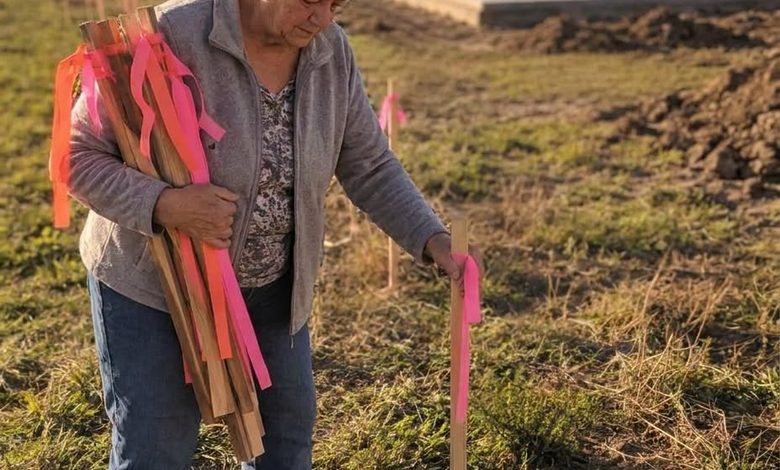
Mr. Pruitt arrived that Thursday with a soil probe, measuring tape, wooden stakes, and orange marking ribbon. We walked past Brian’s curing concrete slab and examined the surrounding land. I told him I wanted sweet corn to the north, flowers to the south, and an orchard on the higher ground to the east. I’d leave sixty feet open on the west side so Brian could drive trucks and trailers into his future workshop. Mr. Pruitt collected soil samples, identified a patch contaminated by concrete washout that shouldn’t be planted immediately, and explained how we could improve the old ground for vegetables and trees. Then he began marking the garden boundaries. I insisted that the first stakes go only inches from Brian’s concrete, because I wanted my son to understand where his workshop ended and my plans began. By noon, orange ribbons marked three sides of the foundation. Brian arrived and stared at the stakes. “Mom, what’s all this?” he demanded. I told him I was planting a garden. He complained that he’d need room around the building for a ladder and mower and accused me of acting out of spite. I reminded him I’d wanted an orchard on that land since before he could ride a bicycle. “Your father always said we’d get to it,” I told him. “I quit waiting after you reminded me I might be running short on ‘soon enough.’” Brian looked away. He said he hadn’t meant his words that way. I asked how he’d meant them. He couldn’t answer. I assured him I wasn’t trying to stop his business. He still had sixty feet of access along the west side, and I’d move a stake if he genuinely needed more turning room. But I was going to plant my garden. He left without saying anything else. Over the next several weeks, Dale helped plow the ground, and I ordered twelve bare-root apple trees: five Enterprise, five GoldRush, and two Liberty. They cost $384. When the trees arrived, I was digging their planting holes when Josie’s school bus stopped at the end of the lane. My granddaughter came running toward me and asked why I’d planted so many sticks. I explained that they were apple trees and might take four or five years to produce fruit. She counted on her fingers and announced she’d be thirteen by then. Then she asked how old I’d be. “Seventy-one,” I answered. She shrugged. “That’s not that old, Grandma.” I had to look toward the fence to hide my tears. Together, we planted all twelve trees. She tied orange ribbons around them, placing two on the last Liberty tree because she said it belonged to Grandpa Carl. Brian arrived while we were finishing. He stayed by his truck, watching his daughter help me, then quietly drove away. In May, I planted blocks of Peaches and Cream and Silver Queen sweet corn, followed by zinnias, cosmos, sunflowers, and gladiolus. In June, Brian’s red steel workshop arrived, and he erected it with two local workers. The building was handsome, sturdy, and properly squared. It also stood surrounded on three sides by my growing garden. In July, members of a local 4-H club began visiting to learn how to cut flowers, and they carried bouquets to a nearby nursing home. People from church came to admire the garden. Farmers arriving at Brian’s shop walked past my flowers, and several complimented my work. One man asked whether the entire place belonged to Brian. I overheard my son answer, “It’s my mother’s. I’m just on it.” I didn’t say anything, but I smiled while pulling weeds. Toward the end of July, the corn began ripening. Brian installed an electric fence around it to keep raccoons away without being asked. I placed a table near the lane with fresh ears of corn and a coffee can for donations to the food pantry. In two days, people left $212. By the first Sunday in August, I decided it was time for the family to sit down together. I invited Brian, Stacy, and Josie for a pot roast supper, using the same roast I’d returned to the freezer after discovering his concrete slab. We ate fresh corn and green beans with bacon, with a jar of Josie’s zinnias in the middle of the table. Everything was peaceful until Josie set down her corn and asked, “Daddy, whose farm is this?” Brian hesitated. She explained that someone at 4-H had called it Grandma’s farm, while a customer had congratulated Brian on owning such a nice place. I kept quiet and allowed him to answer. Finally, he told her the eighty acres belonged to me. Josie asked why he’d built his workshop there. My son stared at his plate. “Because I put it there without asking her,” he admitted. Then he looked at me and said he was ashamed of what he’d said when he poured the foundation. He explained that he’d been frightened after losing his job, that he couldn’t afford to fail, and that he’d convinced himself I was finished with the farm because he was afraid I’d say no if he asked. I told him I hadn’t been finished with the land, although I’d come close to believing it myself. Then Brian said something I hadn’t expected. “Dad told me I could build there,” he whispered. He explained that the summer before Carl died, while the two of them repaired the gate, his father had suggested using the back lot for a workshop if Brian ever wanted to work for himself. I stood up, walked to Carl’s desk, and returned with the nursery catalog from 1987. I opened it to the page showing the apple trees and placed it beside Brian’s plate. He read his father’s handwriting about the same back lot. He stared at me and said, “Dad promised that ground to you too.” I nodded. Carl had always been generous with promises because he hated disappointing people. Brian laughed sadly, then wiped his eyes. Finally, he looked up and asked whether he could start paying rent for the workshop. I told him I had a proposal: one dollar a month and one full day’s work on the first Saturday of every month, beginning at seven in the morning. Brian frowned, thinking I was offering charity. I smiled and told him he hadn’t seen my list of chores yet. There was a deer fence to build around twelve apple trees, lime to spread, and a gate that needed repairing. Then I held out my hand and said—
“Every month, you hand me one dollar at this table, and every month you give me one Saturday of honest work. That way neither of us forgets whose farm you’re on—or that you’re welcome here.” Brian stared at me for a long moment, then stood and shook my hand across the pot roast. His palm was rough from twenty years of working on machinery, and I recognized the small scar on his thumb from an engine he’d taken apart when he was eleven. Stacy laughed and announced that Josie would be the witness. My granddaughter straightened in her chair, very serious, then asked what a witness was. I told her it meant she’d seen us make a promise and would remember it. Brian opened his wallet, found a dollar bill, and smoothed it flat beside my plate. “August,” he said. I carried it to Carl’s old coffee can on the windowsill. The first Saturday of September, Brian arrived at ten minutes before seven. We spent the day building protective fencing around the apple trees, working until late afternoon. That morning, I’d told him I was moving the garden stakes back four feet on all three sides of his workshop so he could maintain his gutters and mow around the building properly. Around noon, he quietly moved every stake himself, fastening the orange ribbons in their new positions. Neither of us made a speech about it. We didn’t need to. In October, we spread lime according to the extension office’s recommendations. In November, Brian rehung the old gate his father had built. Each month, he placed another dollar on my kitchen table, and each month I put it in the coffee can. His repair business began attracting regular customers. Farmers brought tractors, hay balers, and combine parts, and he started earning enough to keep his family afloat. Stacy told me he was finally sleeping properly again. Meanwhile, my garden had become more than something I’d planted to prove I was still alive and capable. The local 4-H girls visited regularly, learning about flowers and soil. Our church arranged to bring elderly members out to walk the orchard, and bouquets from the cutting garden continued going to the nursing home. People stopped by to buy corn, leaving donations that helped stock the food pantry. Josie spent Thursday afternoons helping me in the garden. She learned how to identify weeds, check soil moisture, and care for the little apple trees that still looked like sticks. Every few weeks, she’d ask when we’d have apples. I’d remind her that trees needed time. “I’ll be thirteen,” she’d say, smiling. “And you’ll be seventy-one.” Then she’d insist that seventy-one wasn’t old. The more I worked outside, the more I understood that Brian hadn’t been entirely wrong about the years after Carl died. I had withdrawn. I’d stopped inviting people over, stopped making plans, and allowed grief to convince me that the best parts of my life were finished. But planting the orchard had changed something. Instead of waking up thinking about what I’d lost, I began thinking about what needed watering, when the corn would be ready, and which flowers were opening. My farm had become a place of activity again. Trucks arrived at Brian’s workshop, children came to cut zinnias, and the smell of fresh earth replaced the silence that had surrounded the barn lot for years. Brian began stopping at the farmhouse after work, sometimes bringing Stacy and Josie for supper. We talked about ordinary things: his customers, the weather, the garden, and the next repair job. We didn’t pretend his original decision had been acceptable. He understood that he’d crossed a boundary, and I understood that fear had made him act without thinking. But we’d found a way to live beside each other without turning the concrete into a permanent source of bitterness.
By the week before Thanksgiving, the growing season was over. The corn stalks had been cleared, the flower beds were quiet, and the apple trees stood inside their little protective fences with mulch around their roots. One warm afternoon, I walked out to the orchard and examined the Liberty tree on the rise, the one Josie had marked with two orange ribbons for Carl. Along its branches were tiny brown buds, no larger than grains of wheat. Next spring’s leaves were already there, waiting for their time. I stood with my hands in my coat pockets and looked around the back lot. In April, I’d thought my son had taken away something important when he poured concrete across my land. In a way, he had. He’d made a decision that wasn’t his to make and spoken about my future as though it were already settled. But without that awful afternoon, I might never have opened Carl’s desk or found the orchard plans we’d made so many years earlier. I might never have called Mr. Pruitt, ordered twelve apple trees, planted corn, or met the children who now came to my farm to learn about growing things. I might have spent another six years sitting in the house telling people I was too old to begin anything new. Instead, I had a garden, an orchard, a granddaughter who counted the years until the first apples, and a son whose workshop stood beside my flowers. Behind me, an air wrench rattled inside Brian’s building. His radio was playing, and I could hear him whistling off-key, exactly the way his father used to when he worked on a stubborn tractor. For a moment, I closed my eyes and remembered Carl standing beside me in 1987, showing me apple trees in a nursery catalog and promising we’d plant them when we had time. I didn’t blame him for the years that passed. We had built a good life, even if some of our dreams had remained unfinished. But I understood now that finishing those dreams wasn’t something I had to wait for him—or anyone else—to do. I could begin them myself. I walked over to the Liberty tree and gently touched one of its buds. If everything went well, it would start producing apples in four or five years. I’d be seventy-one or seventy-two. Josie would be a teenager, probably taller than I was, and perhaps Brian’s little workshop would have grown into a thriving business. There would be time for new disagreements, new seasons, and new plans. But they would be ours to make while we were living, not decisions someone made for us because they assumed our time was almost over. My son once told me the farm would be his soon enough. I decided that “soon enough” wasn’t a date on which I planned to disappear. It was a reminder that I still had time to plant something worth waiting for. And when those apple trees finally bear fruit, I intend to be standing right there beside my granddaughter, picking the first one.