I Found $18,940 Hidden in Mama’s Flour Tin After Her Funeral — My Brother Said, “Probably Grocery Money.” Then I Read the Note Underneath
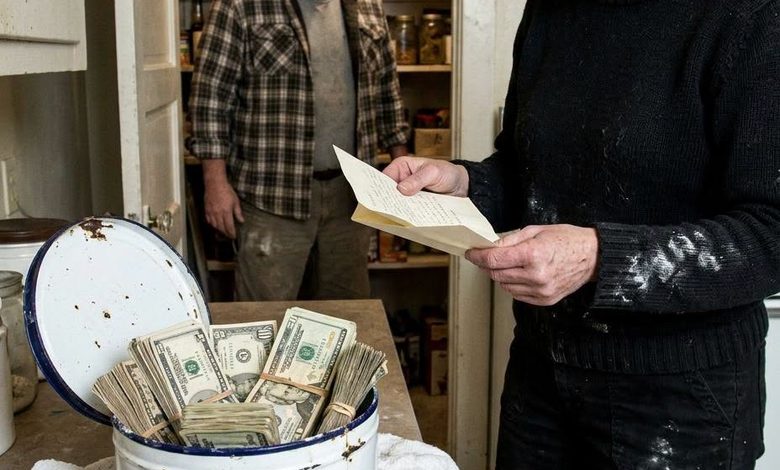
Mama’s pantry was barely bigger than a coat closet, but she ran it like she was expecting the end of the world.
Green beans lined up by expiration date. Sugar in a glass jar with a hand-written label. Coffee filters in the same yellow Tupperware since 1993.
And on the very top shelf, the flour tin. White enamel, blue chips around the rim.
Nobody was allowed to touch it. When I was twelve, I reached for it to make biscuits, and Mama slapped my hand so hard I cried. She apologized later and made me hot cocoa, but that tin went right back up on the top shelf, and I never reached for it again.
Two days to empty 78 years
After Mama passed, my brother Russell wanted the house cleared in two days. He had a camper payment, a bad back, and a long drive back to Memphis. Our stepfather, Wayne, had been gone six years, so it was just the two of us sorting through 78 years of Mama’s life.
I took the pantry because nobody else wanted to deal with expired soup. The kitchen still smelled like cinnamon and the lemon oil Mama rubbed into the cabinets every spring.
When I finally lifted the flour tin down, it was far too heavy.
There was no flour inside. Just money. Twenties, fifties, hundreds, bundled with rubber bands so old they cracked when I touched them. Some of the bills looked older than my kids.
Underneath was an envelope with one word on it, in Mama’s handwriting: Linda.
Not Russell. Me.
“Probably grocery money”
Russell walked in from the living room, where he’d been wrapping the TV remote in newspaper like it was a family heirloom. He saw the cash and his face changed.
“Probably grocery money she forgot about.”
I counted it later. $18,940. Nobody forgets $18,940 in a flour tin.
I opened the envelope before he could reach for it. The first words were: “I’m sorry, Linda.”
The next line made me sit down in Mama’s kitchen chair: “I should have told you what Wayne did with your settlement.”
The truck outside the Piggly Wiggly
When I was seventeen, a delivery truck backed into me in the parking lot of the Piggly Wiggly. I spent nine weeks in a cast and almost a year walking with a limp. I missed my senior prom. I missed the scholarship tryouts for the track team.
Wayne told me afterward that the insurance settlement “barely covered the hospital bills.” Mama cried at the kitchen table when he said it. She never argued with him. She never argued with Wayne about anything.
For thirty-five years, I thought she was crying because she was worried about me. Now I wondered if it had been guilt.
Russell looked at the letter in my hand. “Don’t start digging up old stuff, Linda.”
That was the moment I knew he already knew something.
“Read this at the bank”
The letter was three pages. But the last page was folded separately and sealed with tape so old it had turned brown. On the outside, Mama had written: “Read this at First County Bank. Not in the house.”
At 5:05 that afternoon, I walked into First County Bank with the flour tin under my arm and flour dust still on my sleeves.
The teller looked at my driver’s license. Her face went pale. She picked up the phone and called the branch manager.
Why would a small-town bank teller turn white at my name, and what had Mama been hiding there for thirty-five years?
The branch manager was a gray-haired woman named Mrs. Dalrymple. She’d worked at First County for forty years. She led me into her office and closed the door.
“Your mother told me you’d come someday,” she said. “She made me promise I’d still be here. I pushed back my retirement twice.”
Then she nodded at the sealed page. “Go ahead. She wanted you to read it here.”
What Wayne did
I peeled off the brittle tape with shaking fingers.
“Linda, your settlement was not small. It was $46,000. The hospital bills were paid by the trucking company’s insurance, not by us. Wayne signed your name on the check and deposited it into his own account. He used it to buy the bass boat, the new truck, and Russell’s first car. I found the bank statement two years later. When I asked him, he told me if I ever said a word, he would leave and we’d lose the house.
I was a coward. I’m sorry. So I started putting money aside. A little from every grocery trip, every birthday check, every Christmas. That’s what’s in the flour tin.
But I also did something Wayne never knew about. In 1991, I took the photocopies of that check and that statement to Mrs. Dalrymple. Ask her about box 114.”
Box 114
Mrs. Dalrymple walked me to the vault. Safe deposit box 114 was in my name. Mama had been paying the $40 annual fee for thirty-three years.
Inside were the photocopies: the settlement check, with my “signature” in Wayne’s slanted handwriting, and the bank statement showing it deposited into his account. There was also a certificate of deposit Mama had opened in 1991 in my name with $2,000 she’d saved. She’d added to it every year. With interest, it was worth $31,600.
Between the flour tin and the CD, Mama had paid me back $50,540. More than the settlement Wayne stole.
I sat on the little bench in that vault and cried until Mrs. Dalrymple brought me a box of tissues and a paper cup of water.
Russell
That night, I put the photocopy of the forged check on Mama’s kitchen table in front of my brother.
He looked at it for a long time. Then he rubbed his face. “I found out when I was twenty-five,” he said. “Wayne got drunk one Fourth of July and bragged about it. Said the Mustang I drove in high school was ‘courtesy of your sister’s bum leg.’”
“And you never told me.”
“I was ashamed,” he said. “I loved that car. And Mama made me swear not to. She said she was taking care of it.”
We sat at that table until two in the morning. Russell cried, which I hadn’t seen since Daddy’s funeral when we were little. Before he left for Memphis, he wrote me a check for $6,500. “That’s what that Mustang was worth,” he said. “It’s yours. It always was.”
The flour tin
Wayne is long gone, so there was no one left to confront. But Mama made sure the truth didn’t die with her.
I used part of the money to pay off my daughter’s nursing school loans. I donated $1,000 to the physical therapy clinic that helped me walk again after the accident. And the rest went into a savings account I named “Flour Tin.”
The tin itself sits on my kitchen counter now, not on a high shelf. White enamel, blue chips around the rim. It’s full of flour again.
My granddaughter reached for it last week while we were making biscuits. I didn’t slap her hand. I lifted it down for her.
Mama wasn’t brave enough to fight Wayne. But for thirty-three years, one grocery trip at a time, she quietly fought for me.
Could you forgive a parent who stayed silent but spent decades making it right? Tell us in the comments.