“Your Oxygen Machine Is Ruining the Mood, Hal.” My Son-in-Law Made Me Eat Thanksgiving Dinner Alone in the Garage — He Forgot Whose House It Was. By 7 A.M. He Had Called Me 23 Times
This is a fictional story.
“Your oxygen machine sounds like a dying vacuum, Hal. My guests didn’t come here to listen to that all night.”
My son-in-law pointed at the garage door with the carving knife.
“I set you up a little table out there. It’s heated. Mostly.”
Eighteen people sat in the dining room. Nobody said a word. Not even my daughter.
Hal
My name is Harold Brooks. Everybody calls me Hal. I’m seventy-nine years old. I served two tours in Vietnam, came home with a Purple Heart and a bad lung, and spent thirty-five years as a mail carrier in Lancaster, Pennsylvania.
My wife, Dottie, died three years ago. Forty-nine years of marriage. After the funeral, my daughter Kristen and her husband, Greg, offered to move in “to help Dad out.” They had been renting, and money was tight. I was lonely. I said yes.
I gave them the big bedroom, the one Dottie and I had shared for forty years, and moved into the little room at the end of the hall. I told myself it was what Dottie would want.
Little by little, Greg started talking about “our house.” He repainted the living room without asking. He took down Dottie’s curtains. He put my recliner in the basement because it “didn’t match.” He started calling the den his office.
I didn’t argue. I’d fought enough battles in my life. I didn’t need one at my own kitchen table.
Thanksgiving
That year, Greg invited eighteen people for Thanksgiving: his brothers, his boss, a few couples from his work. Kristen was frantic all week.
I paid for the groceries. $640: the twenty-two-pound turkey, the wine, the pies from the Amish bakery. Greg handed me the receipt on Tuesday. “Thanks, Hal. You’re the man.”
I wore my good cardigan and my VFW pin. My oxygen concentrator sat next to my chair, humming the way it always does. It’s not loud. You stop hearing it after a minute.
Greg heard it.
The Garage
Right before dinner, Greg stood at the head of the table, my table, with the carving knife in his hand.
“Hal, buddy. Your oxygen machine sounds like a dying vacuum. My guests didn’t come here to listen to that all night. And no offense, but nobody wants to watch somebody’s hands shake over the gravy boat.”
His boss laughed. One of his brothers snorted into his wine.
“I set you up a little table in the garage. It’s heated. Mostly.”
I looked at Kristen. She was holding a bowl of mashed potatoes, staring at the tablecloth. Dottie’s tablecloth.
“Dad,” she whispered, “it’s just for tonight.”
I didn’t argue. I unplugged my machine, picked up my plate, and walked out to the garage.
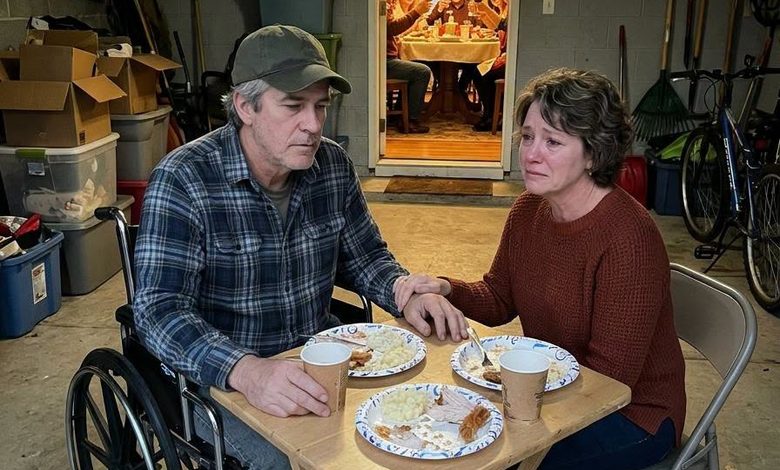
There was a card table between the lawnmower and the recycling bins. A folding chair. A space heater that wasn’t plugged in. The thermometer on the wall said forty-one degrees.
Through the door, I heard Greg raise his glass. “To family!”
Everyone cheered.
Ellie
I’d eaten Thanksgiving dinner in worse places. In 1968, I ate it out of a can in the mud near Hue. But that night in my own garage was the loneliest meal of my life.
Ten minutes later, the door opened. My granddaughter Ellie, sixteen, came out carrying her plate and a blanket.
“Dad told me to go back inside,” she said, plugging in the space heater. “I told him no.”
She wrapped the blanket around my shoulders and sat down on an upside-down bucket. We ate together between the lawnmower and the recycling bins, and she asked me about Grandma Dottie, and for a little while it didn’t feel so cold.
“Grandpa,” she said quietly, “this is your house. Why does he act like it’s his?”
I didn’t have an answer. Not that night.
The Deed
After the guests left, I went to my little room and opened the metal box in my closet. Inside was the deed Dottie and I signed in 1981. One name on the mortgage that we paid off in 2006: Harold J. Brooks.
Greg had spent three years forgetting that.
At 11:15 p.m., I made one phone call he never saw coming. Then I packed a small bag and drove to my old Army buddy’s house across town.
By 7 a.m., Greg had called me 23 times.
Who did Hal call — and what was waiting in the front yard when Greg woke up? Continue to the next page…
The Call
I called Barbara Kline. She sold Dottie and me that house in 1981. She’s eighty now and still sells real estate, because she says retirement is for quitters.
“Hal Brooks! Happy Thanksgiving, honey. What can I do for you at this hour?”
“Barb, I’d like to put my house on the market.”
There was a pause. “Hal… isn’t Kristen living there with you?”
“I ate dinner in the garage tonight, Barb. Forty-one degrees. My son-in-law said my oxygen machine was ruining the mood.”
Barbara was quiet for a long moment. Her husband had been a Marine.
“I’ll have the sign in your yard by sunrise,” she said.
The Sign
She kept her word. At 6:30 a.m., a red-and-white sign went into the front lawn: FOR SALE. Underneath was a smaller sign: “Contact owner: Harold J. Brooks.”
Greg saw it when he went out for the newspaper.
The calls started at 6:41. By seven o’clock, there were twenty-three. The texts went from confused to angry to desperate.
“Hal, what is this sign??”
“You can’t sell OUR house.”
“Where are you? Kristen is crying. Call me NOW.”
At 7:30, I answered.
“Hal! Thank God. Listen, I think there’s been a misunderstanding. You can’t just sell the house out from under us!”
“Greg,” I said, “it’s not out from under you. It was never under you. My name is the only one on the deed.”
Silence.
“Last night you told me the dining room was for people who belong there. You were right. So I asked myself who belongs in my house. And it isn’t a man who makes a veteran eat next to the recycling bins at his own Thanksgiving.”
Kristen
Kristen came to my buddy’s house that afternoon. Alone. She sat down across from me and burst into tears.
“Dad, I’m so sorry. I should have stopped him. I should have walked out to that garage with you.” She wiped her eyes. “There’s something else. Greg’s been pushing me to get you to sign a power of attorney. He said it was ‘for your own good.’ He already talked to a lawyer about putting the house in our names.”
I’d suspected as much. Hearing it still hurt.
“Kristen,” I said, “you’re my daughter. You’ll always have a home with me. But Greg has sixty days to find somewhere else to live.”
She nodded slowly. Then she said something I didn’t expect. “Ellie and I are staying with you, Dad. If you’ll have us.”
Sixty Days
Greg moved into his brother’s spare room in January. His boss, the one who’d laughed, heard the whole story from someone at the VFW, and Greg wasn’t invited to the company Christmas party.
Barbara took the sign down. She refused to charge me a dime. “Best listing I ever had,” she said. “Sold a man some self-respect.”
I moved back into the big bedroom. Kristen hung Dottie’s curtains again. Ellie carried my recliner up from the basement with two boys from her school.
And I went to see my lawyer. When I’m gone, the house goes into a trust for Ellie. The girl who brought a blanket to the garage.
The Next Thanksgiving
The next November, Ellie had an idea. “Grandpa, let’s eat in the garage this year. All of us. On purpose.”
So we did. We hung an American flag on the wall, strung lights over the lawnmower, and set up three folding tables with Dottie’s tablecloth across them. Kristen invited my buddies from the VFW. Barbara came with a pecan pie.
My oxygen machine hummed beside my chair the whole night.
Nobody minded at all.
This story is a work of fiction. Names, characters and events are invented.