My Daughter-in-Law Laughed When I Refused Them My Lake House for a Month — Then I Found Out She’d Forged My Signature and Rented It to Strangers
This is a fictional story.
The first thing my son tried to take was a month at my lake house. The second was the last promise I ever made to his mother.
My name is Walter Brennan. I’m seventy-one, a retired high-school shop teacher from northern Michigan. For forty years, I taught teenagers how to measure twice and cut once. I should have applied that lesson to my own family sooner.
“We’re Informing You, Not Asking”
“Dad, we’ll be using the lake house for thirty days,” my son Nathan texted me on a Tuesday morning.
Before I could answer, a second message arrived from his wife, Brooke.
“Make sure the fridge is stocked and the cleaning service is paid. We’re bringing guests.”
I was sitting in my workshop, repairing a wooden fishing lure my late wife, Ellen, had carved by hand. Four years after her death, all her tools still hung exactly where she’d left them.
“No,” I typed.
Nathan replied with eight laughing emojis.
Then Brooke: “Stop being selfish. We’ve already booked paying guests. We’re informing you, not asking you. Don’t make this awkward.”
My hands shook as I set the phone on the workbench. I’ve always treated anger like a sharp chisel. Handle it carefully, and never grab it by the blade.
Ellen’s House
Ellen and I spent twenty summers building that lake house with our own hands. We saved for every window, every board, every railing. She painted the front door blue because it reminded her of the lake at dawn. She sewed the wedding-ring quilt that still lies across our bed.
When her health began to fail, she made me promise one thing. “Keep it a welcoming place, Walt. A place where people feel loved.”
At her funeral, Nathan gripped my shoulders and promised he’d take care of me. I believed him. Grief can make a small kindness feel like an unbreakable vow.
He used that trust as easily as he used the spare key he’d quietly taken from my kitchen drawer.
Since then, he’d only come around when he needed something. Last Thanksgiving, he called my pension “a quaint little allowance.” Brooke suggested I sell the lake house and move into a senior apartment so they could “manage the proceeds.”
I said no then, too.
The Listing
Three days after their texts, my neighbor at the lake, June, called me.
“Walter, why is your cottage being advertised online as an ‘exclusive lakeside retreat’?”
She sent me a screenshot. There was Ellen’s blue front door. Our wooden dock. Ellen’s wedding-ring quilt, spread across the bed for the photo.
Below the photos were four weekly reservations, each with a large advance deposit. And one more listing at the bottom: “Private dockside event — Saturday the 14th — 60 guests.”
Brooke was listed as the “property manager.” The description promised that “the owner has authorized private events.”
“Walter,” June said quietly, “there’s a document attached. It looks like your signature.”
I opened it. An electronic authorization form, with my name signed across the bottom in a poor imitation of my handwriting.
My son and his wife hadn’t just decided to borrow my house for a month. They had forged my name and collected money from strangers for a place that wasn’t theirs.
The Calendar
Then I looked at the booking calendar, and suddenly their insistence on those exact thirty days made sense.
Because something very important was already scheduled at that house on the first morning of their “visit.” Something they knew nothing about, because they had never once asked me about the house. Only about what it could do for them.
I didn’t call Nathan. I didn’t confront Brooke.
I made one phone call.
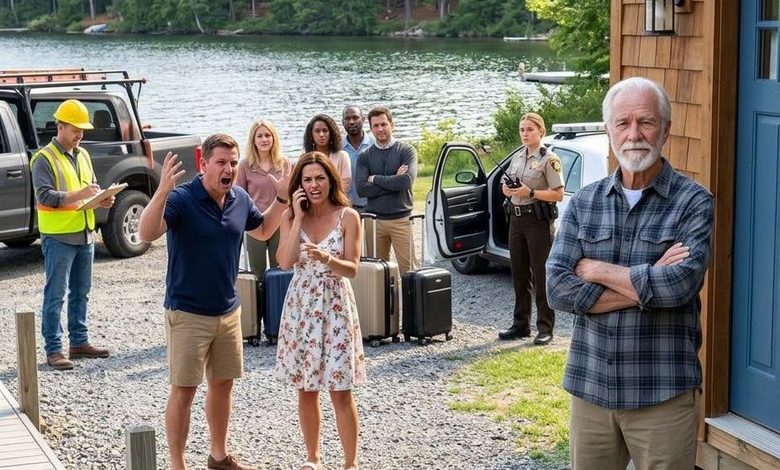
Three days later, my son stood in the gravel driveway of the lake house, red-faced, screaming at me: “DAD, YOU’VE RUINED EVERYTHING!”
But what happened next was even worse. For them.
What Was Scheduled
Last fall, after a hard winter, I noticed a crack running along the stone foundation of the lake house. An engineer confirmed what I feared. The old foundation Ellen and I had poured ourselves in 1989 was failing. The house needed to be lifted off its base so a new foundation could be built underneath.
I’d hired a structural moving company months earlier. Permits were approved. Water and power would be shut off. The entire house would sit on steel beams and timber cribbing for four weeks.
The lift was scheduled to begin at 7 a.m. on the first day of Nathan and Brooke’s “thirty days.”
Nobody would be staying in that house for a month. Not Nathan. Not Brooke. Not their paying guests. Not sixty people at a dockside party.
The One Phone Call
My phone call was to the county sheriff’s office.
I spoke with a deputy named Carla Reyes. I explained that someone had forged my signature to rent out my property, and I emailed her the listing, the fake authorization, the deed in my name, and the construction permit showing the house would be uninhabitable.
Deputy Reyes listened carefully. “Mr. Brennan, I’ll contact the rental platform today. And I’d like to be at the property on the first morning, in case anyone shows up expecting to get in.”
That afternoon, the rental platform suspended the listing, froze Brooke’s host account, and began refunding every guest. The total in deposits Brooke had collected: $18,400.
The First Morning
At 7 a.m., the house-moving crew arrived with hydraulic jacks, steel beams, and cribbing. By 10 a.m., Ellen’s lake house was sitting four feet in the air, blue door and all, like a ship in dry dock.
At 11:15, Nathan’s SUV came crunching up the gravel driveway, with Brooke in the passenger seat. Right behind them was a minivan carrying the first group of “guests,” a polite couple from Ohio and their teenage kids, dragging suitcases.
They all stopped and stared at the house hovering on steel beams.
Then Nathan saw me standing by the dock, and he exploded.
“DAD! WHAT DID YOU DO? YOU’VE RUINED EVERYTHING!”
“I fixed the foundation, son,” I said calmly. “It’s been cracking for a year. You’d have known if you’d ever asked.”
Brooke was already on her phone, shouting at someone. “What do you mean my account is frozen?!”
Even Worse
That was when Deputy Reyes stepped out of her patrol car, which had been parked beside the contractor’s trailer all morning.
She walked over to the couple from Ohio first. “Folks, I’m sorry about your trip. This property was never legally available for rent. The platform has refunded your deposit in full. You should see it in your account by tomorrow.”
The husband looked at Brooke with open disgust. “You told us the owner was your father-in-law and he was thrilled to share it.”
Then Deputy Reyes turned to Nathan and Brooke and held up a printed copy of the authorization form.
“Which one of you signed Walter Brennan’s name to this?”
The silence stretched so long that the crane operator turned off his engine to listen.
Finally, Nathan looked at the gravel. “Brooke did,” he said quietly. “But I knew.”
The Reckoning
I could have pressed charges. Deputy Reyes told me the forgery alone was serious.
Instead, with my attorney’s help, I offered them a written agreement. Brooke would sign a confession admitting to the forgery. They would personally cover every cancellation fee, platform penalty, and the vacation costs of the families they’d misled. And neither of them would set foot on the property again without my permission. If they broke any term, the confession would go straight to the district attorney.
They signed. They paid back over $6,000 in fees and costs over the next eight months. The spare key came back to me in an envelope, with no note.
The Foundation
Two weeks into the construction, I was at the lake supervising the concrete pour when Nathan’s SUV pulled up again. Alone this time.
He got out wearing old jeans and work boots. Boots I recognized. They were the ones I’d bought him for his sixteenth birthday, when he used to follow me around this very property with a hammer, begging to help.
“Dad,” he said. “I’m not here to ask for anything.” He looked up at the house on its beams. “I’m here to help. If you’ll let me.”
I handed him a shovel.
We worked side by side for nine straight Saturdays. Some days we barely spoke. Other days, he told me things I’d never known. About how lost he’d felt after his mother died. About how Brooke’s big plans had felt like a way to fill the hole. About how ashamed he was.
On the last Saturday, as the house was lowered gently onto its new foundation, Nathan pressed his palm into the wet concrete at the corner by the blue door, right next to the handprint Ellen had left there in 1989.
A Welcoming Place
I kept my promise to Ellen. The lake house is a welcoming place.
Every summer now, I open it, free of charge, for one week to a family from the local veterans’ center, and for another to the hospice nurses who cared for Ellen in her final months. No deposits. No listing. Just a key under the mat and a stocked fridge.
And on the Fourth of July, Nathan comes up with his fishing pole. We sit on the dock Ellen and I built, using lures she carved, and we don’t say much.
We don’t need to. The foundation is solid now. All of it.
This story is a work of fiction. Names, characters, places, and events are products of the author’s imagination. Any resemblance to actual persons, living or dead, or actual events is purely coincidental.