“A Dead Woman’s Dress Is Bad Luck.” The Groom’s Mother Threw My Late Wife’s Wedding Gown in a Dumpster Before My Granddaughter Could Try It On — She Forgot Whose Orchard the Wedding Was At
This is a fictional story.
My name is Gene Albright. I’m seventy-seven, and fifty-four years ago, my wife Dorothy walked down an aisle of apple trees in a lace gown her mother sewed by hand.
It took her mother eight months. Ivory lace, a high collar, and forty-two tiny pearl buttons down the back. After the wedding, Dorothy had it cleaned, wrapped in tissue, and sealed in a box under our bed.
“For a granddaughter someday,” she said.
Abby
Dorothy passed four years ago. Our granddaughter Abby got engaged last fall to a nice young man named Connor.
Abby wanted two things. She wanted to get married in our orchard, under the same trees where her grandparents said their vows. And she wanted to wear her grandmother’s dress.
I gave her both. The orchard was free, of course. The rental fee I normally charge for weddings there, $12,000, I waived. That’s what family does.
Connor’s mother, Victoria, had other ideas.
The Boutique
Victoria offered to “help” by taking Dorothy’s dress to a bridal boutique downtown for alterations. Abby was working double shifts at the hospital, so she gratefully said yes.
A week later, Abby called me in tears. “Grandpa, Victoria says the dress was ruined. She says it fell apart.”
That didn’t sound right. I drove downtown to the boutique myself.
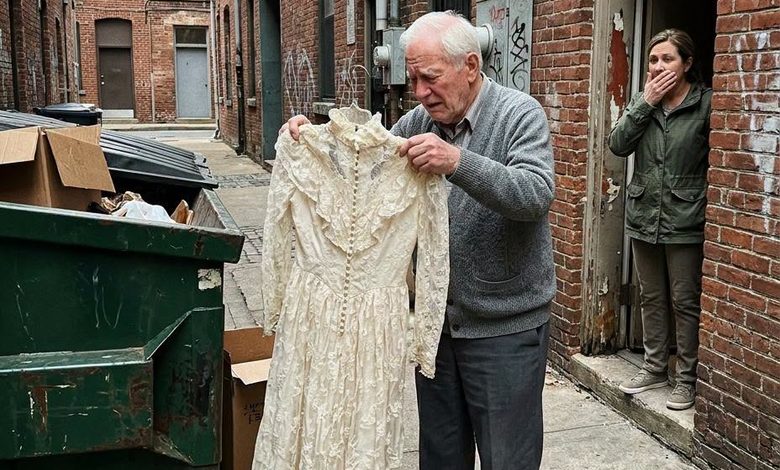
The owner, a woman named Mrs. Ortiz, went pale when I told her who I was. She took me out the back door, to the dumpster in the alley.
“She told my seamstress to throw it out,” Mrs. Ortiz said quietly. “In front of everyone. She said, ‘A dead woman’s secondhand dress is bad luck. My son’s bride will wear designer.’ Then she ordered a $9,000 gown on her card for Abby and told us not to say a word.”
“Is it still in there?”
She nodded. “I couldn’t bring myself to let the trash truck take it. But she was standing right there. I didn’t know what to do.”
The Dumpster
I climbed in.
Seventy-seven years old, with a bad knee, in my church slacks. I dug past cardboard boxes and coffee cups until I found the garment bag. Dorothy’s dress was inside, crumpled, with a coffee stain on the hem.
All forty-two pearl buttons were still there. I counted them sitting in the alley.
I Didn’t Argue
That evening, Victoria called me to “discuss wedding logistics.” Her voice was syrupy. “Gene, I’m so sorry about the old dress. These things just don’t survive. But don’t worry, I’ve taken care of everything.”
I didn’t argue. I didn’t tell her what I’d found.
I said, “Thank you for letting me know, Victoria,” and hung up.
Then I looked at the stack of invitations on my kitchen table. One hundred and eighty of them, already mailed. Victoria had insisted on designing them herself. Every single one listed the venue: Albright Family Orchard.
My orchard.
What did Gene do the next morning, and why did Victoria call him twenty-nine times before the wedding?
The Venue Contract
I run the orchard as a wedding venue every summer. I have a standard contract. Victoria had insisted on signing it herself, “as the groom’s family, to handle everything.” She’d crossed out the $12,000 fee and written “waived — family.”
At 9:00 a.m., I called my attorney.
By noon, Victoria had a letter. The fee waiver had been extended to Abby, my granddaughter, as a family gift. Since Victoria had signed the contract in her own name, the waiver did not apply to her. If she wanted to remain the contracted party and keep planning the event, the $12,000 fee was due in full within ten days.
Otherwise, the contract would be transferred to Abby. And Abby would make every decision about her own wedding.
Twenty-Nine Calls
Victoria called that afternoon. Then that evening. Then every day.
“Gene, this is extortion!” “The invitations are already out!” “I’ve spent $9,000 on Abby’s dress!”
By the end of the week, she’d called twenty-nine times.
I answered the twenty-ninth. “Victoria, you can keep your designer dress. Abby won’t be needing it.”
Silence. “What do you mean?”
“I mean I climbed into the dumpster behind Mrs. Ortiz’s shop. All forty-two buttons are still on it.”
She hung up.
Abby and Connor
I told Abby everything. She cried so hard she couldn’t speak. Then she called Connor.
To his credit, Connor drove straight to my house. He stood in my kitchen and looked at Dorothy’s dress laid across the table.
“Sir, I’m so sorry. My mother has always needed to control everything. I didn’t know she’d go this far.”
Then he called his mother on speaker, in front of us both.
“Mom, Abby is wearing her grandmother’s dress. The wedding is at her grandfather’s orchard, on her terms. You’re welcome to come as a guest. But you’re done planning.”
Victoria never paid the $12,000. The contract was transferred to Abby that Friday.
Mrs. Ortiz
Mrs. Ortiz insisted on restoring the dress herself, at no charge. She removed the coffee stain, repaired a torn seam, and let out the waist an inch for Abby.
“I’ve been sewing for thirty-five years,” she told me when I picked it up. “I’ve never worked on anything made with this much love.”
Under the Apple Trees
On a warm September afternoon, my granddaughter walked down the same aisle of apple trees her grandmother walked fifty-four years earlier.
Ivory lace. A high collar. Forty-two pearl buttons down the back.
I walked her to Connor. Halfway there, she squeezed my arm and whispered, “Grandma’s here, isn’t she?”
“She never left, sweetheart.”
Victoria sat in the third row. She didn’t say much all day. But at the reception, I saw her standing alone by the dance floor, watching Abby spin in that dress, with tears on her cheeks.
Maybe she finally understood that some things can’t be bought.
The designer gown, by the way, she donated to a charity that gives wedding dresses to brides who can’t afford them. Abby told her that was the nicest thing she could have done with it.
Dorothy would have agreed.
This story is a work of fiction. Names, characters, and events are products of the author’s imagination. Any resemblance to actual persons or events is purely coincidental.