A Flight Attendant Moved Me From First Class to the Last Row Because I Was Crying on the Way to My Husband’s Funeral — Then the Captain Walked Back and Knelt Beside Me
This is a fictional story.
My name is Ruth Hollis. I’m seventy-six, and I was married to Walt for fifty-three beautiful years.
He served twenty-two years in the Navy and retired a chief. Then he taught high school shop for another twenty-one. Last October, he died peacefully in his favorite recliner with an unfinished crossword across his lap.
Walt always said he wanted to be buried back home in Virginia, with the military honors he’d earned. So I boarded a flight from Phoenix to Norfolk alone.
Seat 3A
My daughter used her miles to book me a first-class seat. I’d never flown first class in my life. It didn’t matter much without Walt beside me. For fifty-three years, he always took the middle seat so I could have the aisle for my bad knees.
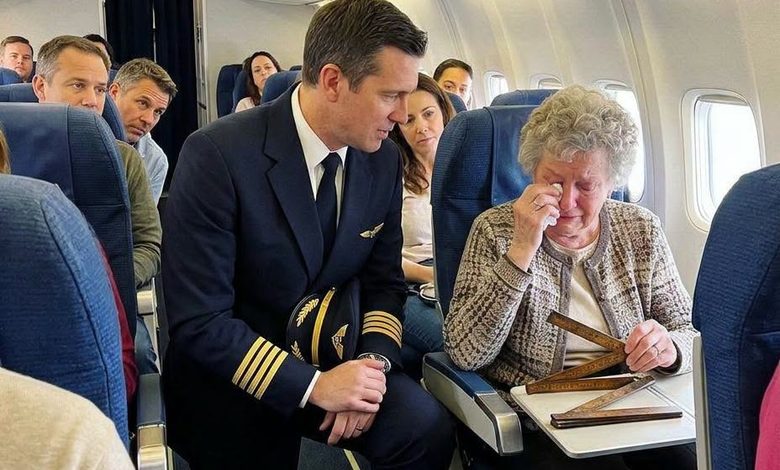
Somewhere over New Mexico, I took out his old wooden folding ruler. He’d carved his initials into it at nineteen, aboard a Navy destroyer. When my fingers found those letters, the tears came. Quiet tears. Eleven days of holding it together for everyone else, and I simply couldn’t anymore.
The businessman in 3C pulled out an earbud and pressed the call button.
“Could you please move her somewhere else? She’s been crying for twenty minutes. I paid for first class because I have work to do.”
A young flight attendant crouched beside me. I told her I was on my way to my husband’s funeral. She suggested, politely, that I might be “more comfortable somewhere quieter.”
I should have said no. But I was raised not to make trouble. So I nodded. “That’s alright, dear.”
Row 32
She walked me past the curtain, past row after row, all the way to the very last row. Row 32. The seat didn’t recline. The bathroom door slammed every few minutes. She handed me a cup of water and a bag of pretzels and went back to the front.
I leaned my head against the window. Walt had spent fifty-three years choosing the worse seat so I’d be comfortable. On my first trip without him, I’d been sent to sit by the toilets because a stranger found my grief inconvenient.
An hour later, an older flight attendant named Denise stopped beside me and noticed the ruler. I told her about Walt. When I mentioned he’d been a Navy chief, her face softened. “My dad was a chief too.”
“May I ask your husband’s name?”
“Walter Hollis.”
She went completely still. Then she leaned in and whispered, “Please stay right here, sweetheart. Don’t go anywhere.” And she hurried toward the cockpit.
Ten minutes later, the cabin went quiet. A tall man with four gold stripes on his shoulders was walking slowly down the aisle, studying faces. The captain.
When he reached row 32, he stopped. He took off his hat. And in front of 160 passengers, he knelt beside my seat.
Then he called me by a nickname only Walt had ever used.
Who was the captain, how did he know Walt’s secret name for Ruth, and what had Walt done for him decades earlier that she never knew about?
“Hello, Birdie”
“Hello, Birdie,” the captain said softly.
I couldn’t breathe. Walt had called me Birdie since our second date, when I hummed along to the radio the whole drive home. Nobody else on earth called me that.
“How do you know that name?”
“Because Mr. Hollis talked about you every single day in third-period shop class,” he said, his eyes filling. “My name is Marcus Bell. Class of 1996. I’m flying to Norfolk for his funeral, too. I just didn’t know you were on my airplane.”
Denise had recognized Walt’s name because the captain had told the whole crew before departure: today he was flying to bury the man who saved his life.
The Boy in Third Period
Marcus told me the story right there, kneeling in the aisle.
At sixteen, he was failing every class. His father was gone. His mother worked two jobs. He’d been caught skipping school so many times the principal wanted him expelled.
“Your husband was the only teacher who argued to keep me,” he said. “He told the principal, ‘Give him to me.’ And then he made me build a model airplane. A real one, with a little engine. Took me the whole semester. When it flew, he said, ‘Son, you’ve got a pilot’s hands. Don’t waste them.’”
I remembered that semester. Walt came home with glue on his fingers every night and wouldn’t say why.
“After graduation, I wanted to go to flight school, but there was a $2,000 deposit we couldn’t afford,” Marcus continued. “Two weeks before the deadline, the school called and said an anonymous donor had paid it.”
He looked at me. “It took me twenty years to find out it was Mr. Hollis. I wrote him a letter. He wrote back one line: ‘Don’t tell Birdie. She thinks I lost it on the fishing boat.’”
I laughed and sobbed at the same time. In 1996, Walt had told me he’d sunk our “fishing boat fund” into a used boat motor that died after a week. I’d teased him about it for twenty-eight years.
There had never been a boat motor.
Back to Row 3
Marcus stood and offered me his arm. “Birdie, Mr. Hollis would never let you sit back here. Neither will I.”
He walked me up the entire length of the plane. People stood to let us pass. At the curtain, the young attendant who’d moved me had tears in her eyes. “I’m so sorry, ma’am,” she whispered.
Marcus settled me back in seat 3A. The man in 3C looked up from his laptop, confused.
Then the captain picked up the cabin phone.
“Ladies and gentlemen, this is your captain. On board today is Mrs. Ruth Hollis, wife of Navy Chief Walter Hollis, who served our country for twenty-two years and taught teenagers for twenty-one more. One of those teenagers is flying your airplane today. Mrs. Hollis is traveling to lay her husband to rest. Please join me in honoring her.”
The applause started in first class and rolled all the way back to row 32.
The man in 3C closed his laptop. After a long moment, he turned to me. “Ma’am, I’m sorry. I didn’t know. I shouldn’t have needed to know.” He handed me a fresh napkin. I accepted it.
Norfolk
Two days later, Walt was laid to rest with full military honors. The flag was folded and placed in my hands.
Captain Marcus Bell stood in his uniform as one of the pallbearers. Beside him were four other men and two women I’d never met. All former students of Walt’s. All people he’d quietly “given to himself” over the years. A welder. A nurse. A fire chief. A high school shop teacher.
After the service, Marcus handed me a small, worn model airplane. “I’ve kept it for thirty years,” he said. “I think it belongs with you now.”
Carved on the bottom of one wing, in Walt’s careful hand, were three words: Fly high, son.
It sits on my mantel now, beside his folding ruler. Every morning, I tell them both good morning.
And on my flight home, I sat in the aisle seat. The middle seat beside me stayed empty the whole way. I like to think Walt was sitting in it, the way he always did.
This story is a work of fiction. Names, characters, and events are products of the author’s imagination. Any resemblance to actual persons or events is purely coincidental.