My Wife Passed Away After Our Twins Were Born—Three Months Later, Her Silent Mother Arrived With a Letter
Part 1: The Woman on the Porch
For thirteen weeks, I believed my mother-in-law could not bear to look at me because I had come home from the hospital and her daughter had not. Every photograph of our twins received the same two-word reply: “Thank you.” Then she appeared on my porch carrying an envelope, and the apology I had rehearsed for months finally escaped—before I understood what she had come to say.
The doorbell rang while June was crying against my shoulder and Clara was beginning to join her from the bassinet. On the kitchen counter, a bottle stood beside an untouched piece of toast. My phone showed two missed calls from work, and I had spent the previous five minutes trying to remember whether I had eaten anything since midnight.
Through the glass beside the front door, I saw Ruth Bennett.
My first thought was that someone else had died.
She had not crossed our threshold since the afternoon after Emily’s funeral. Now she stood on the porch in the same sensible shoes she had worn to the cemetery, pressing a cream-colored envelope against her coat.
“Ruth?”
Her eyes went immediately to June. For a second, she raised her hand. Then she lowered it without touching her.
That small withdrawal hurt more than I was prepared for.
“I didn’t want to lose her,” I said.
Ruth looked up.
“Daniel—”
“She asked me to save the girls. I keep hearing myself say it back. I know you probably think I should have said something else.”
June rooted against my shirt, impatient with a conversation that had delayed breakfast. Ruth watched me adjust the baby higher on my shoulder.
“Is that what you think?” she asked. “That I stayed away because I blame you?”
I had imagined this conversation so often that her actual words made no sense.
Before the twins were born, Ruth had called almost every evening. She had measured the nursery windows for curtains, argued cheerfully with Emily about whether newborns needed shoes, and bought a folding crib for her own house.
Afterward, there had been flowers, one casserole, and silence.
When I sent photographs, she always answered.
Thank you.
Two words beneath Clara’s first crooked smile. Two words beneath June asleep with one fist beside her cheek. Two words when I wrote that the pediatrician was pleased with their weight gain.
Eventually, I stopped adding questions.
Emily and I had been married for nine years. I was thirty-six, she was thirty-four, and we had spent long enough hoping for children that the sight of two flickering heartbeats had made us laugh and cry in the same breath.
Her pregnancy had required extra appointments, especially after her blood pressure began rising. Still, at thirty-five weeks, we thought we understood the plan: close monitoring, an early delivery if necessary, and two little girls who might need help feeding before they came home.
We had not agreed on their names.
Emily refused anything that rhymed.
“They’re sisters, not a breakfast cereal,” she told me from her hospital bed.
I suggested Clara and June again, names she had separately written on opposite corners of a notebook page.
She pretended to consider them for the first time.
“You occasionally have a useful thought, Mercer.”
That was the last ordinary conversation we had.
Her blood pressure worsened. The obstetrician explained that waiting was no longer safe and that they needed to deliver the babies urgently. People moved around the bed with practiced purpose while I stood there holding a bag of clothes we had packed for a much calmer day.
Emily reached for my wrist.
“The girls,” she said. “Save our girls.”
“They’re taking care of all three of you.”
She squeezed harder.
“Promise me you’ll look after them.”
“I promise.”
When a clinician asked me to step back so they could move her, I heard myself say the words that would follow me home.
“Save the babies.”
No one had asked me to choose. The team was working to save everyone. I knew that, even then.
But memory is not a recording. Grief kept cutting away everything except my wife’s face and my own voice.
Clara was born first, June two minutes later. After the delivery, Emily developed severe bleeding. The doctors treated it, brought in more help, operated again, and gave her blood. She was taken to intensive care.
By the following morning, she was gone.
The girls stayed in the hospital for twelve days, learning to feed and keep themselves warm. I traveled between their nursery and a house where Emily’s slippers still waited beside our bed.
When I finally brought them home, my sister Hannah carried the car seats inside. I carried a hospital bag containing Emily’s clothes, her glasses, and the gray sweatshirt she had worn to every appointment because the pockets were large enough for snacks.
I put the bag in our closet.
For thirteen weeks, I did not open it.
People told me the girls would give me a reason to keep going. They did, but they were also babies, not a treatment for grief. They needed food when I could barely swallow, clean clothes when I could not remember where I had put my own, and steadiness from someone who had begun to distrust silence.
Hannah came after work. A neighbor cut the grass. My employer approved leave and later let me return on a reduced schedule from home.
Ruth sent two words.
I filled the space around those words with accusations she had never spoken.
Now she stood in front of me, and Clara’s crying sharpened from the living room.
“I should get her,” I said.
“May I come in?”
I stepped aside.
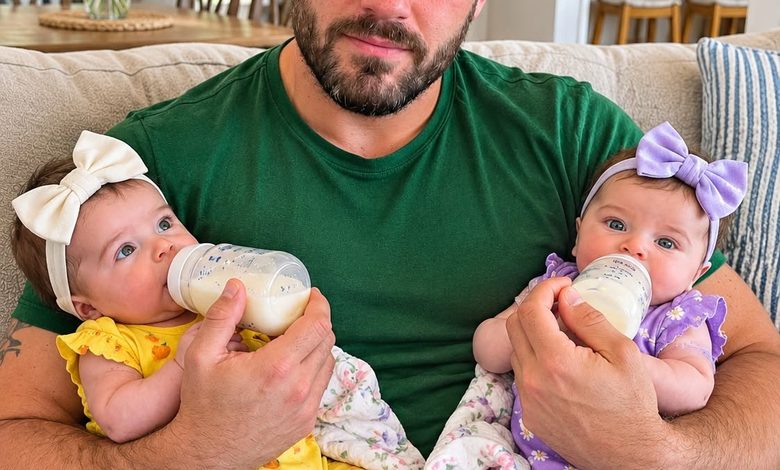
She followed me to the living room but stayed near the doorway while I settled both girls against my arms on the sofa. I had learned the arrangement by necessity: pillows beneath my elbows, bottles within reach, a clean cloth where I could find it without looking.
Ruth watched as I offered June her bottle.
“You know which cry belongs to which baby,” she said.
“Usually.”
Her mouth tightened, and I could not tell whether she was about to cry or leave.
“Why are you here?” I asked.
She looked down at the envelope. I recognized Emily’s handwriting before Ruth turned it over.
My name was not on the front.
The word there was Mom.
“There’s something about Emily’s childhood you don’t know,” Ruth said. “And before you read this, I need to tell you what I did.”
Part 2: The Question No One Answered
I finished feeding the girls before Ruth began. It was not an act of composure. Clara needed burping, June needed changing, and there were only so many terrible things I could hold at once.
Ruth offered to wash the bottles.
I nearly said yes. Then I saw how tightly she was gripping the envelope.
“Leave them,” I said. “Please. Just tell me.”
We sat at the kitchen table after the girls settled in their separate bassinets nearby. A pale rectangle marked the place where Emily used to keep a stack of parenting books. I had moved them because I could not bear the hopeful notes tucked between their pages.
Ruth placed the envelope across her knees.
“You know her father died when she was eight.”
“A heart attack. At home.”
She nodded.
Emily had told me about the ambulance, a neighbor arriving without her coat, and someone giving her orange juice she did not want. She had told me her father’s name was Martin and that he could whistle almost any song after hearing it once.
She rarely talked about what happened afterward.
“I thought keeping everything running meant I was doing enough,” Ruth said. “I packed her lunch. I paid the bills. I signed the school forms.”
She stopped to straighten a corner of the placemat.
“I could do all those things without really looking at her.”
I waited.
“She looked so much like him. Not only her face. The way she tilted her head when she wanted an answer. The way she laughed before the funny part of a story.”
Ruth pressed her lips together.
“Sometimes she would start telling me something, and I would leave the room.”
I looked toward the bassinets. Clara made a soft sound in her sleep.
“What did you tell her?”
“That I had a headache. That I needed a minute.”
“Did you come back?”
Ruth did not answer immediately.
That told me enough.
One evening, she said, Emily had found her on the sofa holding a photograph of Martin. Ruth had been crying, and Emily had climbed up beside her.
“She asked if I wished Daddy were still alive. I said, ‘More than anything.’”
Ruth folded her hands, then unfolded them.
“Then she asked, ‘More than you want me?’”
The kitchen seemed to contract around those words.
“What did you say?”
“Nothing.”
I stared at her.
“I was shocked. I thought she ought to know that wasn’t what I meant. Then I started crying harder, and she apologized for upsetting me.”
Ruth looked at me directly.
“She was eight, Daniel. She apologized to me.”
I thought about my wife standing beside our bed with a fever two winters earlier, asking whether I was too busy to bring her water. I had laughed gently and told her she did not need an appointment to be sick.
I thought about how often she said, “It’s nothing,” before admitting something hurt.
I had known those habits. I had not known their beginning.
“She stopped bringing him up,” Ruth continued. “I told myself she was adjusting. Really, she had learned which parts of herself made me leave.”
“Did no one notice?”
“My sister did. Her teacher suggested someone Emily could talk to. I said we were managing.”
There was no excuse in her voice now, which somehow made the story harder to hear. These had not been invisible chances. Someone had offered a door, and Ruth had kept it shut.
“When did Emily tell you how she felt?”
“A few months before your wedding.”
I remembered that visit. Emily had come home with swollen eyes and said she and her mother had needed a difficult conversation. I had asked whether she wanted to talk about it.
Not yet, she had said.
Later, life had supplied other subjects.
“She told me she knew I loved her,” Ruth said. “She said she just wished she’d known it while she was little.”
“And you apologized.”
“Yes. But I think I treated the apology as the end of something she was still living with.”
I got up to check June, although she did not need checking. Her hands were open beside her face. Emily had spent an entire evening watching those hands on an ultrasound screen.
When I sat down again, Ruth had taken a folded tissue from her pocket.
“During the pregnancy, she started asking questions. Whether I would be nearby. Whether I understood that helping meant coming when she actually needed me, not only when it suited me.”
“She was worried about managing twins.”
“Yes. But there was more.”
I remembered a night about a month before the delivery. Emily had been lying on her side, guiding my hand toward a kick. Without looking at me, she had asked whether I would regret having children if something happened to her.
I had hated the question.
“Nothing is going to happen to you.”
“That isn’t what I asked.”
So I had answered properly.
“I would miss you every day. And I would love them every day. One wouldn’t cancel the other.”
She had cried so suddenly that I thought I had frightened her. I had kissed her forehead and tried to turn the conversation toward names.
Now, across the kitchen table, her mother began crying at the same words.
“That’s what I should have told her,” Ruth said. “When she was eight. Something that simple.”
For a while, the only sound was the refrigerator motor and June’s uneven newborn breathing.
“Why didn’t Emily tell me all of this?” I asked.
“I don’t know. Not completely. She said she didn’t want every good day with me examined for damage. She wanted to decide how much of the past to bring into her marriage.”
That sounded like Emily: generous, stubborn, determined to own the terms of her life.
It also hurt. I wanted one more evening with her. Not to demand explanations, but to ask better questions and leave enough silence for her answers.
Ruth finally lifted the envelope.
“She gave me this after the appointment when they increased her monitoring. She said writing helped her put her fears in order.”
“When was that?”
“Eight days before the girls were born.”
I looked from the envelope to her face.
“You’ve had it this whole time?”
She nodded.
A different kind of anger entered the room.
Ruth set the envelope between us.
“She told me to let you read it if something happened to her,” she said. “And I was too ashamed to bring it.”
Part 3: What Her Handwriting Held
I did not touch the envelope immediately.
For thirteen weeks, I had looked for Emily in things that could not answer: a saved voicemail, the dent in her pillow, the last shopping list on her phone. Ruth had been holding something that could answer, and she had left me alone with questions it might have softened.
“You watched me at the funeral,” I said.
“I know.”
“You heard me say I should have done more.”
“I know.”
“Then why?”
She drew a breath that trembled on the way out.
“Because the letter was also about me. Because bringing it meant admitting I was doing exactly what she had asked me not to do.”
“That isn’t a reason to keep it from me.”
“No,” she said. “It isn’t.”
I picked it up.
The envelope had been opened carefully along one edge. Inside were three sheets of the yellow paper Emily kept beside the telephone, although almost no one called our landline except people trying to sell us a roof.
On the first page, she had crossed out a sentence and written above it. The sight of that correction nearly undid me. This was not a polished farewell. It was my wife trying to find the right words.
“Mom,” it began, “I’m writing this because when we talk, I worry about making you cry, and then I stop saying what I mean.”
I lowered the page.
Ruth looked at the table.
I made myself continue.
“First, I am not expecting to die. The doctors are watching me closely, and I intend to be extremely annoying about how you fold the girls’ clothes.”
A broken laugh escaped me.
That was Emily. Even frightened, she had left room to be particular about laundry.
“But becoming somebody’s mother has made me think about being your child. I know you loved me. I believe that now. When I was little, I thought you would have given anything to have Dad back, even if anything included me.”
The words blurred. I wiped my face with the heel of my hand and kept reading.
She described listening outside Ruth’s bedroom before asking for help with homework. She described learning to tell funny stories because funny Emily could sometimes keep her mother in the room.
Then she wrote something that made Ruth cover her mouth.
“I don’t think you meant to make me feel unwanted. I think you were drowning and assumed I knew how to swim.”
There was no accusation sharpened for effect. That almost made it worse.
On the second page, Emily wrote about the twins.
“I already love them differently, which I didn’t know was possible before meeting them. One kicks like she has a complaint with management. The other waits until I’m trying to sleep.”
I glanced at Clara, who had been the more restless baby before and after birth.
“If something happens to me, I don’t want the girls growing up thinking their father wishes I were here instead of them.”
My hands stopped moving.
Below that, Emily had underlined a sentence.
“I know Daniel won’t wish that. My fear is that grief makes people quiet, and children make up answers when nobody gives them any.”
I read the line again.
She had not doubted me. She had feared the silence around me.
“He told me he could miss me every day and love them every day. He thought he was just answering a question. He doesn’t know how much he has already healed in me.”
I pressed my fist against my mouth.
Ruth reached toward me, then stopped. For once, she seemed to understand that wanting to comfort someone did not automatically entitle her to touch them.
I kept reading.
“If he ever reads this, please tell him I trusted him. Not because I think he can do everything alone. Because I know he will try, and because I know he will need people who don’t make him ask three times.”
At that, I looked toward the sink, where bottles waited in a cloudy bowl.
I had asked Ruth once in the second week whether she could sit with the girls while I attended an appointment to register their births and deal with paperwork. She had said she was not ready.
I had not asked again.
Emily’s next words were firmer.
“Please don’t disappear. They cannot spend their childhood earning their way past everybody’s sadness. Tell them about me, but let them be themselves. They don’t owe us resemblance. They don’t owe us cheerfulness.”
On the final page, she had written about me.
“Daniel will probably blame himself for whatever goes wrong, including things no person could have prevented. Remind him that loving someone is not the same as being able to keep them alive.”
I folded forward over the table.
For weeks, people had told me I had done nothing wrong. I had nodded because arguing required energy. But Emily had reached the place their assurances could not reach: the private belief that a sufficiently loving husband would somehow have found a different ending.
The letter did not make that belief disappear.
It made it possible to question it.
At the bottom, below her signature, she had added one last paragraph.
“And Mom, if the worst happens, show him this. Don’t wait until you have the perfect words. He won’t need perfect. He’ll need you there.”
I put the pages down carefully.
Ruth was crying without trying to hide it.
“She really trusted me,” I said.
“Yes.”
For a moment, I let that stand alone.
Then I looked at her.
“She told you exactly what I would need.”
“I know.”
“And you still left us here.”
Ruth nodded once.
“Every time you sent a photograph, I thought Emily should be holding them. Then I felt ashamed of thinking it. I told myself I should stay away until I could look happy.”
“They don’t need you to look happy.”
My voice rose, and Clara stirred. I lowered it with effort.
“They need you not to disappear because loving them hurts.”
Ruth stared at the empty chair beside me, Emily’s chair.
“I thought staying away would keep my grief from hurting them.”
“That’s what you thought when Emily was eight.”
She closed her eyes.
When she opened them, she did not ask for forgiveness.
“Yes,” she said. “And now you have every reason not to trust me with them.”
From the bassinets came a small, rising cry. Ruth half stood, then looked at me for permission—and I realized that reading the letter had been easier than deciding what to do next.
Part 4: The Cost of Coming Back
I reached June first. She had worked one arm free of her sleep sack and was waving it with increasing indignation. Clara opened her eyes at the disturbance and immediately decided she had a complaint too.
“Of course,” I murmured. “An emergency meeting.”
I lifted June, then bent awkwardly toward Clara. Before I could make a poor decision involving one elbow and a pacifier, Ruth spoke.
“Let me bring her to you.”
I hesitated.
“Support her head.”
“I will.”
It was an unnecessary instruction, but Ruth did not remind me that she had raised a child. She slid her hands beneath Clara, lifted her carefully, and waited.
For the first time since entering the house, she was holding one of her granddaughters.
Clara blinked at her. Ruth’s face changed, not into happiness exactly, but into something less defended.
“Hello,” she whispered. “I’m your grandmother.”
Her voice broke on the last word.
I watched her turn slightly toward the doorway. It was so small a movement that I might once have missed it.
“You can sit down,” I said.
Ruth lowered herself into the armchair.
June needed a diaper. Clara wanted another ounce of milk. We dealt with those things because the girls did not know we were standing in the wreckage of a family argument.
By the time both babies were settled, the bottle water had gone cold and the morning had become afternoon.
Ruth looked down at Clara.
“Last night’s photograph,” she said. “That’s why I finally came.”
I remembered taking it. Clara had caught June’s sleeve, and June looked offended. I had written that they were beginning to smile when I sang.
“Emily sang constantly when she was little,” Ruth continued. “I kept thinking that I didn’t know what songs you sing to them. I didn’t know which one smiled first. I had made myself a stranger while telling myself I was waiting to become a better grandmother.”
“So you found the letter.”
“It was in my bedside drawer. I knew where it was every day.”
I appreciated the correction, though it hurt.
“I called a grief counselor last week,” she said. “My first appointment is Tuesday. I’m not saying that to make this all right. I just need you to know I understand I cannot keep solving pain by leaving.”
I shifted June against my chest.
“Sometimes I think Emily should be doing this,” I said.
Ruth looked up.
“When they smile. When one of them does something new. Even when I’m too tired to stand. I think, she should be here.”
I had never admitted that aloud. It had seemed dangerously close to the thought I feared most.
“That doesn’t mean you wish they weren’t,” Ruth said.
“I know it in my head.”
“Wishing Emily were alive is not the same as wishing the girls hadn’t been born.”
For a moment, neither of us moved.
Then I told her about the medical review appointment.
The hospital had offered it after Emily died: a chance to sit with her obstetrician, go through the sequence, and ask questions after the first shock had passed. I had postponed twice.
“Why?” Ruth asked.
“Because if they told me there was nothing I could have done, I was afraid I wouldn’t believe them. And if they told me there was something…”
I could not finish.
Ruth nodded, but she did not offer an easy reassurance.
“Would you want someone there?”
“Hannah’s coming.”
A flicker crossed her face. Then she looked back at Clara.
“Good,” she said. “You shouldn’t go alone.”
It was the first answer she gave that made me think she might understand what repair would require: helping without insisting on being the person closest to the hurt.
Before she left that afternoon, I made the boundaries plain.
“I can’t promise the girls you’ll keep coming if you’re going to vanish again.”
“I understand.”
“If you need to step into another room, tell me. If you can’t make a visit, call. Don’t leave me guessing whether I did something wrong.”
Ruth’s eyes filled again.
“You didn’t.”
“I need actions to make that believable.”
She nodded.
We agreed she would come the next morning for two hours while I slept upstairs. I did not offer overnight visits or a key. She did not ask.
At eight fifty-five the next day, she knocked.
She returned on Saturday with groceries from a list I had sent, not a trunk full of things she thought we ought to need. On Sunday, she learned how I recorded feedings. On Monday, she admitted she could not always tell the girls apart from behind and asked me to show her again.
Clara had the fuller tuft of auburn hair. June’s left ear folded slightly at the top. Both distinctions mattered less than the fact that Ruth wanted to learn.
The following week, Hannah went with me to the hospital.
Dr. Shah had set aside enough time that I did not have to ask my worst question quickly.
“Did saying ‘save the babies’ change what you did?”
She did not glance away.
“No, Daniel. Your words did not direct us to stop treating Emily. We delivered the girls because her condition made continuing the pregnancy dangerous. When the bleeding began afterward, our team treated her continuously.”
She walked us through the sequence again, explaining what they knew, what they had tried, and where treatment had failed. She did not claim that every medical question had a comforting answer.
But this answer was clear.
“You were not asked to choose between your wife and your daughters.”
Hannah took my hand beneath the table.
I cried then—not because everything made sense, but because one terrible version of the story finally had someone qualified to contradict it.
When we came home, Ruth was feeding June.
The baby had curled her fingers around Ruth’s thumb. Ruth’s eyes shone.
“Emily used to do that,” she whispered.
I saw the familiar glance toward the hallway.
Then June made an impatient sound. Ruth looked down, adjusted the bottle, and stayed in her chair.
That evening, I took the hospital bag from the closet and carried it downstairs. Ruth looked at it, then at me, and I knew there was one more room in our grief neither of us had yet entered.
Part 5: The Things We Chose to Keep
The bag made a small, ordinary sound when I set it on the table.
I had expected something larger from an object I had avoided for more than three months. A warning, perhaps. Instead, there was only a zipper catching against folded fabric.
Ruth stayed where she was.
“Do you want me to go?”
“No. But I don’t know what I want you to say.”
“Then I won’t decide that for you.”
I opened it.
Emily’s glasses were in their blue case. Her phone charger had tangled around a hair tie. Beneath them lay the gray sweatshirt, folded by someone at the hospital who could not have known how carefully I would preserve their work.
I lifted it and sat down.
The scent I had been protecting was fainter than I remembered. For a moment, that felt like losing her again.
Ruth watched me press the fabric between my hands.
“She stole that from me,” I said.
Ruth blinked.
“The sweatshirt. I bought it on a trip to the coast. She said it looked better on her.”
“Was she right?”
I laughed, though my face was wet.
“Completely.”
I told her about the weekend: rain ruining our plans, Emily buying supermarket sandwiches and declaring that eating them on the hotel floor counted as an indoor picnic. She had spilled mustard on the cuff and denied it for the rest of our marriage.
Ruth touched the faded stain.
“She blamed the washing machine when she was little.”
We sat with that small, imperfect memory. Emily was not a lesson or a final letter in it. She was a woman who stole sweatshirts, argued badly when hungry, and considered a little dishonesty acceptable in the defense of clean cuffs.
That mattered.
I did not want our daughters to inherit only the story of how their mother died.
A week later, Ruth brought a photograph album. This time, she called first and asked whether I was ready.
We spread it on the living room rug while the girls lay awake on their play mat. There was Emily missing two front teeth, Emily scowling beside a science project, Emily on Martin’s shoulders with both hands buried in his hair.
Ruth paused at that photograph.
I waited for her to turn the page.
Instead, she smiled.
“She insisted he was a horse. He said horses didn’t have mortgages.”
I laughed, and Clara startled at the sound before giving us a broad, gummy smile.
“That one,” Ruth said softly. “I’m glad I was here for that one.”
Her visits became dependable, but not effortless.
One morning, she called before she was due and said she had barely slept after dreaming about Emily. My stomach tightened before she finished.
“I can still come,” she said. “But I might need a quiet hour when I arrive. Could we walk with the stroller instead of staying inside?”
It was such a modest request. It was also the opposite of disappearing.
We walked.
Another day, she began to say, “Emily always—” while Clara protested a nap, then stopped herself.
“Clara doesn’t like that position, does she?”
“No,” I said. “She wants to see the room.”
Ruth shifted her granddaughter outward against her chest.
She was learning the difference between remembering her daughter and asking a baby to bring her back.
I began counseling too. At first, I talked mostly about sleep and schedules because they seemed safer than the image of Emily reaching for my wrist. Eventually, I talked about that as well.
The medical review had not erased the memory. Nothing did. But when guilt repeated its accusation, I had more than an exhausted argument to answer it.
I had the facts Dr. Shah had explained. I had Emily’s letter. I had people who could sit beside me without demanding I feel better.
Hannah continued coming on Thursdays, even after Ruth became part of our routine.
“You don’t get to make me redundant,” she informed me.
She brought dinner, complained about my organization of the kitchen drawers, and sometimes took photographs while Ruth and I fed the girls on the sofa.
In one, I looked tired enough to fall asleep sitting up. June was watching the ceiling fan. Clara had milk on her chin. Ruth was laughing at something outside the frame.
I sent it to the small family group on my phone.
Ruth answered with a full sentence.
“Clara looks very pleased with herself, and June is clearly supervising.”
I stared at the message longer than it deserved.
Then I wrote back.
“That sounds about right.”
I did not tell Ruth that everything was forgiven. It was not. Sometimes I still felt anger when I remembered reaching for my phone in those first weeks and deciding not to ask her again.
She did not rush me past it.
When I finally said, “You should have brought the letter sooner,” she answered without defending herself.
“Yes. I should have.”
There was relief in not having to prove the hurt before we could live beyond it.
By the time the girls were five months old, we had made a small memory box for each of them. Copies of Emily’s letter went in both. So did photographs, notes from friends, and stories I wrote down before fatigue could wear away their details.
The original letter stayed with me, protected in a sleeve rather than folded and unfolded every night.
I was beginning to understand that keeping something safe did not mean keeping it constantly in my hands.
One evening, Ruth helped with the last feed and then went home at the time she had promised. Hannah had already called to check in. There were clean bottles on the counter and enough food in the refrigerator for tomorrow.
The house was quiet.
For once, quiet did not feel like evidence that I had been abandoned.
I sat between the cribs and told the girls about their mother rejecting rhyming names. I told them how she had pretended Clara and June were my only useful suggestions in nine years.
They did not understand the story. June studied her own fingers. Clara kicked beneath her sleep sack.
I would tell it again when they did.
I would tell them their mother wanted to live. She had plans, complaints, favorite songs, and a growing list of things she meant to teach them. I would never make her death into a debt they owed her, or turn their birthday into an apology.
They had arrived during the hardest part of my life.
They were not the reason it was hard.
I bent over June’s crib, then Clara’s, and kissed each warm forehead.
“I miss your mother every day,” I whispered. “And I am so glad you’re here.”
On the landing, Emily’s gray sweatshirt hung over the banister, waiting to go into the memory box. I left it there until morning. Downstairs, two clean bottles stood ready for the next time my daughters called for me—and this time, I knew I did not have to answer alone.
Disclaimer: This story is a work of fiction inspired by real-life themes. Names, characters, places and events are fictionalized, and any resemblance to real persons is purely coincidental. Images are for illustration purposes only.