My Brothers Laughed When Dad’s Will Left Me Only His Old Bible — Then the Lawyer Opened a Second Envelope Marked “Only If My Sons Laugh”
This is a fictional story.
For six years, I drove forty minutes each way, every single day, to take care of my father. I cooked his meals. I sorted his pills. I sat with him through two hospital stays and one long, terrible winter when he forgot my name for three weeks.
My two brothers visited at Christmas. Sometimes.
When the lawyer read Dad’s will, my brothers got the farm. I got his old Bible.
And they laughed.
Three Hundred and Forty Acres
My name is Grace. I’m forty-four, a dental hygienist, and the youngest of three. My father, Hank Whitfield, farmed three hundred and forty acres of Iowa corn and soybeans for fifty-one years.
My older brothers, Wade and Darryl, left for the city the day they turned eighteen. Wade sells commercial insurance. Darryl “flips houses,” which mostly means he borrows money.
When Dad got sick six years ago, they both had reasons they couldn’t help. Work. Kids. Distance. “You’re closer, Gracie. You’re better at that stuff.”
So it was me. Every day. Through the dialysis, the falls, the night he wandered out to the barn in his socks at 2 a.m. looking for a tractor he’d sold in 1998.
Dad passed in October, in his own bed, holding my hand.
The Reading
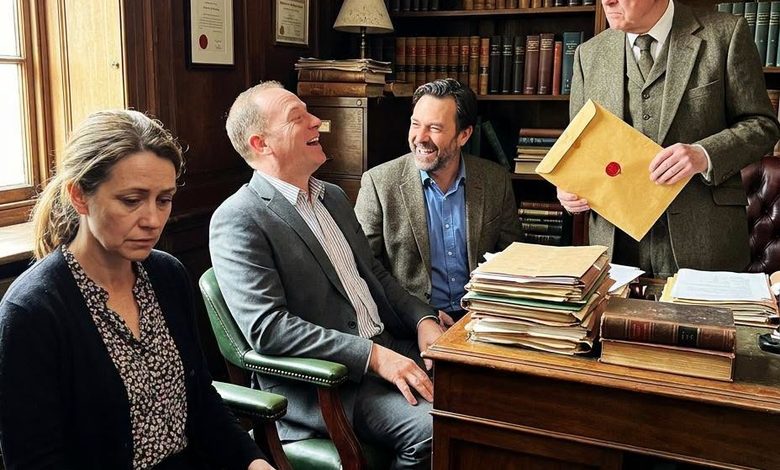
Three weeks after the funeral, we sat in the small office of Dad’s lawyer, Mr. Ellison, a white-haired man who’d known our family for forty years.
He read the will slowly. It was dated 2019, before Dad got really sick.
“To my sons, Wade and Darryl, I leave the farm, the house, and the equipment, to be divided equally.”
Wade let out a breath. Darryl actually fist-pumped under the table. I saw it.
“To my daughter, Grace, I leave my Bible, which she always read to me, and which I want her to keep close.”
That was it.
“Pray About It”
Darryl laughed first. A short, ugly bark.
“The Bible,” he said. “Six years of babysitting, and you get the Bible. Well, Gracie, I guess you can pray about it.”
Wade chuckled into his coffee. “Dad always was practical. The farm’s worth what, Mr. Ellison? Two and a half million? Three?”
“Look,” Darryl said, leaning back, “you were the free help, sis. That was your choice. Nobody asked you to move your whole life around.”
I didn’t argue. I didn’t cry. I just picked up the worn black Bible from the desk, the one with Dad’s coffee rings on the cover, and held it in my lap.
Mr. Ellison hadn’t moved. He was watching my brothers over the top of his glasses.
Then he opened his desk drawer and took out a second envelope. Thick. Sealed with old-fashioned red wax.
On the front, in my father’s shaky handwriting, were five words:
“Open only if my sons laugh.”
The room went very quiet.
The Letter
“Your father gave me this in the spring of 2022,” Mr. Ellison said, breaking the wax. “His instructions were very specific. If the will was read and either of his sons laughed, I was to read this out loud. If nobody laughed, I was to burn it.”
Darryl wasn’t laughing anymore.
Mr. Ellison unfolded a single page and read.
“Boys. If you’re hearing this, you laughed at your sister. I’m not surprised, and I’m not angry. But I am disappointed, and I want you to know why I did what I did.
The will you just heard is real. It gives you everything that is still in my name. But the farm is not in my name anymore.”
The Trust
Mr. Ellison set down the letter and explained, very calmly.
In March of 2022, while he was still completely clear-headed, Dad had placed the farm, the house, and the land into a living trust. Property in a trust doesn’t pass through a will. It goes to whoever the trust names.
“What’s left in your father’s name,” Mr. Ellison told my brothers, “is a 2006 pickup truck, some hand tools, and a checking account with a balance of $2,140. That’s what the will divides between you.”
Wade’s face went gray. “Then who does the trust name?”
Mr. Ellison looked at me. “Grace. Did you happen to look inside the back cover of that Bible?”
I opened it with shaking hands. Tucked into the back cover, behind the family record pages where Dad had written all our birthdays, was a folded document with a notary’s stamp.
The Whitfield Family Trust. Trustee and sole beneficiary: Grace Whitfield.
“Keep it close,” he’d written. He meant it literally.
The Rest of the Letter
Mr. Ellison picked the letter back up.
“Wade, you borrowed $48,000 from me in 2017 for a business that never opened. Darryl, you borrowed $31,000 for houses I never saw. You both promised to pay it back. Neither of you did, and neither of you came to see me when I couldn’t drive anymore.
Your sister never asked me for one dime. She drove 80 miles a day for six years. She read me this Bible every night when my eyes went bad. She held my hand when I forgot who she was, and she never once made me feel ashamed.
I didn’t leave the farm to the child who stayed because she earned it. I left it to her because she’s the only one of you who knows what it’s worth.
I love you boys. I always will. I hope one day you understand. — Dad”
What I Did
Darryl tried to say it was “undue influence.” Mr. Ellison calmly slid across a letter from Dad’s doctor, dated the same week in 2022, confirming he was fully competent. Then a video, recorded in that same office, of Dad explaining his decision in his own words.
Wade didn’t argue. He just stared at the desk.
I could have walked out. Instead, I said something that surprised even me.
“I’m not selling the farm,” I told them. “Ever. But Dad’s loans? I’m forgiving them. Both of them. You don’t owe me anything.”
Darryl blinked. “Why?”
“Because Dad would have,” I said. “And because I want you to come home sometime without needing something.”
Harvest
I hired Dad’s longtime neighbor to farm the land with me. Last fall, we brought in the best soybean harvest the Whitfield place has had in a decade.
Darryl didn’t call for months. Then, in September, a pickup truck rolled into the driveway at 6 a.m. It was Wade, in work boots that still had the price sticker on the sole.
“I don’t know anything about combines,” he said. “But I figured I could learn.”
He worked the whole harvest with us. On the last night, we sat on Dad’s porch with two cold beers and watched the sun go down over the empty fields.
“I’m sorry I laughed,” Wade said quietly.
“I know,” I said.
The Bible sits on the kitchen table now, right where Dad kept it. I still read it some nights. And every time I open the back cover, I smile.
My brothers thought Dad left me the least valuable thing he owned. They never understood that he’d put everything inside it.
This story is a work of fiction. Names, characters, and events are products of the author’s imagination. Any resemblance to real people or events is purely coincidental. This story is not legal advice; estate laws vary by state, so speak with a licensed estate attorney about your situation.