I Found a Baby in My Backyard and Raised Her for 12 Years—Then a Stranger Said, “You’ve Had Her Long Enough”
Part 1: The Man Who Looked Past Me
“You’ve had her long enough. It’s time to give her back.”
The man on my porch said it as though he had come for a ladder I had borrowed. Behind me, my daughter was at the kitchen table, working on a science assignment. I kept one hand on the door and shifted until my body blocked his view of the hallway.
“I think you have the wrong house.”
“The baby you found twelve years ago. I’m her grandfather.”
A chair scraped across the kitchen floor.
“Mom? Who’s there?”
Hope appeared holding a pencil, her curls caught behind one ear. The man’s expression changed when he saw her. He took a step forward, and I stepped outside, pulling the door almost closed behind me.
“Stay in the kitchen, sweetheart.”
She didn’t move immediately. Then I heard her retreat.
“Who are you?” I asked.
“Peter. My daughter is her mother.”
“I’m her mother.”
He glanced toward the narrow opening beside my shoulder.
“You know what I mean.”
I did. That was what frightened me: not that he possessed some power over us, but that he had arrived prepared to speak as if he did.
Twelve years earlier, I had been alone in that same house when I heard a baby crying outside. At first I thought the sound came from a neighbor’s yard. Then it stopped, started again, and drew me through the kitchen toward the patio.
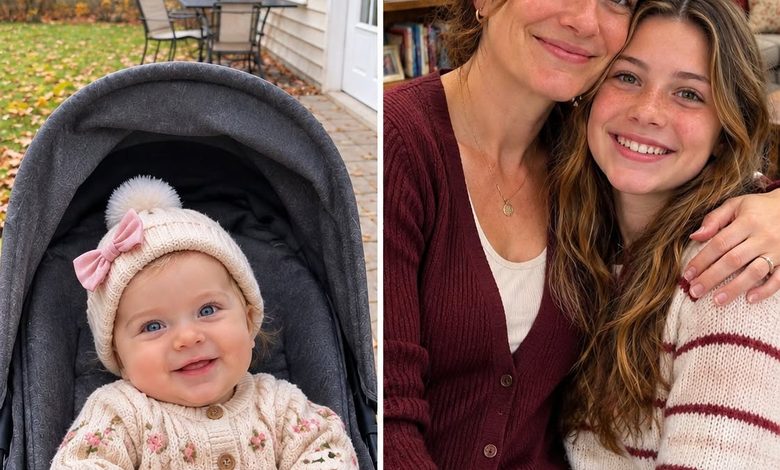
A stroller stood beside the back steps. Beneath its canopy was a little girl in a pink knitted hat, her cheeks wet, one fist working free of her blanket. An envelope lay near her feet.
Inside was a single sentence.
“Please keep her safe.”
I called emergency services before touching anything else. The dispatcher stayed with me while I checked that she was breathing comfortably. When I picked her up, she caught my finger and held it so tightly that I struggled to free my hand when the paramedics arrived.
They estimated she was around seven months old. Beyond that, nobody could tell me much.
An officer asked whether I had seen anyone near the house, whether I recognized the stroller, whether someone might have chosen my address deliberately. I answered no to everything. By evening, the baby was in the care of the county, and my house had become silent again.
I had once imagined that house full of children.
My husband, Trey, and I had spent years attending appointments and learning to recognize disappointment in a doctor’s face before a word was spoken. Two pregnancies ended before we could bring either baby home. After the second loss, Trey sat beside me on the edge of our bed without reaching for my hand.
“I can’t keep doing this, Cameron.”
“Then we stop treatment for a while.”
He looked toward the doorway.
“I don’t mean just treatment.”
Three months later, he moved out. Our marriage had other fractures, but grief had stripped away our ability to pretend they were small. The room we had painted for a child remained closed because opening the door felt harder than passing it.
After the baby was found, I started leaving that door open.
For weeks, I called the social worker only to ask whether she was all right. The woman could share very little, and I understood why. Still, I found myself making those calls from the kitchen, facing the patio as though the answer might arrive there again.
Finally, I asked a different question.
“If no family is found, could I apply to foster her?”
“You can apply,” she said carefully. “Finding her doesn’t give you priority, Cameron. We would have to assess your home and your readiness like anyone else.”
“I know.”
I didn’t know how difficult waiting would be. There were interviews, classes, background checks, references, and conversations about loss that left me exhausted. I was asked whether I wanted to parent this particular child or whether I expected a baby to repair my life.
It was a fair question. I took it seriously.
Four months after the morning on the patio, she came to live with me as a foster placement. The search for her family continued. I kept appointments, recorded milestones, and learned not to mistake the joy of having her home for a promise that she could stay.
When the social worker asked what I called her, I looked down at the small hand wrapped around my thumb.
“Hope.”
The legal process took much longer than the naming. The agency documented its search, the court addressed the rights of her unidentified parents, and my adoption petition was considered only after those steps were complete. By the time the judge made us a family in law, Hope had already learned where I kept the crackers.
She grew up knowing she was adopted. We had a picture book about different families and a box containing the few things that had come with her. I told her what I knew, which wasn’t much, and never invented a comforting explanation for what I didn’t.
At five, she asked why I had named her Hope.
“Because that’s what you gave me.”
She considered this, swinging her feet beneath her chair.
“So I found you, too?”
“Yes, sweetheart. You found me, too.”
Now the man on my porch was looking at our front door as if those years were something he could walk through.
“Does your daughter know you’re here?” I asked.
“She’s been through enough. She deserves another chance.”
“That wasn’t my question.”
He pressed his lips together.
“I know you adopted her.”
“Then you understand she isn’t someone you can come and collect.”
“I’m talking about what’s right. Not paperwork.”
I took out my phone.
“Give me your name and number. If your daughter wants to speak to me, she can contact me herself. You are not coming inside.”
He wrote his number on a receipt. Before leaving, he asked whether Hope knew about her birth mother.
“Neither of us even knew her name until today.”
“Anna,” he said.
Inside, Hope was sitting at the table with her science worksheet turned facedown.
“He can’t take me away, can he?”
I sat beside her rather than answering from the doorway.
“No. You are legally my daughter. Nothing that man says on our porch changes that.”
“Then why did he say it?”
“I don’t know yet.”
She pushed the pencil toward the center of the table.
“You’re going to find out, right?”
I covered her hand with mine and promised I would. By morning, I had arranged to meet Peter—and I still had no idea why my address had survived in his family for twelve years.
Part 2: The Woman in the Photograph
Peter chose a diner near the highway. I chose a table beside the front window and told a friend where I would be. Before leaving home, I had also called the attorney who handled Hope’s adoption. Her office was retrieving the file; she advised me to document every contact and agree to nothing under pressure.
Peter arrived carrying a large envelope. He laid photographs between the sugar dispenser and my untouched coffee.
One showed a young woman standing beside him at a graduation. Another showed the same woman visibly pregnant, smiling with one hand resting against her stomach.
“Anna,” he said. “She loved her baby.”
“Did she send you to my house?”
He adjusted the photographs into a neater row.
“She’s had a difficult time.”
“Did she send you?”
“No.”
I reached for my bag.
“Then this conversation is already different from the one you led me to expect.”
“Wait. She told me where she left the baby. I thought someone needed to do something.”
I remained seated, but kept my bag on my lap.
“How long have you known?”
“She told me last week.”
That explained his arrival, though not his certainty.
He said he and Anna had only recently begun speaking regularly after years of strained contact. During an argument about the past, she had finally told him what happened to her child. He had driven past my house, recognized it from her description, and decided to knock.
“Without asking her.”
“She would have talked herself out of it.”
“Perhaps she had reasons.”
His jaw tightened.
“We’ve had disagreements. Her job choices. Money. What she spent trying to get pregnant.”
Something in that last sentence caught against an old memory.
“She had fertility treatment?”
“Yes.”
I looked again at the graduation photograph. The woman’s hair was darker than it had been in my memory. Her face was fuller, younger. Still, there was something familiar about the way she held her chin.
Peter pushed the picture closer, mistaking my attention for agreement.
“You can see she was a good girl.”
“I’m not here to decide whether your daughter was good. I’m here because you frightened mine.”
For the first time, he looked down.
I asked for Anna’s telephone number. He hesitated, then said he would give her mine instead. I agreed, took a photograph of the two pictures with his permission, and stood.
“Do not come to our house again. If Anna wants a conversation, she needs to speak for herself.”
That evening, after Hope went to bed, I opened the cabinet containing her adoption records. The final decree was where I had left it, inside a blue folder with a cracked corner. I read it anyway, letting its plain language steady me.
Beside it was the envelope with the note.
Please keep her safe.
For years, I had studied those words for some clue to the writer. That night I studied Peter’s photograph instead.
Then I remembered the clinic waiting room.
There had been a young woman who always brought a paperback but rarely turned a page. Once, after an appointment that left me crying beside the elevators, she asked whether I needed someone to sit with me.
We began talking whenever our appointments overlapped. Her name was Anna.
She was single and had chosen donor-assisted treatment after being told that a medical condition could make waiting more difficult. She had a job, savings, and a plan she defended with a brightness that sometimes looked like strain. We didn’t become close friends, but we exchanged numbers.
Once, she came to my house for tea.
She teased me about how much sugar I used. I showed her the room Trey and I had painted, then apologized for getting emotional. She stayed until I could laugh again.
Later, she called to tell me she was pregnant.
Not long afterward, my marriage collapsed. I changed numbers when I separated our accounts, withdrew from almost everyone associated with treatment, and lost touch with her. Until that night, I had not connected the woman from the clinic with the baby beside my patio.
I called Peter.
“Did Anna tell you she knew me?”
There was a pause.
“She said you’d met.”
I shut my eyes.
“You might have mentioned that.”
“I assumed you remembered her.”
“You assumed a great deal.”
Two days later, Anna called.
“Cameron?”
Her voice brought back the elevator lobby before she said anything else.
“Yes.”
“I’m sorry about my father. I didn’t know he was going to your house.”
I sat down at the kitchen table.
“You used to tell me my tea could hold a spoon upright.”
A small, unsteady breath came through the phone.
“You remember.”
“Now I do.”
We agreed to meet alone at a café the following afternoon. I told Hope I was following up on what Peter had said, not hiding the meeting but not presenting an unverified story as fact. She asked me to find out whether Anna remembered anything about her as a baby.
“Something real,” she said. “Not just that I was cute.”
I promised to ask.
Anna stood when I entered the café. She looked older, of course, but I recognized the way she tucked her hands beneath her elbows when she was nervous.
“Do you still drink that terrible tea?”
“Every day.”
Neither of us smiled for long.
Once we were seated, I asked whether Hope was the baby she had been expecting when we knew each other.
“Yes.”
“And you brought her to my house.”
She nodded.
For twelve years, I had thought chance brought my daughter to the patio. Now I was looking at someone who remembered choosing the route.
“Why didn’t you knock?”
Anna rubbed the edge of a paper napkin.
“I was afraid you would say no.”
“You should have allowed me to answer.”
“I know.”
“And you should have allowed someone to help you before it reached that point.”
Her hands stopped moving.
“I did ask someone.”
I waited.
“My father.”
She looked toward the window, then back at me.
“I’ll tell you what happened. But he needs to hear it, too. I’ve let him explain my life for too long.”
Part 3: What Nobody Had Asked
We met at Peter’s house the next afternoon. Anna had suggested it, and I agreed on the condition that Hope would not be involved. I wanted answers before introducing my daughter to anyone else’s version of her history.
Peter opened the door with visible relief.
“I’m glad we’re making progress.”
“We’re having a conversation,” I said.
Anna was seated at the dining table. She had brought a folder, but before she opened it, Peter began explaining that she had not been ready for motherhood.
“Let me answer,” she said.
He stopped, looking more surprised than offended.
Anna told me that her job had disappeared during her pregnancy when the small business employing her closed. She found temporary work, but it ended after Hope was born. Savings that had once seemed sufficient disappeared into rent, insurance, and ordinary expenses.
“I asked Dad if we could stay here while I found steady work.”
Peter leaned back.
“I offered financial help.”
“If I arranged for someone else to raise her.”
“I thought you needed to consider adoption.”
“You said I could come home without the baby. Not with her.”
I looked at him.
“Is that true?”
He ran a finger along the edge of a placemat.
“Yes. I didn’t think bringing an infant here was practical.”
Anna opened her folder. There were copies of old letters and a notice from her former landlord. None of it excused what happened, but it made the sequence less abstract: work lost, payments missed, an eviction approaching, another request refused.
“I managed for months,” she said. “Then I stopped believing I could manage another week.”
“Why my house?” I asked.
“I remembered you. I remembered the room you’d painted. I knew how much you wanted a child.”
“You didn’t know whether I was home.”
Her eyes filled.
“I saw your car.”
“That wasn’t enough.”
“No.”
“You could have knocked. I might have helped you find somewhere to stay. I might have driven you to someone who knew what to do.”
She lowered her head.
“I convinced myself leaving her somewhere loving was better than admitting I couldn’t cope.”
“Better for whom?”
She took a long time to answer.
“For the part of me that couldn’t bear to hear someone tell me I had failed.”
Peter shifted in his chair.
“Whatever happened, Cameron, you got the daughter you wanted.”
I stood so abruptly that my chair struck the table.
“Don’t make this sound like an arrangement we all agreed to. There was a baby outside. There were people searching for her family. There was a child who grew up without answers.”
Anna looked directly at him.
“Stop helping like this, Dad.”
“I’m trying to put things right.”
“By telling Cameron I wanted Hope back? You never asked what I wanted.”
“You’re her mother.”
“I gave birth to her. Cameron raised her. Both things are true, and neither gives you permission to frighten her.”
Peter’s face tightened. For a moment, I thought he would argue again. Instead, he looked at the unopened door to his kitchen.
“I failed you,” he said quietly. “I thought perhaps there was still a way to have my family.”
“Then begin with the daughter sitting in front of you,” I said.
He had no answer for that.
Outside, Anna followed me down the path. Without Peter between us, she looked exhausted rather than relieved.
“Why didn’t you come back?” I asked.
“At first, I was afraid of admitting what I’d done. Later, when I had work and somewhere to live, I was afraid of what I would find.”
“Did you ever contact the authorities?”
“No.”
“The agency?”
She shook her head.
I needed her to say it without her father’s refusal standing in front of it.
“So after you were safe, you still chose not to find out.”
“Yes.”
We stood beside my car.
“What do you want now?”
“To know she’s all right. To answer her questions, if she has them. I’m not asking to take her.”
“She has questions.”
Anna pressed her lips together and nodded.
At home, Hope waited until I had put my keys down.
“Did you find her?”
“I found the woman who says she’s your birth mother. We’re going to verify that before anything else.”
“What’s she like?”
“She talks quickly when she’s nervous.”
Hope gave me a brief smile.
“So do you.”
Then the smile disappeared.
“Did she not want me?”
I sat beside her.
“She says she wanted you very much. She lost her job and didn’t get help she asked for. But leaving you outside was her decision, and it wasn’t a safe way to ask someone else to care for you.”
“But you got me.”
“I did. That doesn’t mean everything that happened was right.”
Hope picked at a loose thread on her sleeve.
“Can I meet her?”
I wanted more time. I also knew that postponing the question indefinitely would be a choice I made for my comfort, not necessarily hers.
“We can work toward that. Carefully.”
Over the following weeks, my attorney reviewed the adoption file and confirmed that the completed adoption made me Hope’s legal parent. The agency connected us with an adoption-competent counselor. With informed consent, we arranged identity checks and DNA testing through an accredited laboratory. Anna also provided her available medical and pregnancy records.
The results confirmed that she was Hope’s biological mother.
Only then did we discuss a meeting. Hope chose a café, asked me to stay, and established a signal: if she turned her bracelet inward, we would leave without debate.
Peter called when Anna told him.
“I should be there.”
“Hope hasn’t agreed to meet you.”
“I’m her grandfather.”
“Then respect her first decision about you.”
That night, Hope appeared at my bedroom door.
“What if I like her?”
I put down my book.
“Then you like her.”
“You won’t think it means I want a different mom?”
“No.”
She sat beside me, unconvinced until I took her hand.
“You’re allowed to know where you came from without leaving where you belong.”
She leaned against me for a moment, then straightened.
“On Saturday, don’t answer my questions for me.”
“I’ll try not to.”
“Promise.”
I promised. After she went to bed, I lay awake wondering whether I could keep that promise when the answers began to hurt.
Part 4: The Questions at the Table
Anna was already at the café when we arrived. She had chosen a table near the exit, just as we had requested, and there was no one sitting with her. I noticed Hope checking the other tables before she loosened her grip on my hand.
“That’s her?” she whispered.
I nodded.
Anna stood, then seemed to reconsider moving any closer.
“Hello, Hope.”
“Hi.”
For a moment, they simply looked at each other. I could see the resemblance now that I knew where to look: their eyes, the slight crease between their brows when neither knew what to say.
Hope pulled out her own chair. I sat beside her, leaving Anna across the table rather than between us.
“Mom said you knew each other before,” Hope began.
“We did. We met when we were both hoping to have babies.”
Hope glanced at me.
“She got me.”
Anna’s mouth trembled before she smiled.
“Yes. She did.”
A server came to take our order. The interruption helped. Hope chose hot chocolate, Anna ordered coffee, and I asked for tea. Nobody commented on the sugar I added.
Hope kept both hands around her cup after it arrived.
“Do you remember what I was like?”
“You liked holding my fingers. Especially my little finger. You would fall asleep holding it, and wake up if I tried to move.”
Beneath the table, Hope found my hand.
“Anything else?”
“You hated having your arms tucked inside a blanket. You always worked one free.”
I remembered the small fist pushing out from beneath the pink blanket on the patio. I stayed quiet.
Hope studied Anna for a moment.
“Did you name me something?”
Anna told her the name she had used during those first months. Hope repeated it once, softly, as though testing a word in another language. Then she said she wanted to keep being Hope.
“Of course,” Anna said. “I’m not here to change your name.”
The answer seemed to settle something. Hope took a sip of her drink.
“Why did you pick my mom?”
Anna looked at me, then returned her attention to Hope.
“She was kind to me when she had plenty of reasons to be sad herself. I knew she wanted to be a mother. But I should have spoken to her. I should have asked for help instead of leaving you outside.”
“Were you watching?”
Anna’s fingers tightened around her cup.
“Not long enough. I left before I knew you were inside.”
Hope looked down.
I felt an answer rise in me—an instinct to soften what she had heard—but I remembered the promise.
Anna went on carefully.
“You deserved to be safe. What I did was wrong. That wasn’t because of anything about you.”
Hope rubbed her thumb over my knuckle.
“Did you think about me on my birthdays?”
“Every year.”
“Then why didn’t you send a card?”
Anna set down her cup.
“I was afraid. Of admitting what I’d done. Of finding out whether you wanted to hear from me.”
“I would have liked a card.”
Anna nodded, and this time she didn’t try to explain further.
“I’m sorry I didn’t send one.”
There was a silence long enough for the coffee machine behind the counter to stop and start again.
“Your dad said I had to go back,” Hope said.
“He was wrong.”
“Did you tell him that?”
“Yes. I told him he must not contact you or your mom again unless you both agree.”
Hope looked at me. I nodded once, confirming what I could.
Anna reached into her bag, then stopped with her hand inside.
“I brought some copies of photographs and family medical information. Would you like your mom to hold them, or would you rather not have them today?”
“Mom can keep them.”
Anna handed the envelope to me without sliding anything toward Hope. It was a small act of restraint, but I noticed it. So did my daughter.
We stayed thirty-five minutes. Hope didn’t turn her bracelet, but eventually she asked whether we could go. Anna rose with us and kept her hands at her sides.
“Thank you for meeting me.”
Hope nodded.
“I still have questions.”
“You can take your time.”
In the car, Hope fastened her seat belt and stared through the windshield. I started the engine but didn’t pull away.
“Are you okay?”
“I don’t know yet.”
“That’s an answer.”
She let out a breath.
“She looks different from what I imagined.”
“How did you imagine her?”
“Different every time.”
We sat another minute before driving home.
Nothing became simple after that meeting. Hope was quiet at dinner, talkative the next morning, then angry three days later about the birthday cards. The counselor helped us make room for those changes without treating every feeling as a decision about the future.
Anna answered questions through me at first. When she didn’t remember something, she said so. When Hope declined another meeting the following month, Anna accepted it without asking me to persuade her.
Peter sent a letter to my attorney’s office apologizing for his visit. I read it before offering it to Hope. He admitted he had frightened her and promised not to approach her at home or school. Hope decided she wasn’t ready to read it.
I put it away. An apology did not create an appointment.
Eventually, Hope asked to see Anna again. We arranged another short visit. There were no promises about what she would call Anna, how often they would meet, or whether Peter would someday be included. There was only an agreement that Hope would not be rushed and that adults would manage their own disappointment.
One evening, months after the knock at our door, I found Hope examining the old pink blanket. The photographs Anna had provided lay beside pictures of school plays, missing teeth, and our badly decorated birthday cakes.
“I’m glad you kept this,” she said.
“I kept everything I could.”
She folded the blanket, not neatly, and returned it to the box.
Then she followed me into the living room and dropped onto the couch.
“Can I pick the movie?”
“You picked last time.”
“You said I get a say.”
“That isn’t unlimited authority over the remote.”
She grinned and tucked her feet beneath her. I handed it over anyway.
A few minutes later, she leaned against my shoulder, as she had through thunderstorms, fevers, and films she insisted weren’t frightening.
“You know I’m still keeping you forever, right?” she said.
I rested my cheek against her curls.
“I was counting on it.”
The box of unanswered questions was still upstairs. Some would take years. But when Hope reached for my hand beneath the blanket, neither of us had to ask whose hand she expected to find.
Disclaimer: This story is a work of fiction inspired by real-life themes. Names, characters, places and events are fictionalized, and any resemblance to real persons is purely coincidental. Images are for illustration purposes only.