My Brother Gave Me a DNA Test for My 35th Birthday and Laughed, “Maybe This Explains Why You’re Another Man’s Mistake” — At Dad’s Will Reading, the Lawyer Opened a Sealed Letter First
This is a fictional story.
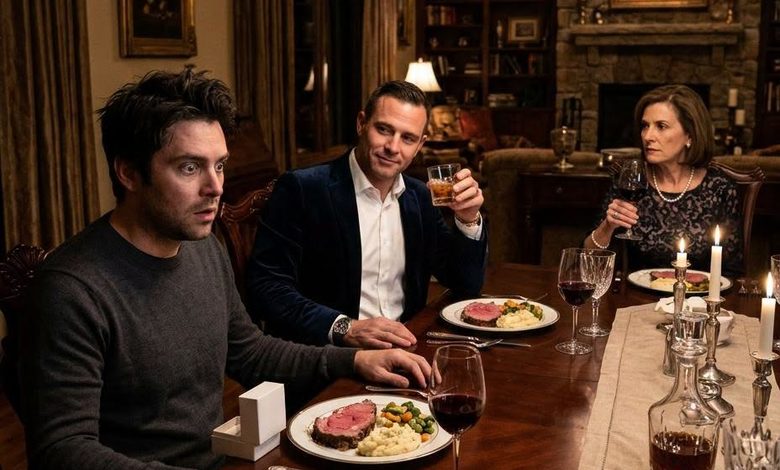
My brother gave me a DNA test for my thirty-fifth birthday.
Not quietly. Not in private. He did it at the mahogany dining table in our family’s Denver house, in front of our mother, sliding the glossy drugstore box across the table until it bumped my plate.
Then Julian smiled. “Maybe this will explain why you’re another man’s mistake.”
The room went silent. Not a shocked silence. A familiar one. The kind that told me everyone at that table knew exactly how cruel he could be, and nobody planned to stop him.
The Golden Son
My name is Arthur Ellington. I’m thirty-five, and for most of my life I was treated like a debt my family resented carrying.
Julian was the golden son. Loud, reckless, and sure of himself. When he failed a class, our mother, Eleanor, blamed the teacher and bought him something expensive. When I brought home straight A’s, she’d glance at the report card and say, “That’s nice, Arthur. Take out the trash.”
At eighteen, Julian got a sports car with a red bow in the driveway. When I left for college, I got a lecture about character and a stack of student loan forms.
So I worked warehouse night shifts, lived on cheap noodles, and built my own life one exhausted paycheck at a time, while Julian skied in Aspen on our parents’ money and called it “networking.”
My Father
The only person in that house who ever made me feel seen was my father, William.
He wasn’t a hugger. He didn’t make speeches. But sometimes, after Julian had humiliated me, he would rest one heavy hand on my shoulder and say nothing at all. That silence meant: I see you.
When I got my first promotion at a financial firm in Austin, he called. The message was four words long. “Proud of you, son.”
I saved that voicemail for years.
Then he died. A cold November funeral with sleet falling over the cemetery. My mother performing grief under a black umbrella. Julian shaking hands with Dad’s business partners like a man campaigning for a throne.
The Fireplace
A few days after the funeral, I walked past Dad’s study and smelled burning paper.
My mother was standing at the fireplace, feeding folders into the flames. Not junk mail. Financial records.
“What are you burning?” I asked.
For half a second, her face went white. Then the old coldness returned. “I am his wife, Arthur. I know what needs to be handled.”
I should have called the lawyer right then. But grief makes you slow, and in that family I’d been trained my whole life not to trust my own instincts.
The Birthday Dinner
Three months later, my mother called in her sweetest voice. “Come home for your birthday. Just the three of us. Your father would want us together.”
Some foolish part of me hoped death had changed them. It hadn’t.
Julian spent the whole dinner bragging about the commercial properties he’d “control once the estate settles.” So I finally asked, “Has Mr. Dalton said anything about Dad’s will?”
“We’re handling it,” Julian said.
“I’m his son too.”
His smile turned sharp. “Are you?”
That’s when the box came out.
I looked at my mother. “Are you going to let him say that?”
A single tear slid down her cheek. She didn’t say it was a lie. She didn’t say he was cruel. She said only: “Julian, please. Not tonight.”
Not tonight. Those two words hurt more than the insult. Because they meant this wasn’t new. It was a secret.
The Cedar Chest
I went upstairs, locked my old bedroom door, and climbed into the attic crawl space where I used to hide from Julian as a kid.
Under a pile of old winter coats, I found a small cedar chest. Inside were letters tied with ribbon and faded photographs.
One picture stopped my breath. My mother, young and smiling, holding a baby. Me. But the man beside her wasn’t William Ellington. It was David Hartman, an old family friend who vanished from our lives when I was little and was never mentioned again.
On the back, in my mother’s handwriting: Forgive me.
That night, I mailed the DNA test.
The Results
Five weeks later, the results came in. Zero percent match to the Ellington family. Fifty percent match to the Hartman line.
I sent a screenshot to the family group chat with one line: Does anyone want to explain this?
My mother called within thirty seconds, sobbing. “Delete it, Arthur. This will ruin everything.”
Julian texted instead: Now you know. Dad’s money belongs to real Ellingtons. Step aside gracefully, or I’ll drag you through probate court and humiliate you publicly.
For the first time in my life, I smiled at my brother. Julian had always been loud. But loud men rarely read the law.
Sarah
I hired Sarah Ang, the kind of estate attorney rich families fear because she doesn’t blink. I gave her everything: the results, the photo, Julian’s texts, the fireplace.
Within days she found what Julian had been hiding. While Dad was dying, heavily medicated and barely able to speak, Julian had moved $50,000 out of his accounts and into his own private LLC.
Then Richard Dalton, Dad’s estate lawyer, called. “There will be an urgent final will reading Friday at 9 a.m. Your attendance is required. Bring counsel.”
Friday, 9 A.M.
Julian arrived in a cream Italian suit with a bulldog lawyer, and parked his red Porsche where everyone could see it. “Hope you didn’t spend too much on that plane ticket, Arthur,” he said. “I’d hate for you to fly home empty-handed.”
Mr. Dalton walked in carrying a thick sealed folder and set it on the table with a thud.
“Before I read William Ellington’s final will,” he said, looking straight at Julian, “I must state for the record that Mr. Ellington anticipated greed, conflict, and one specific DNA-related objection.”
Julian’s smile twitched. My mother covered her mouth.
Dalton broke the seal on the first letter. And when he read its first line, my brother’s face lost every trace of color.
The First Line
Mr. Dalton read slowly, so no one could pretend they hadn’t heard.
“If you are hearing this, then someone has finally told Arthur he is not my blood. I have known since he was six months old.”
My mother let out a small sound, like something breaking.
“Eleanor told me the truth the winter he was born. I was angry for a long time. David left town, and I was left with a choice. I could hand that baby back to a man who had already walked away, or I could raise him as mine. I made my choice in 1991, and I made it legal.”
Dalton slid a document across the table. It was a sealed court record: a formal adoption decree, signed by William Ellington when I was one year old. My father hadn’t just raised me. He had legally adopted the son everyone already assumed was his, quietly, so no one could ever take that name away from me.
“Arthur is my son by choice and by law. Biology made Julian my son. I chose Arthur twice. Once in my heart, and once in front of a judge.”
The Clause
Julian was on his feet. “This is ridiculous. He was drugged out of his mind at the end. We’ll contest the whole thing.”
Mr. Dalton didn’t even look up. “This will was signed four years ago, when Mr. Ellington was in full health, with two witnesses and a physician’s statement of capacity attached. And there is a clause your father asked me to read aloud if you said that exact word.”
He turned a page.
“Any beneficiary who challenges this will, or challenges Arthur’s status as my son on the basis of DNA, forfeits their entire share, which will pass instead to charity.”
Julian’s lawyer put a hand on his arm and whispered something. Julian sat down very slowly.
The Estate
Then Dalton read the will itself.
The house in Denver went to my mother for her lifetime. The commercial properties Julian had bragged about all through my birthday dinner, the ones he’d already been “controlling” in his head, went to me. Not as a reward, my father wrote, but because “Arthur is the only one of my children who has never asked me for anything, and the only one I trust not to sell my life’s work to pay for a Porsche.”
Julian wasn’t cut out completely. Dad left him a trust, paid out over ten years, on the condition that he hold a steady job. “So he learns,” the letter said, “what his brother learned in a warehouse at nineteen.”
The $50,000
That’s when Sarah opened her folder.
“Before we close, Mr. Dalton, there is the matter of $50,000 transferred from William Ellington’s personal account to Julian Ellington’s LLC eleven days before his death, while he was under hospice care.”
She laid the bank statements on the table, one by one.
Dalton nodded slowly. “Then that amount will be repaid to the estate in full before any distribution from the trust. Otherwise, the executor will have no choice but to refer it to the district attorney.”
Julian’s lawyer was already packing his briefcase.
The Porsche was sold within the month. That’s how the $50,000 came back.
The Second Letter
There were two more sealed envelopes. One had my mother’s name on it. She took it with shaking hands and didn’t open it in the room.
Weeks later, she told me what it said. Dad had known she was burning records after his death, because he’d known she would. He’d given Dalton copies of everything years earlier. The letter ended: “You do not need to burn the past, Eleanor. You only need to stop letting Julian use it as a weapon.”
She came to Austin a month after the will reading. She sat in my small kitchen and apologized for thirty-five years. Not well. Not all at once. But she did it.
“I was so afraid you’d find out,” she said, “that I let your brother punish you for something I did.”
The Third Letter
The last envelope was addressed to me.
Inside was an address in Santa Fe and a short note in my father’s blocky handwriting.
“This is where David Hartman lives. He is a decent man who made a cowardly choice when he was young, and he has regretted it ever since. You owe him nothing. But if you ever want to know where your eyes come from, you have my blessing. It does not change who your father is. Proud of you, son. — Dad”
Proud of you, son. The same four words from the voicemail.
Santa Fe
I drove to Santa Fe in the spring. David Hartman opened the door, an old man now, with my eyes and my nervous habit of rubbing his thumb against his knuckle.
He didn’t ask for anything. He just said, “William wrote to me every year on your birthday. Thirty-four letters. He told me about your grades, your job in the warehouse, your promotion. He wanted me to know exactly what kind of man I’d walked away from.”
He handed me a shoebox. Thirty-four envelopes, every one in my father’s handwriting. A whole life of a quiet man watching his son from the other side of the dinner table, and writing it all down so somebody would know.
Julian handed me a DNA test to prove I didn’t belong.
My father had spent thirty-four years proving I did.
This story is a work of fiction. Names, characters, and events are products of the author’s imagination. Any resemblance to real people or events is purely coincidental.