I Drove 6 Hours Through a Storm to the Hotel I Secretly Own — The Manager Charged Me $1,400 for a $180 Room and Threw Me Out Into the Freezing Rain. At 2 AM, a Housekeeper Knocked on My Truck Window
This is a fictional story.
My name is Edmund Hale. I’m sixty-eight years old, and for twenty-seven years I’ve owned a small chain of mountain hotels.
My wife, Beatrice, and I built it together. We started with one tired roadside inn with a leaking roof, and over the years we grew it to seven properties.
But one of them always mattered more than the rest: Cedar Summit Lodge.
Every Guest Matters Here
Beatrice and I spent our wedding night at Cedar Summit, back when it was a creaky old inn with a wood stove and a crooked sign. Eleven years later, we bought it and restored it from the floorboards up.
Beatrice chose everything. The lobby furniture. The black piano beside the fireplace. And the small brass plaque she designed herself and hung beside the front entrance.
It said: Every guest matters here.
She meant it. To Beatrice, hospitality was never about impressing rich people. It was about making a tired traveler feel like somebody was glad they’d come.
Three years ago, Beatrice died. I hadn’t been back to Cedar Summit since the funeral. I couldn’t bear it.
But this fall, I finally felt ready.
Room 312
I called the reservations desk and confirmed that room 312 was available. It has a balcony that looks out over the whole valley. Beatrice and I stayed in that room on every anniversary we ever had.
I didn’t tell anyone I was coming. I just packed a bag, climbed into my old pickup, and drove six hours through the mountains while a storm rolled in behind me.
All I wanted was one quiet night with my memories.
The Bill
The receptionist’s name tag said Mallory. She printed an estimate and slid it across the counter without really looking at me.
Room: $180. Then a “mountain experience package,” $295. A “heritage preservation fee,” $240. “Exclusive arrival service,” $175. “Guest enhancement package,” $160. A “nonrefundable premium service fee,” $350.
Total before taxes: $1,400.
“I didn’t ask for any of these,” I said.
“They’re standard for certain reservations.”
“Then why did you quote the couple in front of me $180 plus tax?”
Her eyes flicked to the glass doors, where my rusty pickup sat in the pouring rain.
“Different guests qualify for different packages.”
I knew exactly what she meant. And I knew something else, too. Four months earlier, I had personally ordered the heritage preservation fee removed from every one of my hotels. Every manager had confirmed it in writing. Including the manager of Cedar Summit.
The Manager
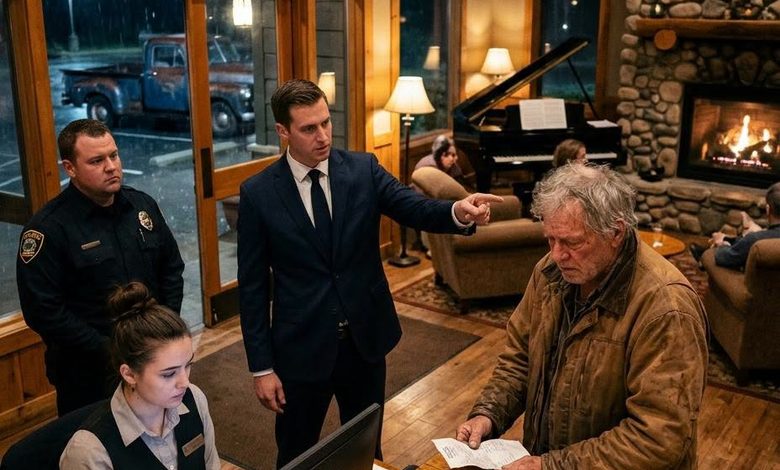
I asked for the manager. A few minutes later, Preston Shaw walked out.
Tall, sharp suit, polished shoes, and the kind of smile that has already decided what you’re worth. He’d run the lodge for two years. We’d traded emails, but we had never met. And no one had asked for my full name yet.
“I’d like room 312 at the advertised rate,” I said.
He glanced at the estimate. Not a flicker of surprise. “Certain rooms include premium charges.”
“And the heritage preservation fee?”
“Corporate policy.”
“Are you certain?”
His smile tightened. “Sir, our policies aren’t up for negotiation. And room 312 is reserved for priority guests.”
“Your front desk told me it was available when I called.”
“Availability changes.” Then he leaned in and lowered his voice. “Perhaps another hotel would be more appropriate for your budget.”
My face went hot. But I kept my voice level. “Are you refusing to rent me a room?”
“I’m declining to proceed.” He turned his head. “Eli, please escort this gentleman outside.”
A broad-shouldered security guard walked over. He looked at me, then at the storm hammering the glass. “Sir… it’s really coming down out there.”
“Then he should have thought of that before he wasted our time,” Preston said.
I picked up my bag. “It’s all right, son. I’ll find my own way out.”
The Plaque
By the door, I noticed Beatrice’s brass plaque. Someone had shoved a big potted plant in front of it, so you could barely see it.
I pushed the leaves aside. Every guest matters here.
I stood there for a long moment. Then I walked out into the rain.
In my truck, I photographed the estimate and opened my email. There it was: Preston’s message from four months ago. “The heritage preservation fee has been removed from all guest invoices, as instructed.”
I could have called headquarters right then. But I wanted to understand why he’d treated me like that. And more than anything, I wanted to know if he did it to other people.
So I stayed. The roads were too dangerous anyway. I ran the engine to warm up now and then, then turned it off and tried to sleep.
2:10 AM
At 2:10 in the morning, someone tapped on my passenger window.
A woman in a housekeeping uniform stood in the rain holding a thermos, a folded blanket, and a foil-wrapped plate. “Sir, I saw you sitting out here. I brought you some tea and something to eat.”
“You came all the way out here in this?”
She smiled. “You looked cold.”
Her name was Rosa Santos. She’d worked at Cedar Summit for almost nine years and had stayed late to get rooms ready for guests stuck in the storm. The plate was chicken and rice from the staff kitchen. She’d warmed it up for me.
I asked her to sit inside out of the rain. She hesitated, studied my face for a moment, then climbed in.
“I heard what happened earlier,” she said quietly.
“Does it happen often?”
Rosa looked toward the hotel. Her hands tightened around the thermos. She went pale.
“Sir,” she whispered, “there’s something you need to know…”
What Rosa Knew
“It happens almost every week,” Rosa said.
Older guests. People who paid cash. People who drove old cars or wore work boots. People who looked like they wouldn’t argue, or wouldn’t know who to call if they did.
“Mr. Shaw has a list of the fees on a card behind the desk,” she said. “The girls at the front are told to add them when he gives a signal. If a guest pays, the extra money doesn’t go into the normal system. It goes into something he calls the ‘enhancement account.’”
“And if they don’t pay?”
“Then suddenly there are no rooms.” She swallowed. “Like tonight.”
I asked about room 312. Rosa looked down at her hands.
“Nobody is in 312, sir. Nobody has been for months. Mr. Shaw keeps it for his friends on weekends. For free.” She hesitated. “Tonight it’s empty. I cleaned it myself at six.”
“Why haven’t you reported it?”
“A front desk clerk named Danny did. Last spring. He refunded an elderly couple their fees out of his own pocket and emailed corporate about it.” Her voice dropped. “Two weeks later he was fired for ‘cash handling errors.’ Nobody’s said a word since. I have two kids. I can’t lose this job.”
I looked at her for a long moment. Then I told her my name.
She stared at me. “Hale… like Hale Mountain Hotels?”
“Like Beatrice Hale,” I said. “She hung that plaque by the door. Somebody hid it behind a plant.”
Rosa covered her mouth with both hands and started to cry.
The Phone Calls
After Rosa went back inside, I made two calls. The first was to my chief financial officer, a woman named Joan who has worked for me for nineteen years. I woke her up. She didn’t complain.
“Pull every invoice from Cedar Summit for the last four months,” I told her. “Every one. Compare what guests were charged with what reached our accounts.”
By 6:30 a.m., she called back. Her voice was shaking.
“Edmund, there are four hundred and twelve invoices with fees that don’t exist. More than $180,000. None of it came to us.”
The second call was to our company attorney.
7:00 AM
At seven o’clock, I walked back into the lobby. Wet coat. Wrinkled shirt. Same old pickup out front.
Preston was at the desk. He saw me and sighed loudly. “Sir, I thought I made myself clear. Eli—”
“I’d still like room 312,” I said. “At $180.”
“That room is reserved for priority guests.”
I set two things on the counter. My driver’s license. And a printout of his own email from four months ago: “The heritage preservation fee has been removed from all guest invoices, as instructed.”
He read the name on the license. Then he read it again.
“Mr. Hale,” he said. All the color left his face. “I— I had no idea—”
“That’s the whole point, Preston. You weren’t supposed to need one.”
At that moment, the front doors opened. Joan walked in with our attorney and two people from our audit team. They’d driven through the night, too.
Preston was walked out of the building at 7:20 a.m. By Eli. In the rain.
The “enhancement account” turned out to be a personal account in his name. Our attorney filed a report that afternoon. Last I heard, Preston has a very good lawyer and a very bad case.
Mallory and Eli
Mallory came to see me before noon. She was crying before she sat down.
“He told us it was corporate policy,” she said. “He said the people who complained were always the ones who ‘didn’t belong here.’ I knew it was wrong. I did it anyway, because I was scared of being the next Danny.”
I didn’t fire her. I told her she’d be the one calling every single one of those four hundred and twelve guests to tell them a full refund was on its way, with an apology letter signed by me. She made every call herself. It took her three weeks.
Eli, the guard who looked at the storm and hesitated, became our new head of security. A man who hesitates before throwing someone into freezing rain is exactly the man I want guarding my guests.
And Danny, the clerk who was fired for doing the right thing, got a phone call from me personally. He’s back. He’s the assistant manager now.
Rosa
Cedar Summit needed a new general manager.
I could have hired someone with an impressive résumé and a nice suit. I’d done that before. I’d hired Preston that way.
Instead, I offered the job to the woman who walked across a parking lot in a storm at two in the morning to bring a stranger chicken and rice, without knowing who he was or what he could do for her.
Rosa said no twice. “I’m a housekeeper, Mr. Hale.”
“Beatrice started out cleaning rooms at our first inn,” I told her. “She was the best hotelier I ever knew.”
The third time, she said yes. We’re paying for her management training. She’s already better at it than I am.
The Night in 312
The first thing Rosa did as general manager was move the potted plant.
Beatrice’s plaque hangs right beside the front desk now, where every guest sees it before they see a bill. Underneath it, Rosa added a small card of her own: “If you are ever treated as less than welcome here, ask for Rosa.”
A week later, I finally spent the night in room 312.
When I walked in, there was a thermos of tea on the nightstand, a folded blanket at the foot of the bed, and a note in Rosa’s handwriting:
“Welcome home, Mr. Hale. You looked cold.”
I opened the balcony door, looked out over the valley where Beatrice and I spent every anniversary, and for the first time in three years, I didn’t feel alone.
This story is a work of fiction. Names, characters, and events are products of the author’s imagination. Any resemblance to real people or events is purely coincidental.