My Mother-in-Law Said My Two Old Horses Were Wasting $3,000 a Year and Sold Them to a Meat Buyer — Then Her $180,000 Tractor Died at Thirty Below With 400 Pregnant Cows Waiting
This is a fictional story.
My mother-in-law had already called the meat buyer. Twelve hundred dollars a head for Duke and Sis, my two old Belgian draft horses. Pickup was Monday.
“Three thousand dollars a year in feed,” Phyllis said, “for two pets.”
Then, on a January morning at thirty below zero, her brand-new $180,000 tractor wouldn’t start. And four hundred pregnant cows stood bawling at the stackyard fence, waiting for hay.
“The Iron Will Quit Someday”
My name is Karin. I married into the Thorsrud ranch thirteen years ago. My husband, Elling, grew up feeding cattle beside his father, Gunnar, from a hay sled pulled by horses.
Gunnar did it that way for forty winters. Tractors came and went on that ranch, but he always kept a team. “The iron will quit someday,” he used to say. “The horses won’t.”
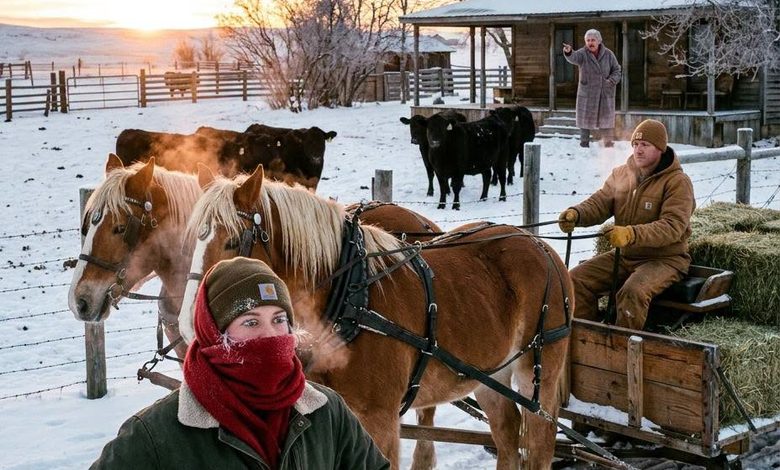
Duke was seventeen now. Sis was fifteen. Sorrel coats, blond manes, about two thousand pounds each. Gunnar had raised them both from foals.
Three years ago, one week before his stroke, Gunnar walked out to the sled one cold morning, put the lines in my hands, and walked back to the house. He never drove the team again.
Phyllis
Phyllis never forgave the horses for that. Or maybe she never forgave me.
At every family holiday she called them “Karin’s pets.” At Thanksgiving she complained about the feed bill. At Christmas she said it again, louder, in front of all the relatives.
Elling had taken a job three hundred miles away in the oil patch, driving a water truck, to help pay off the new tractor. Before he left, he told his mother clearly: the horses were not to be sold.
But Phyllis owned the ranch. And she’d already made the call.
Thirty Below
That morning, Clint, the mechanic Phyllis had hired, tried the tractor twice with starting fluid. It coughed once and died. The diesel had gelled in the cold.
I could have loaded Duke and Sis into the trailer right then and driven them to my brother’s place. Nobody would have stopped me.
But four hundred bred cows needed hay. The tractor was dead. And those two horses were the only working power on the place.
So I harnessed them.
From the porch, Phyllis called out: “Clint takes the team. Not her.”
“Those horses won’t understand him,” I said.
“Then he can teach them. If not, they’re gone Monday.”
“Get Up!”
Clint climbed onto the bobsled. He was a good mechanic and a decent man, but he’d never driven a draft team in his life. My eleven-year-old daughter, Nora, sat on the hay behind him in her purple snowsuit, holding a hook knife to cut the twine.
Clint slapped the lines. “Get up!”
Nothing.
He clicked his tongue and tried again. Sis turned her head and looked back at him. Duke planted his feet like he’d grown roots.
From the porch, Phyllis shouted: “Get the whip from the barn!”
I turned and looked straight at her. “No.”
Thirteen years on that ranch. I had never once told her no.
Clint looked at Phyllis. Then at me. Then he held out the lines. “I’m not whipping a horse at thirty below to prove a point,” he said.
One Word
I climbed onto the sled. My red scarf was pulled over my mouth. Frost had formed on my eyelashes. The sun was just coming up over the hills, and every cow in the stackyard was watching us.
Phyllis went inside and stood at the kitchen window, the same window where she’d watched her husband feed cattle for forty years.
I took the lines. I didn’t slap them. I didn’t click my tongue.
I just said the one word Gunnar had taught me.
“Kom”
“Kom.”
It’s Norwegian. It means “come.” Gunnar’s grandfather brought it over from the old country along with the first team of horses on this land.
The first time Gunnar let me drive, he explained it to me. “Anybody can yell ‘giddyup,’” he said. “That’s telling a horse to go. ‘Kom’ is asking him to come with you. There’s a difference, and they know it.”
Duke and Sis leaned into their collars at the same moment. The sled runners creaked, broke loose from the frozen snow, and we moved.
Nora let out a whoop behind me. Clint, walking alongside, just shook his head and laughed.
One Hour and Forty Minutes
We fed eight round bales and twenty small squares that morning. Nora cut twine until her fingers went numb inside her mittens. The cows strung out behind the sled in a long black line through the snow.
It took an hour and forty minutes. Duke and Sis never missed a step. They stopped where I asked them to stop and started when I asked them to start, and not once did anyone touch them with anything but a hand.
When we pulled back into the yard, Clint stood by Duke’s head, rubbing his neck. “You know,” he said, “I’ve worked on machines my whole life. Never once asked a tractor to come with me.”
The Kitchen Window
The back door opened. Phyllis walked across the frozen yard in her house boots, no hat, no gloves. She walked right past me, up to Duke, and put her bare hand flat against his frosted neck.
Then she started to cry.
“The last Tuesday before his stroke,” she said, not looking at me, “Gunnar asked me to ride the sled with him. Just once. Like when we were young.”
Her voice broke. “I told him it was too cold. I told him to take you instead. And then he gave you the lines and never drove again. Every time I look at these horses, I see the morning I said no to him.”
For thirteen years I thought she hated me. She’d been hating herself.
“He didn’t choose me over you, Phyllis,” I said quietly. “He just didn’t want the horses to stand still. He’d have given them to you in a heartbeat if you’d come out.”
The Phone Call
That afternoon, Phyllis called the meat buyer herself and canceled the sale. I heard her through the kitchen wall. “They’re not for sale,” she said. “Not Monday. Not ever.”
That night I called Elling and told him everything, including what his mother had said about that last Tuesday. He was quiet on the phone for a long time.
He gave his notice the next morning. On February 1st, his truck pulled into the yard. He didn’t come into the house first. He walked straight to the barn, gave Duke a peppermint from his coat pocket, and said, “I’m home, old man.”
March
Phyllis sold the new tractor that spring. She lost about thirty thousand dollars on it, and she didn’t complain once. Gunnar’s old tractor stayed for haying season. Clint stayed on full-time.
One morning in March, I handed the lines to Nora.
She stood on the sled, eleven years old in her purple snowsuit, and said it just the way I’d taught her. “Kom.”
Duke and Sis leaned into their collars.
Behind her on the hay, cutting twine with a hook knife and a scarf around her ears, sat Phyllis.
At the top of the hill, Nora stopped the team without being told, right at the spot where Gunnar always used to stop to look out over the cattle. Phyllis put her hand on her granddaughter’s shoulder, and the two of them just sat there for a minute in the cold, watching the sun come up.
The iron quit, just like Gunnar said it would. The horses didn’t.
This story is a work of fiction. Names, characters, and events are products of the author’s imagination. Any resemblance to real people or events is purely coincidental.