“Discovering a Hidden Secret in My Father’s Letter Transformed Our Family”
After my father passed away, the farm that had been in our family for generations was suddenly mine. It was both a gift and a burden, steeped in memories of hard work, quiet mornings, and the rhythms of rural life.
But it came with more than just land, barns, and fields — it came with the weight of a long-standing feud between our family and the Walters.
The neighbors whose lives had been intertwined with ours through decades of proximity, rivalry, and silence. For as long as I could remember, tension had simmered between us like a dormant fire, never fully extinguished but rarely spoken of.
Harsh glances across the fence, curt greetings at town events, and an unspoken agreement of distance defined the boundary between the two families.
It was accepted as fact: we didn’t speak to the Walters, and the Walters didn’t speak to us. Why, no one had explained.
The feud was just there, a shadow over every shared season, every harvest, every summer evening spent walking along the dirt roads that divided our properties.
The day after my father’s funeral, I drove to the farmhouse with a sense of trepidation I could hardly name. Grief sat heavy on my chest, a persistent weight pressing down on my shoulders, but beneath it was a pulse of curiosity — a need to step back into the life he had built and see it with my own eyes.
As I walked through the house, each room felt like a time capsule, frozen in the last moments of his life. Dust coated old tools, papers were stacked in organized chaos, and the kitchen smelled faintly of coffee, lingering as though he had just stepped out for a moment.
Everything was exactly as he had left it — the sofa cushions slightly indented, the radio on the counter quietly humming in its standby mode, the curtains drawn just so, filtering the sunlight into golden stripes across the wooden floor.
While sorting through his belongings, I reached up to a high shelf in the kitchen, trying to retrieve an old jar of preserves, and accidentally knocked it over.
It rolled across the counter with a dull thud, and in its place, wedged tightly against the wall, was an envelope. My name was written across it in my father’s familiar, precise handwriting. My heart skipped.
The placement seemed intentional, as if he had hidden it in a spot that required curiosity and care to discover — not a casual glance, not a passing moment.
This letter was meant to be found, but not by accident. I hesitated, running my fingers over the paper, when my eyes caught something through the window.
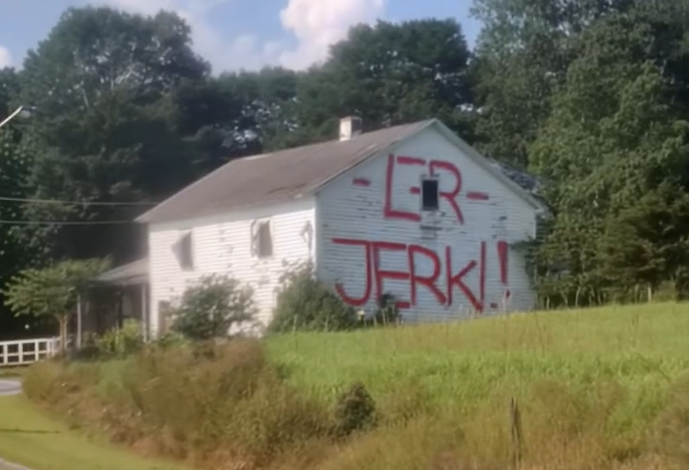
Red paint — bright and angry — streaked across the siding of the farmhouse. My stomach dropped. Someone had vandalized the house, leaving an unmistakable, furious message.
The words “LIAR” and “THIEF” glared back at me, dripping across the pale wood like blood on stone. The fury behind them was palpable. I felt a jolt of anger surge alongside a strange, icy pang of fear.
The message was for me — or perhaps, more accurately, it was for my father. I immediately checked the security cameras, uncertain whether they were still functional after years of neglect.
To my surprise, the footage was clear. I watched, my hands trembling, as the figure of Carlos Walter, the son of our neighbor, stormed toward the farmhouse in the dead of night, paintbrush in hand, shaking and wild with rage. Every stroke was violent, every movement infused with years of bottled-up frustration.
I felt the heat of my own anger rise. Without hesitation, I drove to the Walters’ property, my father’s keys clutched in my hand.
The confrontation was inevitable. Walter, the father, came to the door quietly, his expression unreadable, while Carlos, young but filled with fire, shouted at me with hands shaking and face red from fury.
“Your family ruined ours!” he cried, the weight of generations of resentment boiling over in his voice. I tried to steady myself, but the words resonated in my chest. Ruined?
I had grown up hearing of the feud, sensing the coldness, the resentment, but I had never known its origin. My father, a man of strict principles and deep privacy, had never spoken of any betrayal, at least not to me.
Later, as dusk fell and the sky blushed with the soft purples and pinks of an early evening, I sat alone in the farmhouse. The envelope I had discovered lay on the table in front of me, its paper creased and heavy with the weight of secrets.
Finally, I opened it. Inside was a letter written in my father’s own hand, words that would unravel everything I had thought I knew about our family and the feud that had shaped my childhood.
The letter began with familiar warmth, a reassurance of love and pride. But soon, the tone shifted. My father confessed a story I had never heard.
Years ago, he and Walter had been friends, close friends, bonded over shared dreams and the promise of building lives together.
They had planned to buy the farm as partners, sharing the land equally, raising families, and working the earth side by side. But when my mother became pregnant with me, something inside him had changed. Fear, a sense of urgency to secure my future, or perhaps ambition — it is hard to disentangle — led him to act secretly.
Without telling Walter, my father took the money Walter had invested and registered the land solely in his name. The betrayal was complete.
Walter, once a partner and friend, was left with nothing — no land, no ownership, no acknowledgment of the trust that had been broken. “I built everything on betrayal,” my father wrote in the letter.
“I’m sorry for lying to you. I’m sorry for stealing what wasn’t fully mine. You deserved to know the truth.” I read and reread the words, feeling a storm of emotion surge through me — shame, confusion, sorrow, disbelief.
The man I had idolized as strong, capable, and principled had made his fortune on deceit. The foundation of our family farm, everything I had taken for granted, had begun with a stolen dream.
In that moment, clarity fell over years of confusion. The decades of animosity between our families were no longer abstract; they had a clear origin. Walter’s hatred had not been born of envy, as I had assumed.
It was born from betrayal, a wound inflicted by someone he had trusted, a wound that had never healed. Carlos had grown up hearing this story, carrying the pain and resentment with him until it erupted in that burst of red paint on our farmhouse.
The following morning, I walked across the field to the Walters’ home, the letter in my pocket, the farm keys heavy in my hand.
The early sunlight turned the dew on the grass to sparkling diamonds, a fragile beauty against the tension that lay between us. When Walter opened the door, I did not hesitate. Looking him in the eye, I spoke the words that had been weighing on my heart for so long: “This land should have been yours. My father’s mistake ends with me.”
I held out the keys. I offered him the farm, the entirety of it, willing to relinquish ownership so that justice, finally, could be restored. Walter stared at me, eyes wide, taking in the gesture.
I could see decades of pain, anger, and grief reflected in his expression, slowly giving way to something else — relief, perhaps, or a cautious hope.
Carlos stepped forward, the boy who had once hurled paint in anger, now a young man learning the depth of truth. “I was wrong about you,” he said softly, his voice no longer trembling with rage but weighted with acknowledgment.
In that moment, something shifted between our families. There was no magic to undo years of bitterness, no simple act to erase the sting of betrayal. But there was choice.
Honesty, humility, and a willingness to confront the truth allowed the first crack to form in the wall of hatred that had separated us for generations.
The feud that had defined our families for decades ended not with vengeance or recrimination, but with a deliberate choice to do what was right.
The land, once a source of conflict and pain, became a bridge instead of a battleground. And it all began with a hidden letter, a confession, and the courage to face the past without fear.
Walking back across the field that evening, the sun dipping low in the horizon, I felt a strange serenity. The farmhouse behind me was quiet, still marked by traces of anger, yet alive with possibility.
I understood then that inheritance is never just about property or wealth. It is about history, responsibility, and the choices we make when confronted with the truth.
My father’s mistakes had cast a long shadow, but I had the power to reshape its course. By choosing transparency and compassion, I could honor him and also make amends, healing wounds that had festered far too long.
That night, sitting on the farmhouse porch, I looked toward the Walters’ house across the field. The air was filled with the scents of fresh earth, hay, and the lingering warmth of summer.
A gentle wind stirred the trees, rustling the leaves like whispered approval. We could not change the past. But for the first time in decades, the future seemed something we could shape together.
The hidden letter had done more than reveal a secret. It had unveiled the reason behind a generational rift, shed light on human imperfection, and, most importantly, offered a path to reconciliation.
The feud, once a chain binding us to anger and resentment, now seemed like a lesson in courage, honesty, and the transformative power of truth.
And for the first time, I realized that healing does not erase pain, but it allows it to become something that shapes growth, understanding, and the possibility of genuine connection.