I Asked the Girl Next Door to Sit With My Bedridden Father—30 Minutes Later, Eight Strangers Were Outside Our House
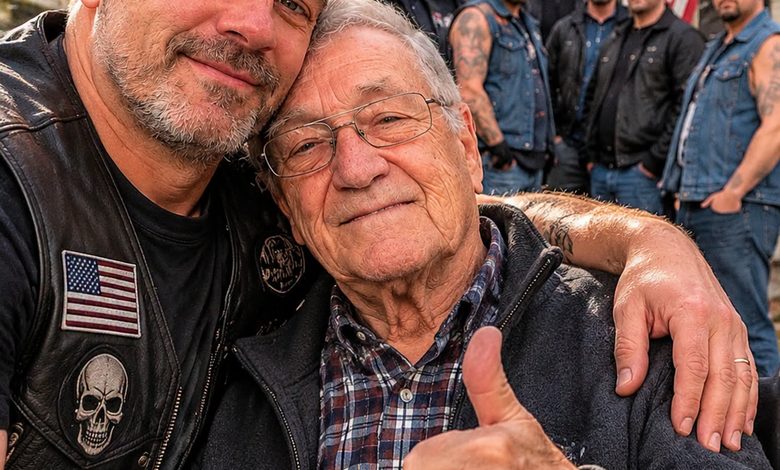
Part 1: The Men Outside
Thirty minutes after I left my father with the girl next door, my phone lit up with Mrs. Patterson’s name. I answered with a spreadsheet still open in front of me, expecting a question about our trash cans.
“Nathan, there are eight men outside your house.”
Her voice rose before I could ask anything.
“Shaved heads, boots, those heavy jackets. They’re all standing by your porch. You need to get home.”
I stood so quickly that my chair struck the cabinet behind me. My father was seventy-four, mostly confined to bed by advanced heart failure, and the neighbor sitting with him was fourteen.
“Have you seen Emma?” I asked.
“No. The front door’s shut.”
I called Emma while walking toward the elevator. When she didn’t answer immediately, the distance between my office and home seemed to lengthen with every ring.
That morning had already gone wrong before breakfast. Dad had slept poorly, my manager needed me at the office to review an urgent discrepancy in a client’s financial records, and the colleague who usually covered those meetings was out sick.
For the previous five months, I had worked mostly from Dad’s kitchen table. His condition had turned ordinary tasks into things we planned: washing, changing clothes, getting from bed to the commode, deciding whether he had enough energy to sit by the window.
A visiting nurse helped us manage his care plan. I handled his medication organizer, meals, appointments, and the hundred small decisions that never appeared on an insurance form.
I loved him. I was also exhausted in a way that made me forget why I had opened the refrigerator.
When my manager asked for ninety minutes at the office, I nearly refused. Then Jennifer Lawson, our neighbor, said she could work from our kitchen while her daughter kept Dad company.
Emma had known him for years. She walked our dog sometimes and brought him library books, choosing mysteries with large print and covers she considered insufficiently mysterious.
“Everybody knows the man holding the shovel did it,” she had once told him.
Dad had laughed so hard that he needed a minute to catch his breath.
That morning, Jennifer agreed to be the responsible adult in the house. Emma would sit with Dad, bring him water, and call her mother if he wanted anything beyond company.
There would be no medication decisions and no helping him stand. I made that clear twice, then apologized for repeating myself.
“You’re allowed to be worried,” Jennifer said. “But we do understand.”
I put both their numbers into my phone, left the nurse’s instructions on the kitchen counter, and checked that Dad’s call button was within reach. His morning medication had already been given.
“Ninety minutes,” I told him.
“Take two hours,” he said. “You look like a man who could use a conversation about something other than my ankles.”
His smile reassured me. Looking back, I wondered whether he had been waiting for me to leave.
Emma called back as I reached my car.
“Everything’s okay,” she said. “Grandpa Frank’s fine. Mom’s here.”
He wasn’t her grandfather, but she had started calling him that after he taught her to repair a loose bicycle brake.
“Who are the men outside?”
There was a pause.
“Your dad asked me to call one of them. I thought you knew.”
I stopped beside my car.
“Don’t open the door. Let me talk to your mother.”
Jennifer came on immediately. She sounded calm, which helped until she explained that Dad recognized the man at the front and wanted the visitors admitted.
“I told them to wait until we spoke to you,” she said. “They’ve been polite. They’re staying on the path.”
“Please keep it that way. I’m coming home.”
My manager met me at the elevator. One look at my face was enough; he took the folder from my hand and said we would finish remotely.
During the fifteen-minute drive, I imagined every bad explanation I could think of. Someone had targeted an ill man. Someone wanted money. Someone had persuaded Dad to sign something while I was distracted.
There was another possibility I didn’t examine until much later: that a group of unfamiliar men could arrive at my house without being a threat.
They stood exactly where Jennifer had said they would, eight men in dark jackets and worn boots along our front walk. Two had shaved heads, several had close-cropped hair, and one wore a narrow strip of gray hair brushed upright.
Mrs. Patterson watched from her porch. A delivery driver slowed at the curb.
I parked crookedly and got out without shutting my door.
“My father is ill, and there’s a child in that house—nobody goes inside until I know why you’re here.”
A broad man with tattooed forearms stepped away from the others. He stopped several feet from me, keeping his hands visible.
“Fair enough,” he said. “I’m Mark Bennett.”
The name meant nothing to me.
“Did my father ask you for something?”
“He asked me to collect a box.”
That did not improve matters.
“What box?”
Mark glanced toward our front window. Someone had pulled the curtain back an inch.
“I think he should tell you.”
“Then you can wait while I ask him.”
“That’s what we were doing.”
His answer was quiet, without a challenge in it. I noticed that one of the other men held a grocery-store bag against his chest, its handles twisted around a carton of strawberries.
The front door opened. Jennifer stood behind the screen, and Emma appeared at her shoulder.
“He wants the blue folder from his drawer,” Emma said. “He says it explains.”
I went inside, leaving the men on the path. Dad lay propped against his pillows, looking irritated by the fuss and far too pale for an argument.
“Nate,” he said, “those are friends.”
“Then why have I never met them?”
His eyes moved toward the framed photograph beside his lamp. My mother smiled out of it, forever younger than I was now.
Dad pressed his palm against the blanket until his fingers stopped trembling.
“Your mother didn’t leave us only memories, Nate. Those men are part of what she left.”
Outside, eight strangers waited for a door I had almost refused to open.
Part 2: The Photograph Turned Over
I wanted an explanation before I wanted guests. Dad, however, was tiring, and arguing beside his bed would not make him stronger.
Jennifer stayed with him while I returned to the porch. I apologized for shouting and invited the men into the living room, explaining that visits with Dad would have to be brief and in small groups.
Mark nodded as if he had expected nothing else.
“We shouldn’t have all come at once,” he said. “He called me. The others heard he wasn’t doing well.”
The man carrying strawberries lifted the bag a little.
“Frank used to say these were the only thing worth getting up early for at the farmers market.”
His name was Peter. He knew something about my father that I did not.
It was a small thing, but it unsettled me more than the jackets had.
Our living room had never held so many boots. Men perched on the sofa, took dining chairs, and remained standing rather than crowd the doorway.
I thanked Emma and handed her the money we had agreed on. When she tried to refuse it because the morning had become complicated, I folded the bills once and put them on top of her library book.
“You did your job,” I said. “Including getting your mom instead of trying to handle this yourself.”
She looked relieved.
“I didn’t tell them anything private. Just that he wanted Mark to call him.”
“You didn’t do anything wrong.”
Jennifer took her home after I assured her I could manage. Before leaving, she quietly reminded me to eat the sandwich she had put in the refrigerator.
Then I sat opposite eight men who appeared to know my family from a direction I had never considered.
Mark opened a flat envelope and slid a photograph onto the coffee table.
Eight teenage boys stood outside the old community center on Mill Street. Some wore boots and patched jackets; one hid half his face behind a fringe of hair.
Between them stood my mother.
She wore the mustard cardigan I remembered hanging on our kitchen chair. One hand rested on a boy’s shoulder, and her mouth was open as if the photographer had caught her halfway through an instruction.
“That’s me,” Mark said, touching the edge of the photograph rather than the image. “Seventeen. Convinced I knew everything.”
Peter leaned forward.
“You’ve narrowed it down a little since then.”
The others laughed, and I heard affection rather than performance.
I remembered Mom leaving on Saturday mornings with cake tins and a canvas bag full of forms. I remembered resenting how she checked the clock when we went grocery shopping because the center opened at ten.
She had died after a sudden illness when I was fifteen. Dad had been forty-four, trying to work, raise me, and get through evenings without the person who had filled them.
We packed her things because neither of us could bear finding them unexpectedly.
Eventually, putting things away became the way we remembered her.
“She volunteered with your program?” I asked.
“Three mornings a week toward the end,” Mark said. “Saturday was just when you saw us.”
He told me about the center’s employment and education program. Some of the boys had been in foster care; others lived with relatives or in homes where there was little room for their troubles.
They had found each other through local music shows. Their clothes and hair had drawn assumptions, not all of them harmless.
“We weren’t an extremist group,” David said, anticipating the question I was ashamed to realize I had carried inside. “We were kids who liked loud music. Helen still made us take our boots off the chairs.”
Mom had not treated them as a project. She asked what they wanted, remembered their answers, and returned the following week expecting them to have tried.
Peter wanted to work on engines. She helped him find an apprenticeship, then insisted he call the shop himself.
David wanted a qualification but kept abandoning the application whenever it asked him to describe his strengths. She made him sit at a folding table until he wrote three honest sentences.
Mark had needed an address employers could reliably reach him at. Mom worked with the center’s staff to arrange one and helped him replace missing identification documents.
“She couldn’t fix everything,” he said. “She was careful about that. If something needed a social worker, she found the social worker.”
That sounded more like my mother than a story about a saint would have.
Mom could be impatient. She burned toast, forgot where she parked, and once made me rewrite an apology because my first version contained the phrase ‘if you were upset.’
“She bought me a birthday cake,” Mark said.
I waited.
“That’s the whole story. I turned eighteen, and she remembered.”
He rubbed the corner of the envelope between his fingers.
“She spelled it Marc. I didn’t tell her until the next year.”
My throat tightened. I remembered icing bowls in the sink and being allowed to scrape them clean.
I had eaten the leftover frosting from a birthday I never knew mattered.
Mark turned the photograph over.
My mother’s handwriting ran across the back, sloping upward at the end as though the words were eager to leave the page.
Everybody deserves someone who believes they can build a future.
I read it twice. Then I looked at the men seated beneath the family pictures on our wall.
“Were you at her funeral?”
“All of us,” Peter said. “Near the back.”
“I don’t remember.”
“You were fifteen,” Mark said. “You weren’t supposed to keep track of who showed up.”
For a moment nobody spoke. From Dad’s room came the soft sound of his bedside radio.
“Your mother was the first adult who expected me to have a future,” Mark said. “I couldn’t bear to prove her wrong.”
I stood because remaining seated had become impossible. I carried the photograph into Dad’s room, where the blue folder lay across his blanket.
“Why didn’t you tell me?” I asked.
He looked at the picture before looking at me.
“At first, because you were hurting.”
“And after the first year? Or the tenth?”
He did not pretend to misunderstand.
“Because I didn’t know how to explain why I hadn’t told you sooner.”
I pulled the chair close enough that he would not have to raise his voice.
“You didn’t protect me from grief, Dad. You kept me outside a room where she was still alive.”
His face changed. He put one hand over the folder, then slowly moved it away.
“I know,” he said. “Open it.”
Inside were receipts, annual summaries, letters from the community center, and a page bearing my mother’s signature.
The heading read “Helen Mercer Education Fund.”
The most recent report was dated only three months earlier.
My mother had been gone for thirty years, but someone was still signing her work forward.
Part 3: What the Records Held
The first number I noticed was $600. It appeared on a photocopied acknowledgment from the community center, dated several months before Mom died.
“Her beginning,” Dad said. “A little from her extra bookkeeping work. She wanted the center to help young people with the expenses that fell between other programs.”
Books. Work boots required for training. Examination fees. Bus passes to reach classes.
Not enough to transform someone’s life in a photograph, but sometimes enough to keep a practical plan from collapsing.
Mom had arranged for the center to hold and administer the money for that purpose. It was not a private account Dad had secretly controlled.
After her death, donations made in her memory were added. Later, Mark and the others began contributing what they could.
“Peter sent five dollars a month at first,” Dad said. “He apologized every time.”
“It was what he had.”
“That’s what I told him.”
The folder held annual reports, not stacks of unexplained cash. Approved payments went through the center, usually directly to schools, testing services, or suppliers.
Dad’s role had been ordinary and substantial: keeping donor contact information current, mailing thank-you notes, checking that supporting documents reached the staff, and reminding people about deadlines.
He had done it around his job and, later, around retirement. When he became ill, the blue folder moved from his desk to his bedside drawer.
“Why arrange this when I was gone?” I asked.
“I thought Mark could take the records. Then I could tell you it was handled.”
“Tell me what was handled?”
He looked embarrassed.
“Something else you wouldn’t have to take over.”
There it was: not a scheme, but another decision about what I could bear, made without asking me.
“You’ve been sleeping in a chair some nights,” he said. “You take calls in the hallway so I won’t hear work asking for more. I wasn’t going to hand you a box and tell you your mother needed something too.”
I wanted to stay angry. Part of me did.
But I could see how a man whose son counted his pills might cling to one responsibility he still performed without assistance.
“Love can still leave someone out,” I said.
Dad nodded. He did not ask me to reassure him.
His eyelids were drooping, so I stopped. We had reached the point in his day when even an important conversation cost more than he had available.
I brought Mark into the hallway and explained that Dad needed to rest. The men visited two at a time for a few minutes, keeping their voices low.
I heard Peter tell him that the strawberries were disappointing.
“Too early in the season,” Dad replied.
“You say that every season.”
“Because you keep buying them.”
It was the ease between them that hurt: years of shared jokes I had mistaken for empty space.
Before leaving, Mark gave me his number and the name of the community center’s program director. He did not ask for the box.
“Check everything,” he said. “Frank will sleep better knowing you understand it.”
That afternoon, Mrs. Patterson came over carrying a covered dish and an apology.
“I saw the jackets, and I frightened myself,” she said. “Then I frightened you.”
“I frightened myself too.”
I told her who the men were without telling her anyone’s childhood history. Those stories were not mine to distribute across the neighborhood.
She glanced at our doorway.
“I’ll apologize to them if I see them again.”
“I think you will.”
Three days later, while Jennifer sat with Dad, I met Mark at the community center. The building had new windows and a different entrance, but I recognized the brick wall from the photograph.
The program director, Denise Howard, welcomed us into a small office with an ordinary printer jam and a stack of appointment forms. Its lack of ceremony reassured me.
She explained the fund’s structure and showed me the records she was authorized to share. Recipient details were protected; totals and the center’s financial summaries were available.
The fund had supported forty-three different young people over thirty years. Some received help once; a few received more than one approved award while completing their training.
There had been lean years with no new awards and better years with several. It was not a miracle machine. It was a modest fund kept useful by people returning to it.
“Your father made sure a missing receipt didn’t sit forgotten for six weeks,” Denise said. “That kind of work doesn’t make speeches, but we notice when it stops.”
She showed me a list of the tasks Frank wanted to relinquish. Beside it was a proposed division of responsibilities among existing volunteers.
My name was nowhere on it.
That should have relieved me. Instead, I sat looking at the empty space where I had expected an obligation to appear.
Mark noticed.
“We didn’t come to recruit you,” he said.
“I know.”
“Do you?”
I looked up.
“You don’t owe us your life because your mother helped ours.”
I had been preparing to defend myself against a demand nobody intended to make.
Denise left us for a few minutes to deal with a staff question. Mark walked me into the multipurpose room where Mom had once worked.
At a table near the windows, two young adults were comparing course schedules with a staff member. One pointed at a bus timetable, then shook his head.
Nothing about the scene was dramatic. It required attention, a pencil, and someone willing to stay until the connection between the last class and the last bus made sense.
I could almost see my mother pulling up a chair.
“Forty-three,” I said.
Mark nodded.
“I spent thirty years thinking the only people who remembered her were Dad and me.”
He looked toward the table.
“Some of them never knew her name until the paperwork.”
That evening, I told Dad what I had verified. He listened with his hands folded, as if I were reporting on a job he was no longer sure he had done properly.
“They’ve made a plan,” I said. “You can stop managing it.”
“Good.”
He sounded relieved, then strangely bereft.
I understood. We were not just removing work from him. We were asking him to set down one of the last things he still believed belonged entirely to his capable self.
I had gone looking for proof that nobody was taking advantage of my father.
Now I had to decide whether I would accept the hand he had finally opened.
Part 4: A Place at the Table
The next morning, I put the blue folder on the kitchen table instead of returning it to Dad’s drawer. Then I opened my work calendar beside his care schedule.
There was no honest way to become a full-time caregiver, remain a reliable employee, and absorb every task my father had performed.
For once, I did not try to make the arithmetic work by removing sleep.
I called Denise and offered two hours a month to help prepare the fund’s donor updates, with no access to confidential recipient records and no responsibility for approving awards. I could write clearly, meet deadlines, and ask questions when the numbers needed explanation.
She accepted that offer rather than asking for a larger one.
Mark would coordinate the volunteers. David would help with event arrangements. The center’s staff would continue handling applications, decisions, payments, and financial reporting.
The work already had owners. I would have a place in it, not inherit the whole room.
When I told Dad, he tried to push himself higher against his pillows.
“Nate, you don’t need another responsibility.”
I adjusted the pillow without answering immediately. I wanted him to hear what I actually meant, not the answer he expected from an overtired son.
“I’m not taking over your life, Dad. I’m choosing a place in it.”
His mouth tightened. He looked toward the window until he could speak.
“I should have offered you that a long time ago.”
“Yes,” I said.
It mattered that I did not rush to erase his mistake. It also mattered that I stayed.
We made another agreement that morning. No more important visitors, documents, or plans concealed because one of us decided the other had enough to worry about.
Dad asked whether that included the bills I had quietly paid from my savings.
I looked at him.
“Jennifer didn’t tell me,” he said. “I can still read an envelope on my own kitchen table.”
For the first time in days, we laughed at ourselves rather than carefully around each other.
I showed him the expenses. We talked through his income, insurance, and what additional support we could realistically arrange.
There was no sudden financial rescue. There were phone calls, forms, and a few services we had not known how to ask about.
Over the following weeks, a part-time home-care aide began coming on two scheduled mornings. We paid for the hours we could afford and kept reviewing the arrangement.
The men offered help too, but I learned to make specific requests instead of saying we were fine until we weren’t.
Peter picked up groceries when he was already shopping. David repaired the loose handrail after asking permission. Mark sometimes sat with Dad while I walked the dog or took a work call without listening for the bedside button.
None of them was expected to provide medical care. Friendship did not require pretending that training and boundaries were unnecessary.
Emma resumed her visits after school, usually with a mystery novel or an argument about whether oatmeal cookies counted as dessert.
Dad insisted they did. Emma said raisins were an attempt to conceal disappointment.
He began saving the chocolate ones for her.
Some afternoons he was too tired for conversation. On those days, Mark could sit beside him without trying to fill the room, and I understood why their friendship had lasted.
Other afternoons, Dad told stories.
He told me Mom had once practiced an interview with David while making meatloaf, using a wooden spoon as an imaginary microphone until David threatened to leave.
He told me she had argued with a shop manager who dismissed Peter before reading his application. She had not won Peter a job that day; she had helped him find a better shop.
That distinction felt important. My mother had not controlled outcomes. She had refused to let one closed door become the entire map.
I asked questions I should have asked years earlier. Sometimes Dad remembered. Sometimes he did not, and we wrote down what he knew without filling the gaps with nicer inventions.
Mark brought copies of letters. Peter brought an old apprenticeship photograph. David remembered a sentence neither Dad nor I could place, and we let it belong to his version of her.
My mother became less like a framed portrait and more like a person again.
Two months after the morning on our front path, the community center held its annual awards gathering. Three young adults would receive support, bringing the number of people helped by the fund to forty-six.
Dad wanted to attend. His nurse helped us plan a short outing with wheelchair transport, rest beforehand, and an easy way to leave if he became tired.
He was not suddenly better. The morning of the event, fastening his shirt took enough energy that we paused before putting on his glasses.
“We can stay home,” I said.
He rested a hand over mine.
“I know.”
Then he asked for the blue plaid shirt instead of the gray one.
At the center, Mark had saved us seats near the side exit. The other seven men were already there, looking only slightly uncomfortable in a mixture of clean work shirts, denim, and jackets they had clearly debated wearing.
Mrs. Patterson approached them before the program started. I could not hear her words, but I saw Mark shake her hand.
Emma sat beside Jennifer and opened the printed program with the seriousness she brought to any occasion involving refreshments afterward.
Denise spoke briefly about the fund’s purpose and its supporters. She did not turn the recipients’ histories into a performance.
Each was invited, not required, to say something.
Caleb Brooks, nineteen, stood with his certificate held in both hands. His award would cover required tools and fees for the first stage of his electrical training.
He thanked his instructor for helping him apply. Then he looked toward Mark.
“You told me asking for the tools wasn’t the same as asking someone to do the work.”
Mark nodded once.
“That helped,” Caleb said.
Beside me, Dad reached for a tissue. His hand shook, so I unfolded it and passed it back without looking at him.
Afterward, Caleb came over while the room rearranged itself around coffee and paper plates.
“Are you Helen’s son?” he asked me.
“I am.”
“Denise said she started all this.”
I looked around: Peter carrying an extra chair, David listening to one of the other recipients, Emma asking where the recycling went.
“She started something,” I said. “A lot of people kept showing up.”
Caleb glanced at Dad and then at the photograph displayed beside the program table.
“I never met your mother, but I know what she made possible.”
Dad closed his eyes for a moment. When he opened them, he was smiling.
We left before the room emptied. He slept on the ride home, the folded program resting against his coat.
That evening, I placed the old photograph on his nightstand beside the newer picture of Mom. The boys outside the center faced the bed, their futures still unwritten.
“Were you afraid I wouldn’t care?” I asked.
Dad considered it.
“I think I was afraid you would. And then you’d give more than you had.”
I sat down beside him.
“Next time, let me answer for myself.”
“I will.”
A week later, Mark arrived with a grocery bag and a question about the next donor update. He knocked once and waited.
Dad heard him from the bedroom.
“Nate? Is that one of the boys?”
“Yes.”
“Well, don’t leave him standing out there.”
I opened the door. Behind me, my father called for the photograph, wanting to tell a story I had not heard yet.
This time, I pulled up another chair.
What might change if we let the people we love choose what they can carry?
Disclaimer: This story is a work of fiction inspired by real-life themes. Names, characters, places and events are fictionalized, and any resemblance to real persons is purely coincidental. It does not represent any person or organization and does not encourage inappropriate behavior. Images are for illustration purposes only.