Deadly Prison Riot Leaves 31 Inmates Dead as Authorities Probe Cause
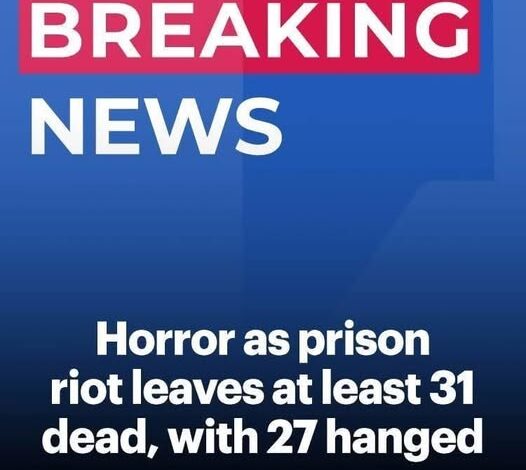
The screams began in the cold darkness before dawn, piercing the quiet of Machala like a warning no one could ignore. Gunfire echoed through the concrete corridors, punctuated by the sharp, metallic crack of explosions, while shadows danced across walls stained with years of neglect and desperation. By the time the sun broke over the city, more than thirty inmates lay dead, bodies contorted in positions that spoke of violence both sudden and brutal. Dozens more were wounded, some critically, as panic spread among prisoners who had been trapped in the chaos, unsure whether they would live to see another hour. Outside, a nation already teetering on edge recoiled in shock and grief. Families rushed to the prison gates, desperate for news, while officials struggled to issue explanations that could make sense of the carnage. But behind those thick, oppressive walls, what had erupted was not a simple riot—it was the visible tip of a far darker, deeply entrenched system of control and terror.
What unfolded in Machala cannot be dismissed as an isolated eruption of chaos. This was another devastating chapter in a long and painful saga that has transformed Ecuador’s prisons from mere correctional facilities into fully operational command centers for organized crime. The bloodshed—reported as hangings, asphyxiations, and methodical killings—was not the product of spontaneous anger. Instead, it bore all the hallmarks of premeditated executions, carried out with cold precision. In a system where gangs have long held sway, deciding who lives, who dies, and who suffers, the state often reacts only after the damage is done. Overcrowding, understaffing, and systemic neglect have turned penitentiaries into hubs for criminal logistics, intelligence, and enforcement. The recent transfers of high-profile prisoners to a new maximum-security facility may have been the immediate spark for violence, but the true fuel had been accumulating for years: the steady erosion of state authority and the rise of criminal hierarchies that now operate with military-like discipline, issuing orders, collecting “taxes,” and meting out punishment as they see fit.
Outside, the human cost is impossible to measure in simple statistics. Mothers and fathers huddle behind police cordons, clutching phones that remain eerily silent, caught between the official silence of government authorities and the whispered, half-confirmed lists of the dead circulating through the city. The anguish is palpable: parents fear for the safety of their children inside the facility, while loved ones mourn those whose names appear on hastily released rosters, uncertain whether the notifications are complete or accurate. The collective grief stretches beyond Machala, touching families across the region who live in constant anxiety that the same cycle of brutality could repeat at any prison, in any city.
Meanwhile, inside the corridors of power, Ecuador’s leaders grapple with promises of reform that have too often collided with the entrenched influence of the very networks they are tasked to dismantle. Political pledges to increase oversight, improve staffing, or modernize facilities are met with the stark reality that drug-trafficking organizations wield more control over daily operations than the prison administrators themselves. Inmate allegiances are mapped and enforced with military precision; messages are passed through coded routines, corners of the prison block serve as tactical positions, and even the flow of food, medicine, and supplies is monitored and taxed by gang leaders. Until the state confronts these facts directly, acknowledging that its prisons have become operational extensions of criminal empires, Machala will not be the last place where Ecuador wakes to the sound of gunfire in the night.
The tragedy also exposes the psychological toll of systemic neglect. Guards, already stretched beyond capacity, often find themselves powerless, witnesses to atrocities they cannot prevent without risking their own lives. Inmates who survive attacks carry physical wounds and psychological scars that may never heal, while the families of the dead endure a grief compounded by frustration at a government that appears impotent in the face of organized violence. Public outrage simmers, but without a sustained and comprehensive strategy, outrage alone cannot dismantle the networks that have entrenched themselves behind prison walls.
Machala serves as a grim illustration of a national crisis: a system in which law enforcement, judicial oversight, and correctional management have been gradually and systematically outmaneuvered by criminal enterprises. Until Ecuador acknowledges the full scale of this reality, invests in structural reform, and reclaims authority over its penitentiary system, the night will continue to belong to those who wield weapons rather than justice. The blood spilled before dawn was not an anomaly; it was a warning, a reflection of the consequences of inaction, and a foreshadowing of further nights punctuated by gunfire, fear, and sorrow.
Families will continue to wait behind cordons. Officials will continue to issue statements promising reform. And inside the prison walls, the silent calculus of gang power will continue to dictate life and death, unchallenged and unchecked. Machala is a tragedy, but it is also a mirror held up to the nation: until Ecuador confronts the organized criminality embedded in its prisons, no citizen can feel truly safe, and no announcement of reform can fully comfort those who live under the shadow of bullets and fear.