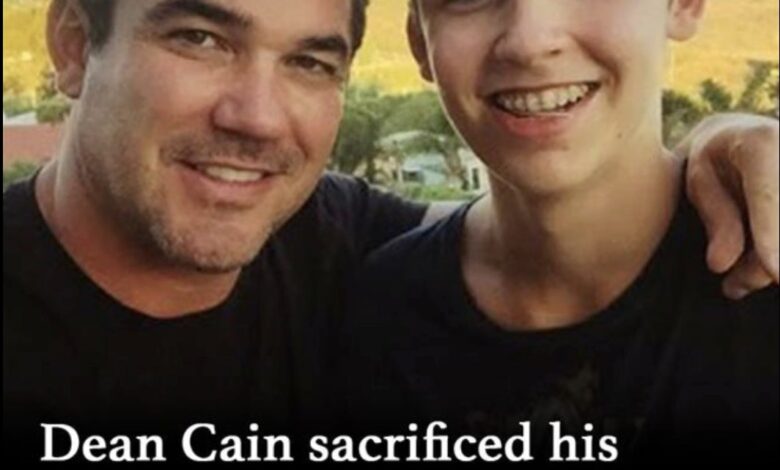
Dean Cain sacrificed his career to raise his son alone – vowing to not be like his own dad who abandoned him
In the nuanced architecture of a child’s development, the presence of a father is often cited by developmental psychologists as a foundational pillar for emotional security and long-term psychological resilience. When a father is not merely present but profoundly engaged, the trajectory of that child’s life is frequently recalibrated toward stability and success. For actor Dean Cain, this was not just a sociological theory, but a personal mandate—one that eventually required him to choose between the high-octane allure of a Hollywood career and the quiet, demanding duties of solo parenthood.

For decades, Dean Cain has been a pervasive figure in the American cultural zeitgeist. Whether soaring through the skies as the Man of Steel or guiding audiences through the high stakes of reality television, his face is synonymous with the leading-man archetype. Yet, the path to the “Cape” was an accidental one. Born Dean George Tanaka on July 31, 1966, in Mount Clemens, Michigan, Cain’s initial aspirations were rooted in the gridiron rather than the soundstage. A gifted athlete, he seemed destined for the NFL until a catastrophic knee injury shattered his professional football dreams. It was this physical setback that inadvertently pivoted him toward the dramatic arts.
While Cain’s career reached a fever pitch with the 1993 breakout success of Lois & Clark: The New Adventures of Superman, his internal compass was shaped by a complex family history. His biological father, Roger Tanaka, abandoned the family when Dean was just two years old, leaving his mother, Sharon Tanaka, to navigate life as a single parent. When Dean was three, his mother remarried the director Christopher Cain. The elder Cain did more than just enter the household; he legally adopted Dean and his brother, providing the stability that their biological father had abdicated. In a poignant act of gratitude and identity, Dean legally adopted his stepfather’s surname. Regarding his biological roots, Cain has remained candid: “My biological father is Japanese. I never knew him, never met him.” Reports indicate that while Roger Tanaka remarried in 1982, he made no documented effort to reconcile with the sons he left behind.
Despite a reputation in the 1990s as one of Hollywood’s most eligible bachelors, Cain’s life underwent a permanent shift in June 2000. Following a relationship with former model and Playboy Playmate Samantha Torres, Cain became a father to a son, whom he named Christopher—a direct tribute to the man who had chosen to be his father years prior. However, the joy of new parenthood was quickly marred by a deteriorating relationship with Torres, culminating in an arduous and highly publicized legal battle for custody.

Refusing to be a weekend father, Cain committed himself to a grueling legal marathon. In 2011, his tenacity resulted in a landmark victory: he was awarded sole physical custody of Christopher. It was at this juncture that the “Superman” actor made a choice that stunned the industry: he intentionally downshifted his career.
The transition from a sought-after leading man to a primary caregiver was a radical metamorphosis. Cain became a fixture not on red carpets, but in school pickup lines and PTA meetings. His commitment is perhaps most visible in the domestic details. “I cook every meal for my child,” Cain shared in a candid interview. “If I don’t cook, he doesn’t eat. I cook a very mean steak. I’m also very good at taking the nine leftovers I have and turning it into something.”
This hands-on approach meant walking away from lucrative filming schedules that would require him to be on location for months at a time. He wrestled with the classic parental dilemma of balancing professional obligations with a child’s milestones, but ultimately, the calculus was simple: Christopher’s well-being was non-negotiable. Cain proved that it was possible to maintain a career in the arts while stubbornly remaining a “father first.”
The dividend of this sacrifice is a bond that appears unbreakable. Cain’s social media presence serves as a digital scrapbook of their relationship—from nostalgic tours of his alma mater, Princeton University, to global travel adventures. The images depict a father and son who genuinely enjoy one another’s company, moving through life as a cohesive unit.
Furthermore, Cain’s definition of family extends beyond biological or legal borders. Christopher has two half-siblings from his mother’s side—twins Elijah and Isabelle—who are frequent fixtures in the Cain household. Despite what sociologists might label a “broken home,” Cain has fostered an environment of total inclusion. “I’d do anything for those two,” he said of the twins. “It can be defined as a broken home, but if you hang out at our house, that’s the last thing you’ll think.”
Looking back at the decades spent in the trenches of solo parenting, Cain expresses a profound sense of contentment. His metrics for a successful life have shifted from box-office receipts to the quiet moments of domesticity. “My best day would be just to wake up, and me and my son have a great day at home,” he reflects. In the end, the actor who spent years playing a superhero found his most significant role in the one that required no costume: being the father he always wished he had.